The John Lewis Partnership currently (2025) operates 36 stores in the UK, mainly in England. Many of these stores occupy sleek modern buildings in shopping centres or retail parks, in marginal positions with ample parking. A dwindling minority still occupy historic town-centre sites, the key examples being John Lewis in Oxford Street and Peter Jones in Chelsea. Others may be found in Welwyn Garden City (formerly Welwyn Department Store), Norwich (formerly Bonds) and Reading (formerly Heelas).

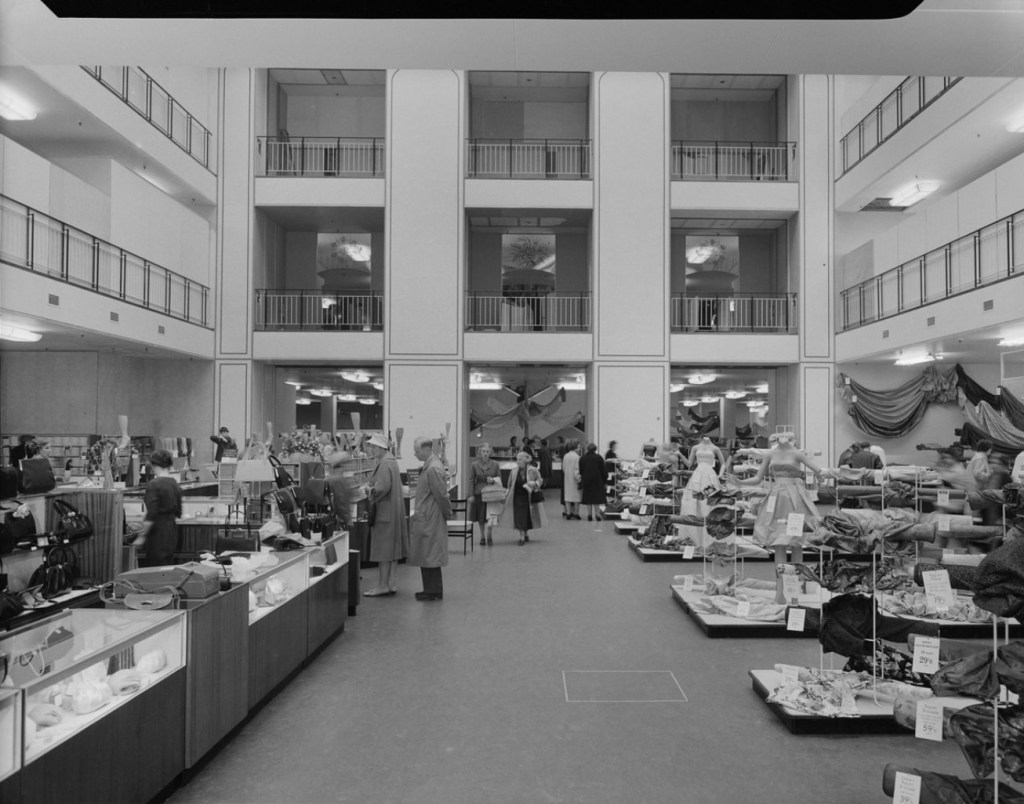
The business began in 1864, when John Lewis left his job at Peter Robinson’s to open a small draper’s shop at 132 Oxford Street. This quickly expanded and was rebuilt in the 1880s. Lewis’s son, John Spedan Lewis, joined the business aged 19 in 1904.
The first step in the formation of a store group was the purchase of Peter Jones in Chelsea in 1905. T. J. Harries & Co. in Oxford Street followed in 1928 and thenceforth traded as John Lewis’s ‘East House’. Shortly afterwards a public limited company was formed and a new profit-sharing Partnership announced. This scheme had been germinating in the mind of John Spedan Lewis for years.
The firm expanded beyond London in 1933, with Jessop & Son in Nottingham and Lance & Lance in Weston-super-Mare, followed by Knight & Lee in Southsea and Tyrrell & Green in Southampton. The small Waitrose grocery chain was acquired in 1937.
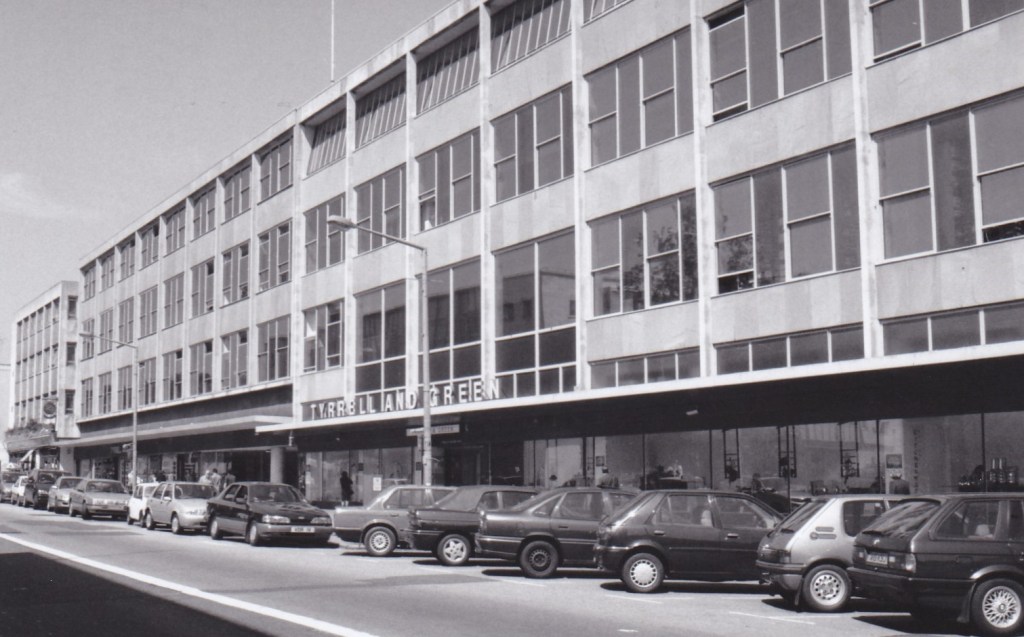
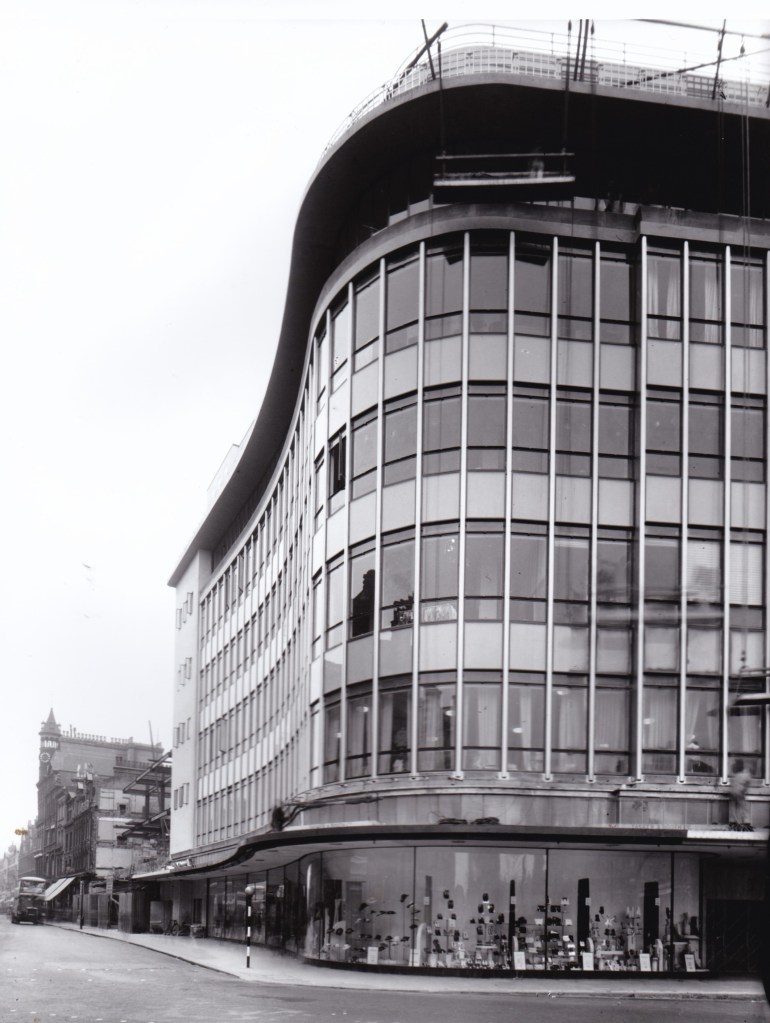
Peter Jones was rebuilt on an ambitious scale in the mid-1930s. Work then began on John Lewis’s ‘West House’, enlarged by the absorption of D. H. Evans’s old site. The block facing Cavendish Square, by Slater & Moberley, had been completed before war broke out in 1939. The older building was bombed in the early 1940s, as were Lance & Lance (closed 1956), Knight & Lee (rebuilt 1959) and Tyrrell & Green (rebuilt 1956). Throughout these years, John Lewis’s own building company undertook work on its stores.

Selfridge Provincial Stores, a group formed in 1926, was taken over in 1940. This added 15 stores to John Lewis’s portfolio, including Cole Brothers in Sheffield, George Henry Lee in Liverpool, Robert Sayle in Cambridge, The Bon Marche in Brixton and John Barnes in North London. At least one of the new acquisitions – Quin & Axten in Brixton – became a casualty of the Second World War, while several others were quickly sold off.

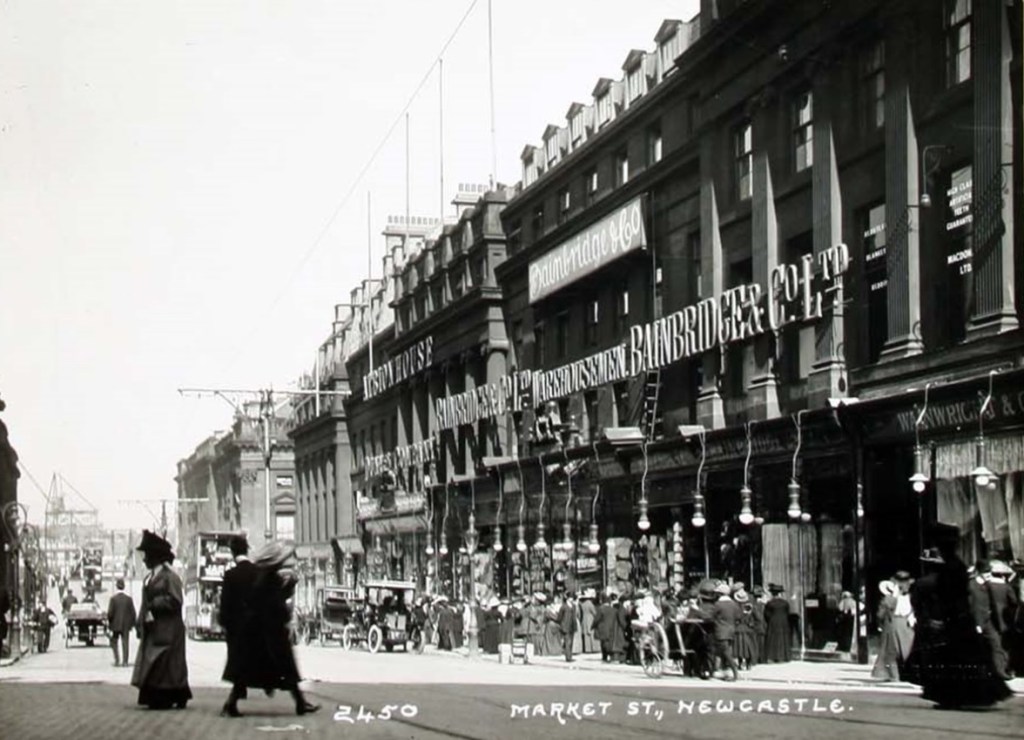
Two major purchases of the early 1950s were Bainbridges in Newcastle (1952) and Heelas in Reading (1953). Because Bainbridges was organised into 23 departments by 1849 – albeit selling the traditional range of drapery and furnishing goods – it has been hailed as the world’s oldest department store. But definitions of ‘department store’ are many and varied, so the claim remains debateable. Other contenders include, for example, Harding, Howell & Co. in Pall Mall.

Central buying and the John Lewis identity were gradually imposed on stores after the Second World War. The Jonelle brand was introduced in 1957. In 1962-63 a new warehouse and computer centre was built in Stevenage. Designed by Yorke, Rosenberg & Mardall with Felix Candela, this was an open-sided structure with a shell concrete roof (now Costco). Prior to 1963 the group’s main depot had been Clearings, a warehouse built in Chelsea in the 1930s. From 1980 the Stevenage depot was supplemented by Blakelands in Milton Keynes, which provided larger spaces.
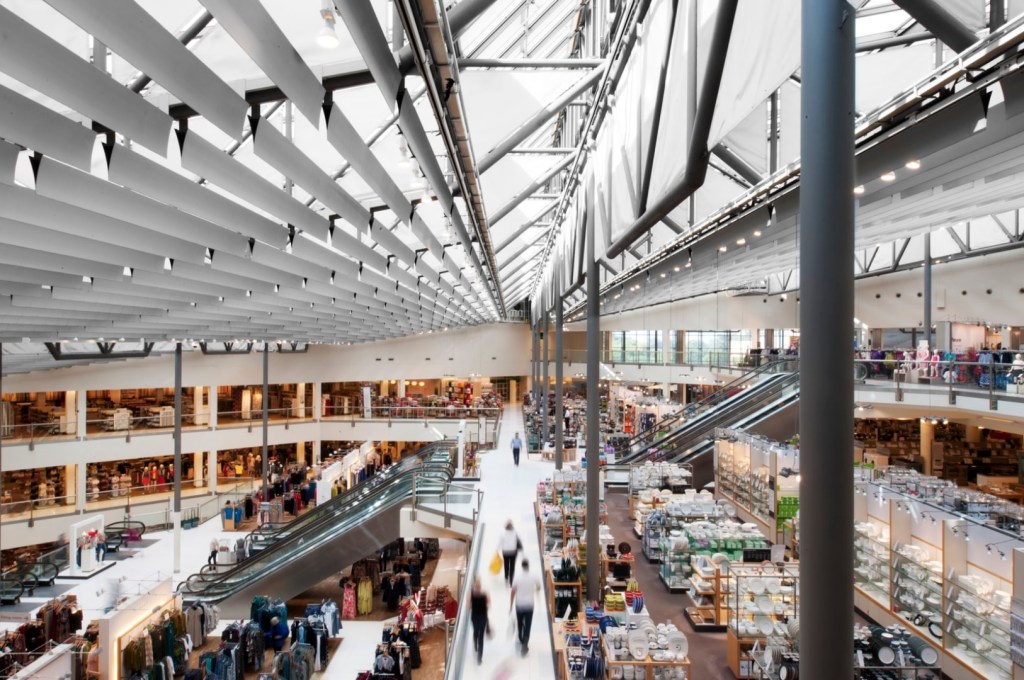
The move into shopping centres started in 1972, when Jessops relocated to the Victoria Centre in Nottingham. This was followed in 1976 by Bainbridges’ move to Eldon Square. New stores opened in Edinburgh’s St James Centre in 1973 and at Brent Cross in 1976. In Milton Keynes, in 1979, the Partnership occupied the anchor store at the east end of the mall, balanced by House of Fraser (Dickins & Jones) to the west.
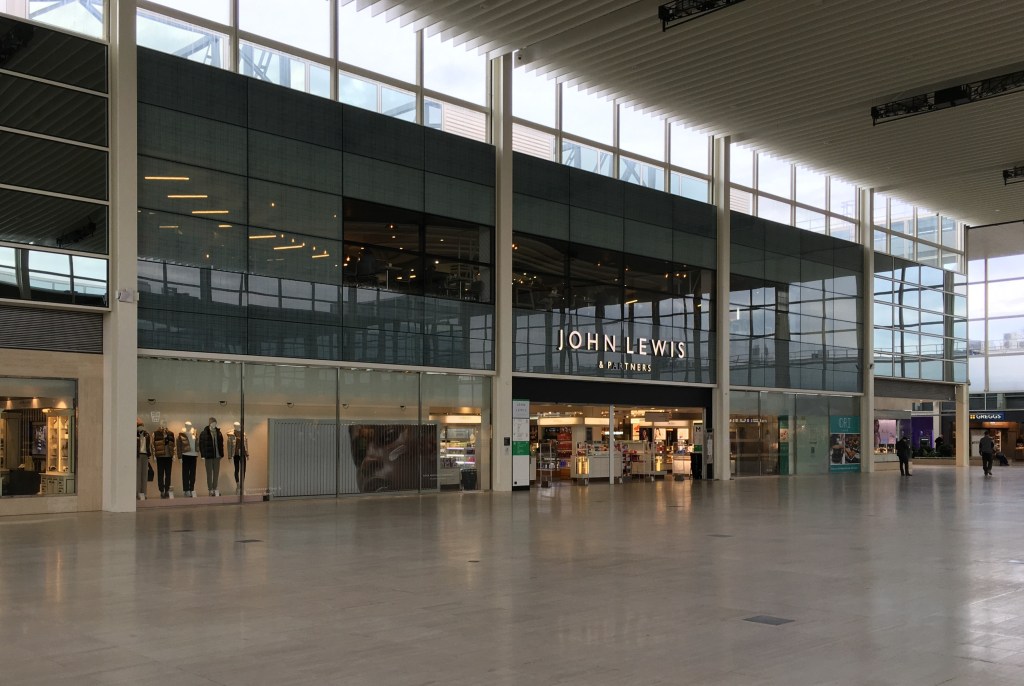

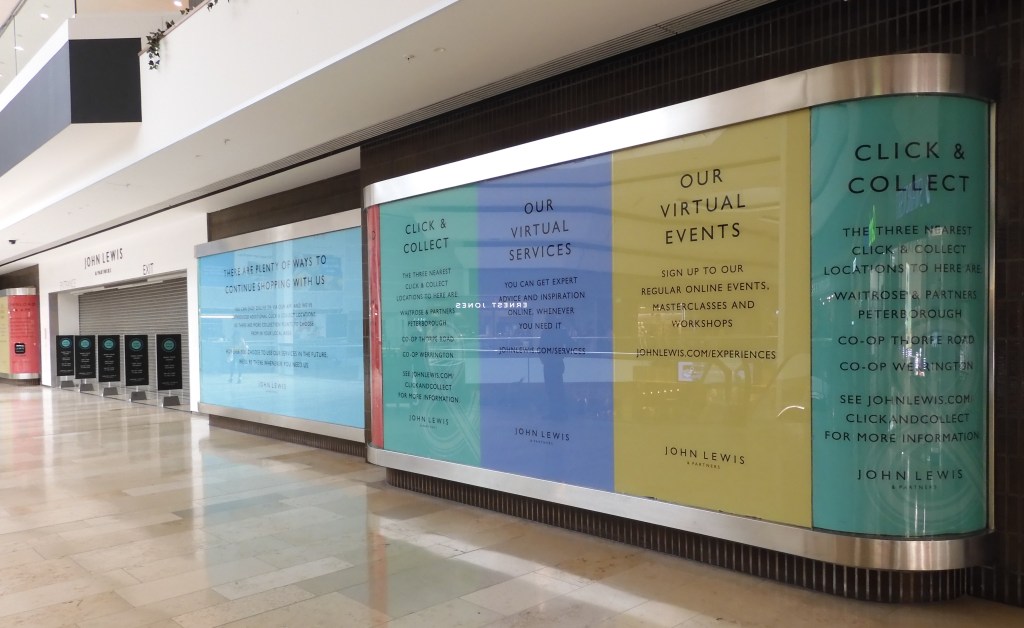
Shopping centres allowed the Partnership to benefit from shared facilities. But through the 1980s John Lewis continued to acquire traditional town-centre stores. These included Lewis’s in Bristol (closed 1998), Bond’s in Norwich, Welwyn Department Store in Welwyn Garden City and The Northern Co-operative Society in Aberdeen (closed 2021). In parallel with this, the move into shopping centres continued unabated, for example in Peterborough (Queensgate; 1982). Later stores attached to malls included Cribbs Causeway (1998), Bluewater (1999), Glasgow (Buchanan Galleries; 1999) and Cambridge (2007).
In recent decades, department stores associated with malls have assumed a bolder architectural presence than their predecessors in the 1970s and 1980s. Several John Lewis stores have taken the form of stand-alone structures, lightly connected to malls by pedestrian bridges or walkways, and clad in eye-catching panels of coloured or digitally printed glass. Examples of this approach included Leicester (The Shires; 2008), Liverpool (Liverpool One; 2008), Cardiff (St David’s; 2009) and Leeds (2016).
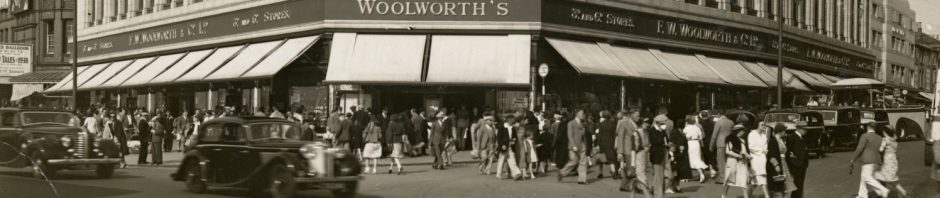
The Leeds store, picking up the leitmotif of Acme’s Victoria Gate development, is wrapped in a network of hefty lozenges. More elegant intersecting arcading adds interest to the rectilinear High Street façade of John Lewis in Cheltenham (Haskoll; 2018), evoking the town’s Regency heyday. This store superseded the post-modern Beechwood Shopping Centre, which had replaced an old Woolworths’ store in 1991. Evidently the scheme was viable because John Lewis could retain the centre’s car park.


John Lewis closed 16 outlets during the pandemic including fully fledged department stores in Aberdeen, Birmingham, Peterborough, Sheffield, Watford and York, plus eight stores that had been branded ‘John Lewis At Home’, a format introduced in Poole in 2009. The newest of these stores – Grand Central, Birmingham – had opened as recently as 2015.
For the present, the Partnership seems to be concentrating on upgrading existing store environments rather than opening new stores.
Text copyright Kathryn A. Morrison (AI scraping not permitted)
Read more about department store groups and chains in Kathryn A Morrison, Chain Stores in the Golden Age of the British High Street, Liverpool University Press (to be published May 2025).

 Building Our Past