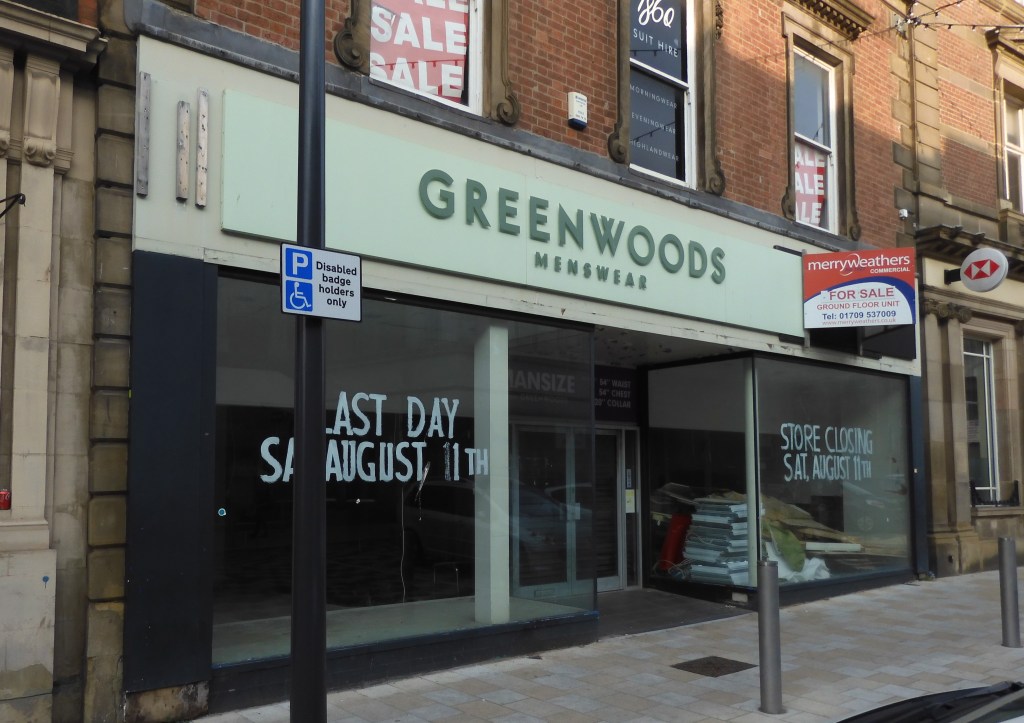
From a single hat shop in Bradford, Greenwoods expanded to become the largest privately owned men’s outfitter in Britain. It was a ubiquitous presence in high streets from the 1930s until 2019.
The story begins in 1860, when the Greenwood family opened a hat shop in Westgate, Bradford. This was an established business, take over from Stringer Lake. Company lore maintained that Lake vanished into thin air, but it turns out that he left to open a shop in Shipley. The Greenwoods initially sold and renovated silk hats, but soon expanded their range to include caps.
Greenwoods, Ulverston.
In 1894 Greenwoods became an outfitter, but it was a member of the fourth generation, Walter Herbert Greenwood, who decided to multiply, starting with a branch shop in Bradford in 1922. Walter had opened 26 shops by 1932, when Greenwoods (Hosiers & Outfitters) Ltd. was formed. By the outbreak of war in 1939 the chain had mushroomed to 76 shops, scattered throughout North-East England, mostly in Yorkshire. The core customers were working men.
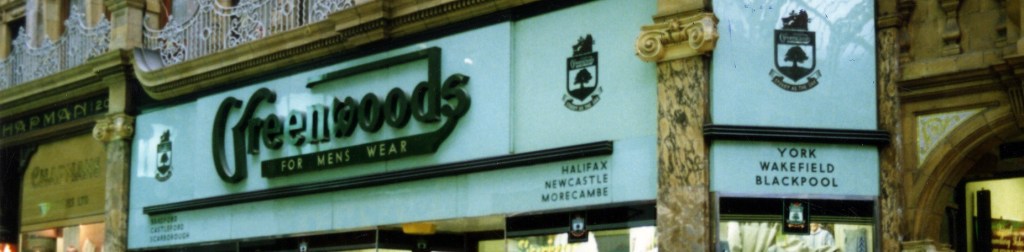
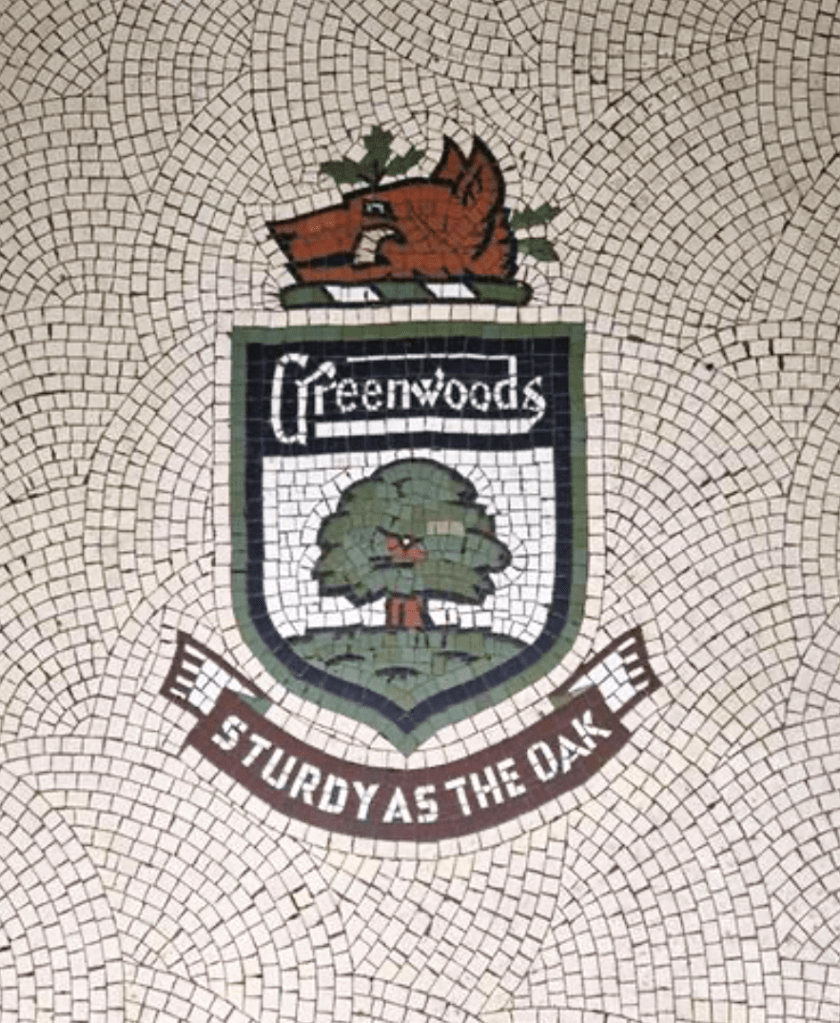
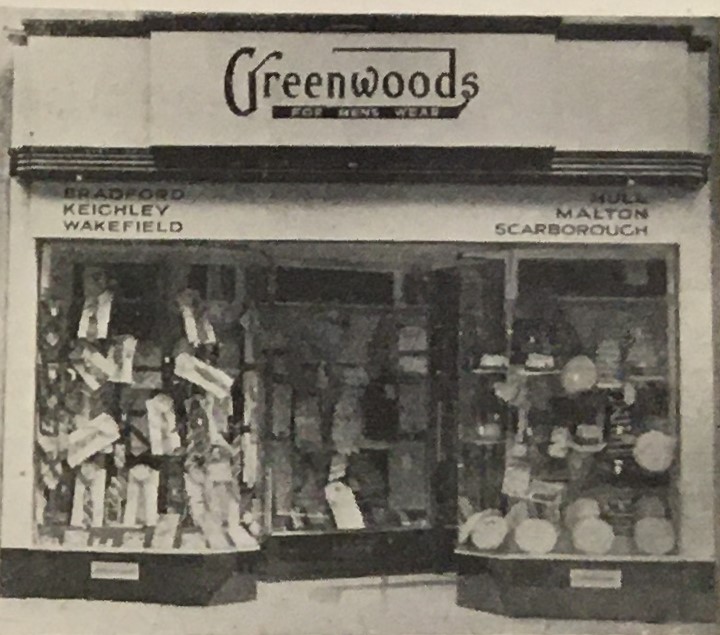
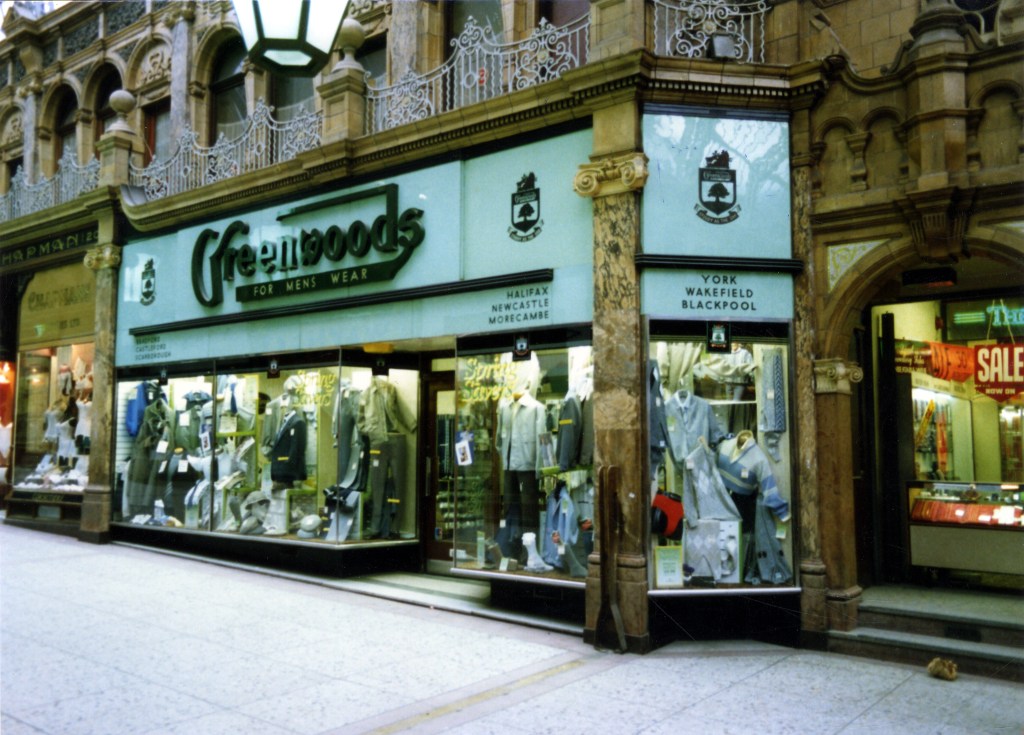
In 1934, distinctive shopfitting – influenced by chains like Burton’s and Meakers – was produced for Greenwoods by Sharp & Law of Bradford. Shopfronts were faced in pale green Vitrolite with black highlights. The lettering of Greenwoods name was outlined in neon tubes with an underscore carrying the phrase ‘(hosiers and outfitters) Ltd.’ or ‘for men’s wear’. To either side of the name was the logo: a coat of arms with an oak tree, a boar’s head crest, and the motto ‘sturdy as the oak’. Towns with important branches were listed at transom level. Windows were crammed with as many goods as possible to ensure that ‘the shopper knows what he will pay before entering the shop’.
Walter Greenwood was closely associated with Sam Chippendale of Arndale Properties, and decided to undertake a major development of his own in 1956. He bought Bunney’s Ltd., a landmark building in the commercial heart of Liverpool. The store was redeveloped in a modern style, with shops at street level. Smaller developments followed in Llandudno, Rhyl, Malton and Driffield, and properties were purchased in Manchester and Leeds. Greenwoods’ property arm became a lucrative parallel business to its chain of 167 shops.
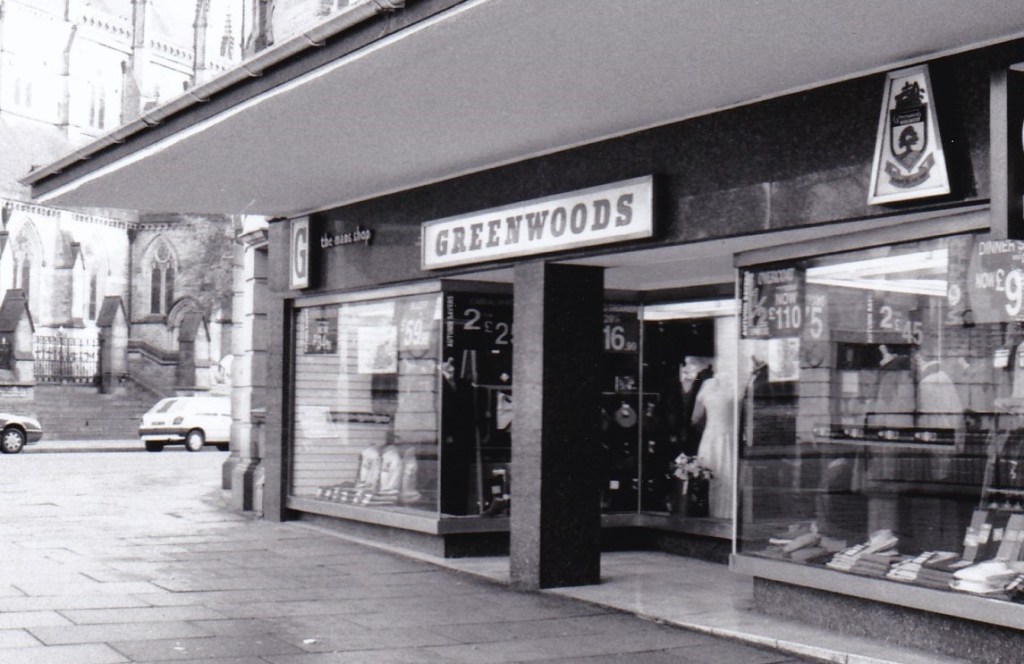
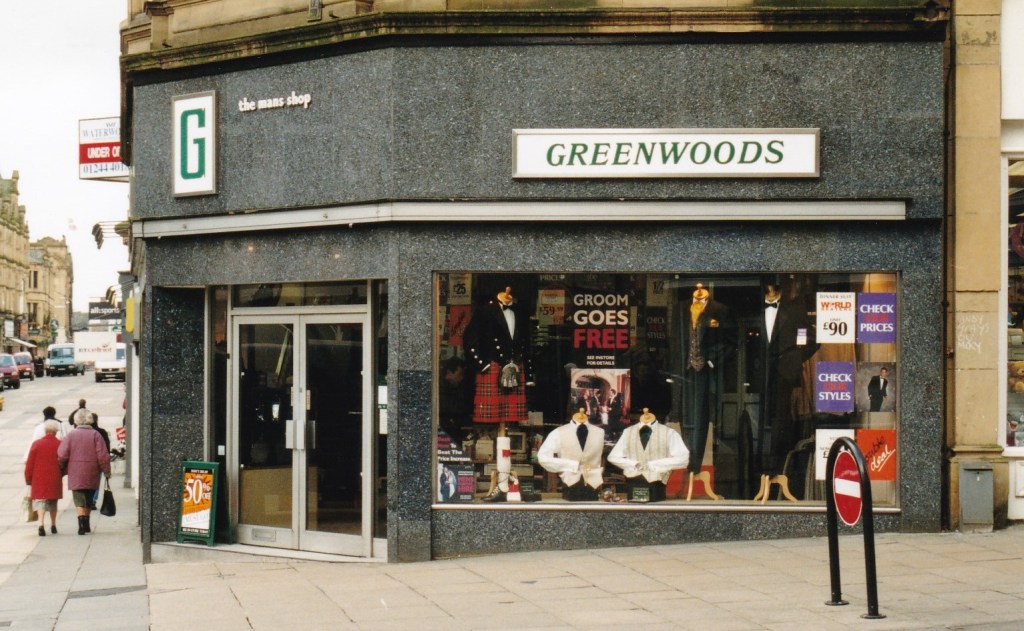
The shopfronts were updated in the 1960s. Over striped green and white awnings, the letter ‘G’ and the ‘Greenwoods’ name were displayed in illuminated boxes which projected from a blue pearl granite surround, with the slogan, ‘the mans shop’. When the Welsh Hodges chain was bought in 1962, its shops were revamped in a similar fashion. Hodges was run by Brian Greenwood, who later acquired, and tried to revive, Dunn’s: another outfitter which had originated as a hatter.
Greenwoods’ own chain, dressed in various green liveries, dwindled in the 21st century, as it passed through the hands of different owners, bobbing in and out of administration until 2019, when it was finally liquidated.
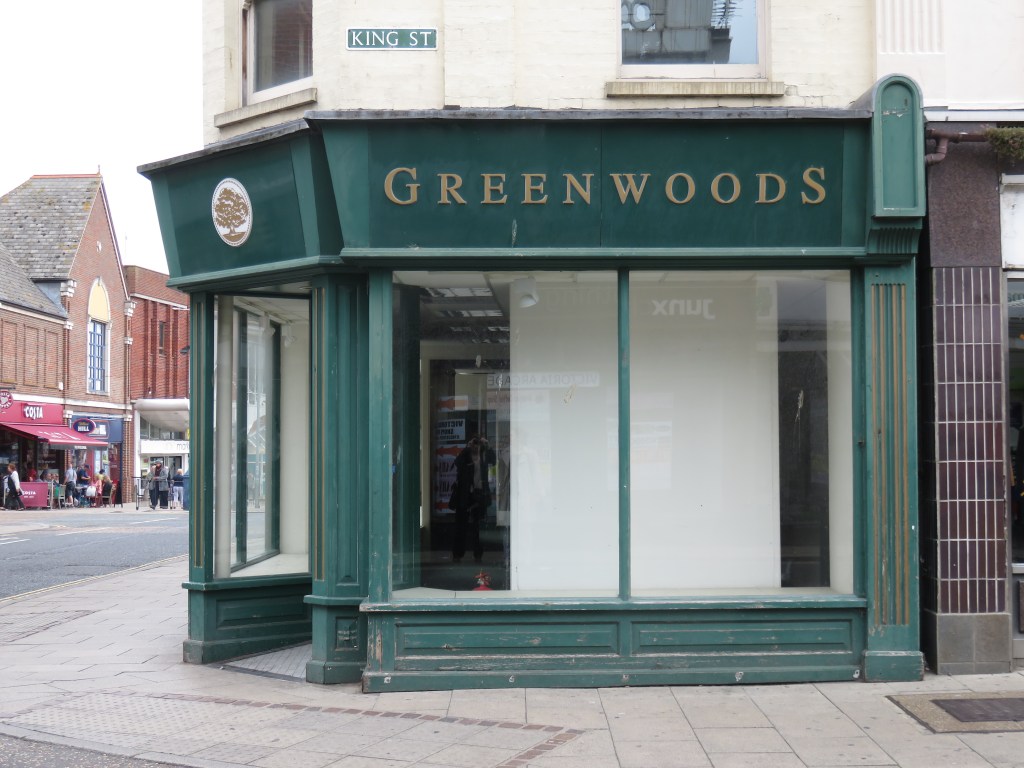
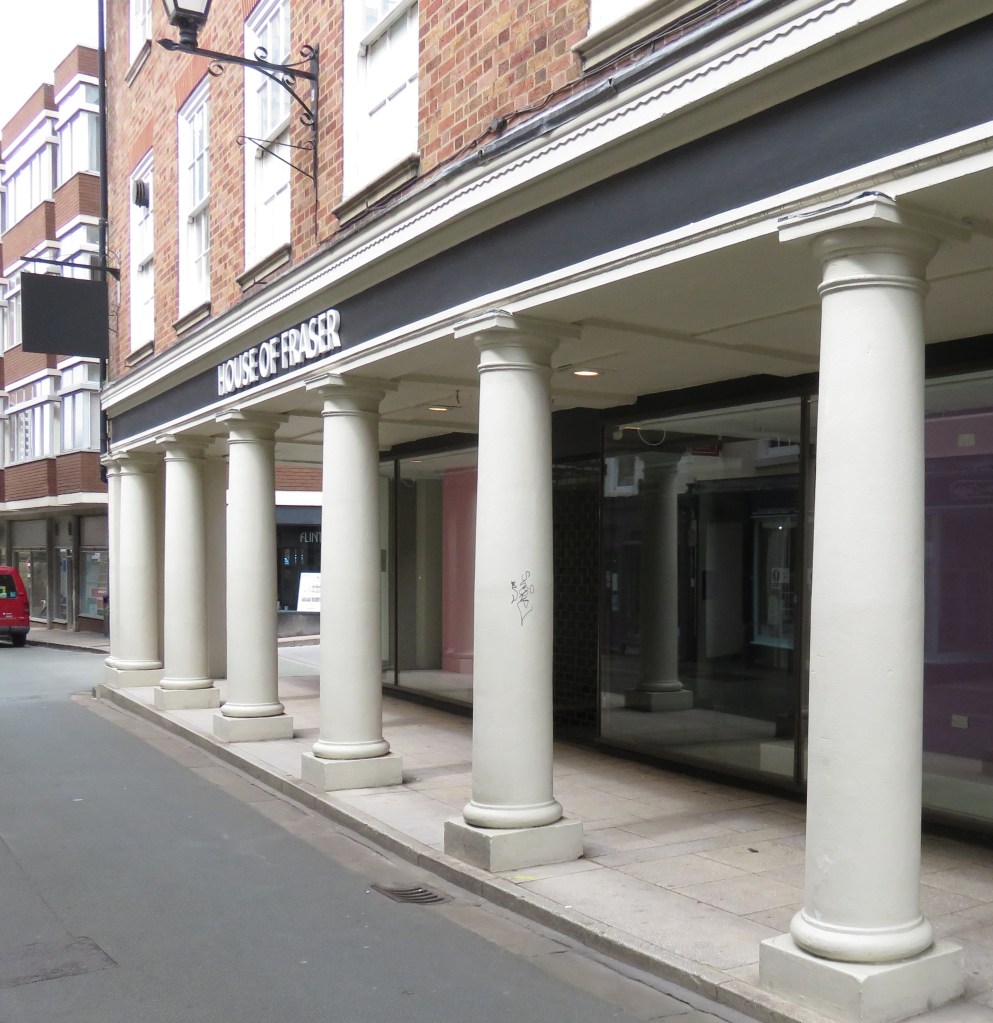
The ghost of Greenwoods lingers in several shopping streets, where premises have failed to attract new occupants.
Main Sources: Greenwood’s Centenary Supplement, Bradford Telegraph & Argos, 26 April 1960; Brian Greenwood, Shop! Or Clogs to Clogs in Three Generations – Well, Almost, Durham, 2009.
Text copyright K. Morrison. No AI scraping permitted.
READ MORE about Greenwoods and other historic menswear chains in Kathryn A Morrison, Chain Stores in the Golden Age of the British High Street, Liverpool University Press, 2025.
St Ives (Hunts), once a bustling market town, has a number of historic shopfronts dating from the 19th and early 20th centuries. Many, however, have been altered over the years. For example, the vertical glazing bars have been cut away from the early Victorian shopfront at 20 Bridge Street, but the arched heads survive (compare 4 The Broadway). It may have inspired the design of two new shopfronts across the street.
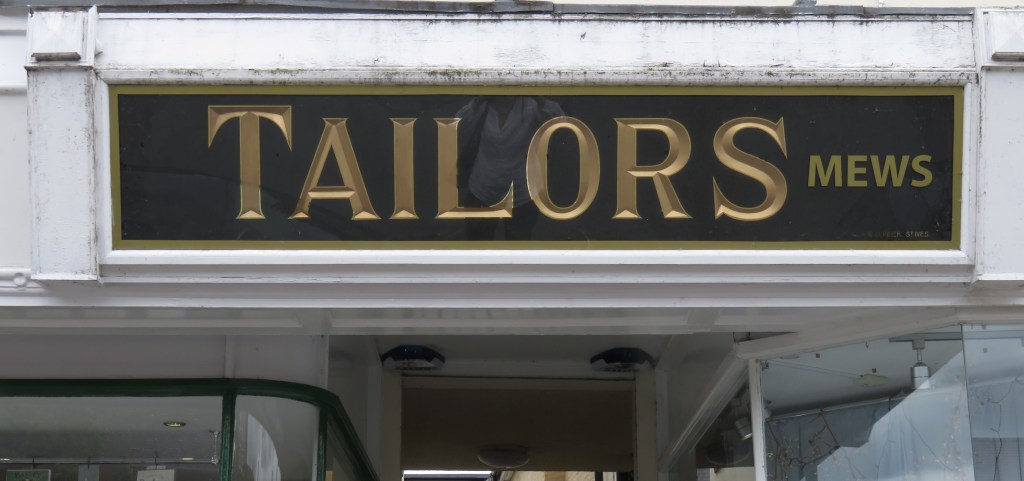
Moving into the early 20th century, a ‘Brilliant’ tailor’s sign — possibly renewed — has been exposed at 14 Market Hill, once the premises of Rowell & Son, tailors and outfitters. It is signed by W. O. Peek (born 1874), a local plumber, glazier and house decorator. The large display windows, fitted with curved glass, are typical of the trade.
Here are five more St Ives shopfronts which deserve a second look.
Prior’s (or Barton’s) Chemist’s Shop, 10 Bridge Street
The first chemist to trade from this property, Daniel Setchfield, died aged 56 in 1834. The house and business were then taken over by Thomas Prior (1804-71). As well as selling medicine, Prior stocked wine, sugar, tobacco and sheep ointment. It was a prosperous business.
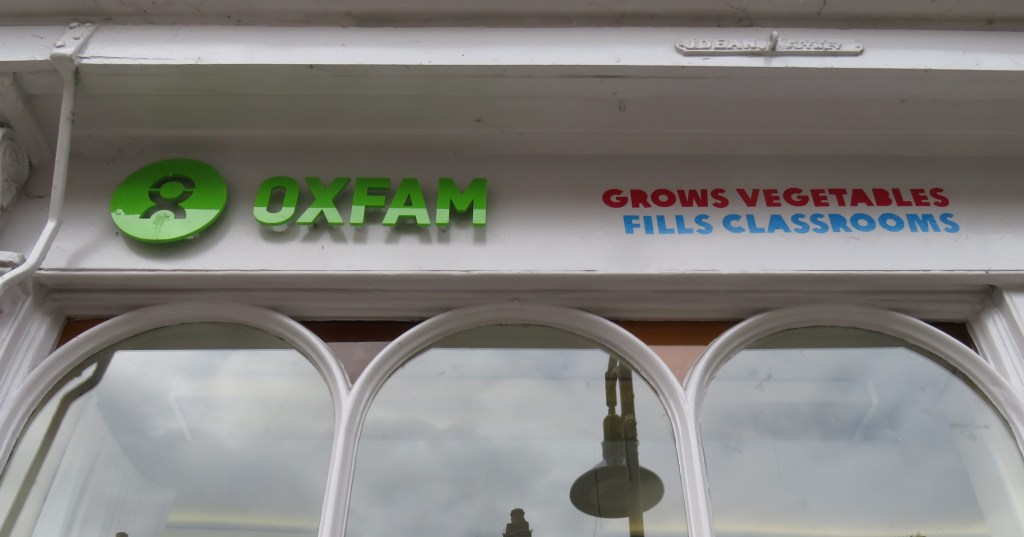
Just six weeks before Prior’s death in 1871, the house and business were transferred to Henry Barton (1844-1921). Barton became an licensed agent for W. & A. Gilbey’s wines and spirits. Through the early 20th century, Barton’s son, Frederick Cooke Barton (1876-1953), ran the shop. It continued to trade as Barton’s until 1987, when Henry’s grandson, Kenderick M. C. Barton, retired. In recent years, it has been occupied by Oxfam.
The lovely shopfront – offset to the right of the house doorway – probably dates from Prior’s time. With its round-headed arches, pinched glazing bars, amber-coloured spandrel glass and typical carboy shelf (originally concealed behind the horizontal glazing bar), it closely resembles a dated chemist’s shopfront in Lowestoft of 1851.
A colour photograph taken in the late 1960s shows that Henry Barton had added a metal stall plate bearing the words ‘Barton chemist’. A red enamelled Gilbey’s sign projected from the front while a more modern illuminated sign over the door advertised Ilford photographic film.
Read Adams’s (or Russell’s) Grocery Store, 12 The Broadway
In Victorian times these premises – recently a pizza restaurant, then a barber’s shop – occupied a desirable position on the north side of St Ives’ thriving Bullock Market. They belonged to a succession of retail and wholesale grocers and provision dealers. The buildings may have extended as far back as East Street, and included a large wholesale department and yard.
From the 1820s, if not earlier, the business belonged to Nix & Wasdale. In Matthew Wasdale’s later years it was assigned to a manager, first Mr Allett, then Mr Clayton. After Wasdale’s death in 1857 it was taken over by Read Adams. Read Adams (1832-1889) had the distinction of being elected first major of St Ives in 1874. Upon his death in 1889, George Russell (1851-1913) – Adams’ manager since 1873 – took over. The shop appears in photographs of c.1900 with a very large canopy on spindly supports extending across the pavement, a necessity in such a sunny spot. It remained in the hands of G. Russell & Son into the mid-1960s, when advertisements claimed the business was established in 1744.
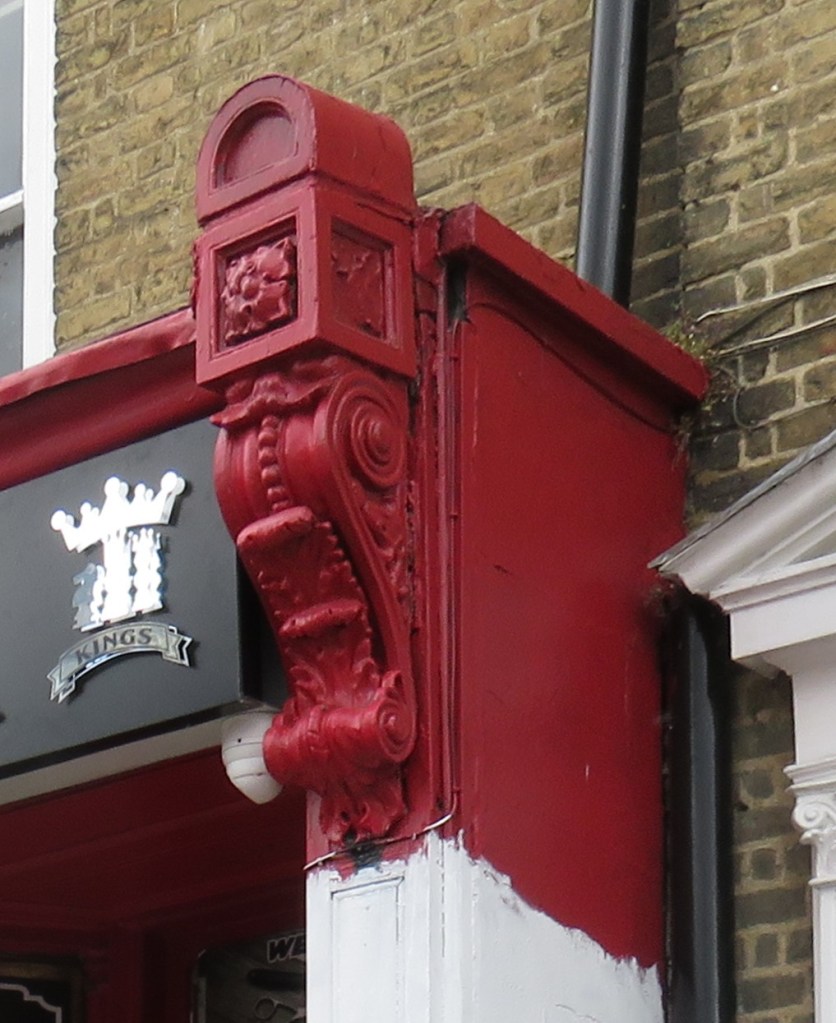
So, which of these successive occupants installed the handsome projecting shopfront? The rounded glazing bars with their small, moulded capitals, the relatively large panes of glass, and the integral entrance lobby, push the date into the second half of the 19th century, but it would have looked old-fashioned by the time Russell took over in 1889. The grilles beneath the window resemble those of 10 Bridge Street. The large scroll consoles with acanthus foliage decoration also find parallels in Bridge Street (nos. 10 and 18) and may represent the style of a local carpenter or shopfitter. All of this suggests that Read Adams installed the shopfront when he took on the business in 1857.
This attractive mid-Victorian shopfront appears to have been extended to either side with chunky consoles, perhaps in the 1980s, but the central section is clearly authentic.
It was installed by the grocer John Johnson (1820-1896), who began trading here between 1851 and 1861. The Johnson family lived over the shop before moving to Westwood Road in the 1880s. From his obituary, we know that Johnson was a staunch supporter of the Congregational Church.
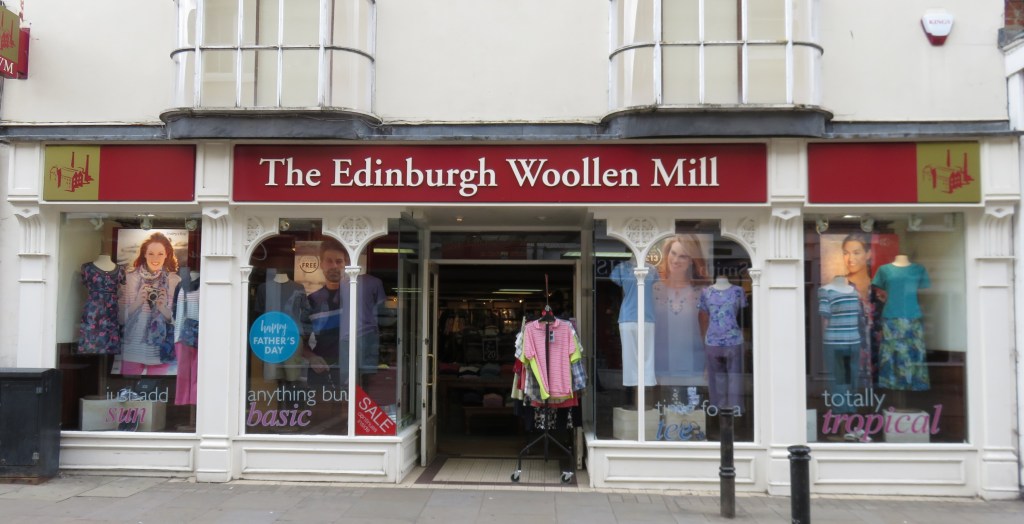
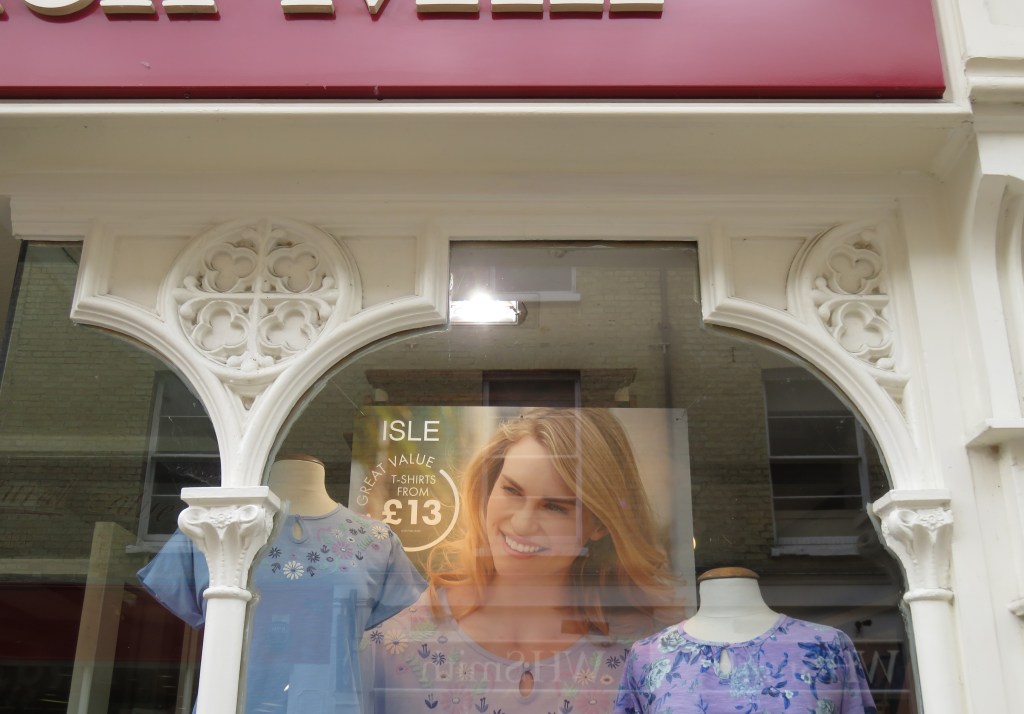
Johnson’s business was continued into the 20th century by his son, Alderman John Johnson (1873-1944), a prominent Freemason, but by the 1920s Johnson’s (St Ives) Ltd. was managed by the London grocers F. C. and R. Eaton. In the 1960s, it was taken over by Northampton grocers G. Civil & Sons Ltd., who renamed the shop – perhaps now extended and reconfigured as a supermarket – Civils. The Civils chain was bought by the South Midlands Co-op in 1988. Later occupants of 23 Crown Street included Freeman Hardy & Willis and Edinburgh Woollen Mill.
The shopfront, dating from c.1880, has spandrels and capitals in a Gothic – even ecclesiastical – style. The Caernarvon arch was popular in shopfront designs of the 1870s and 1880s, featuring in guides like Joseph Barlow Robinson’s Series of Suggestive Designs for Shop-Fronts of a Plain & Elaborate Character suitable for every trade or occupation (1869). The style expressed the substantial and reliable character of Johnson’s business.
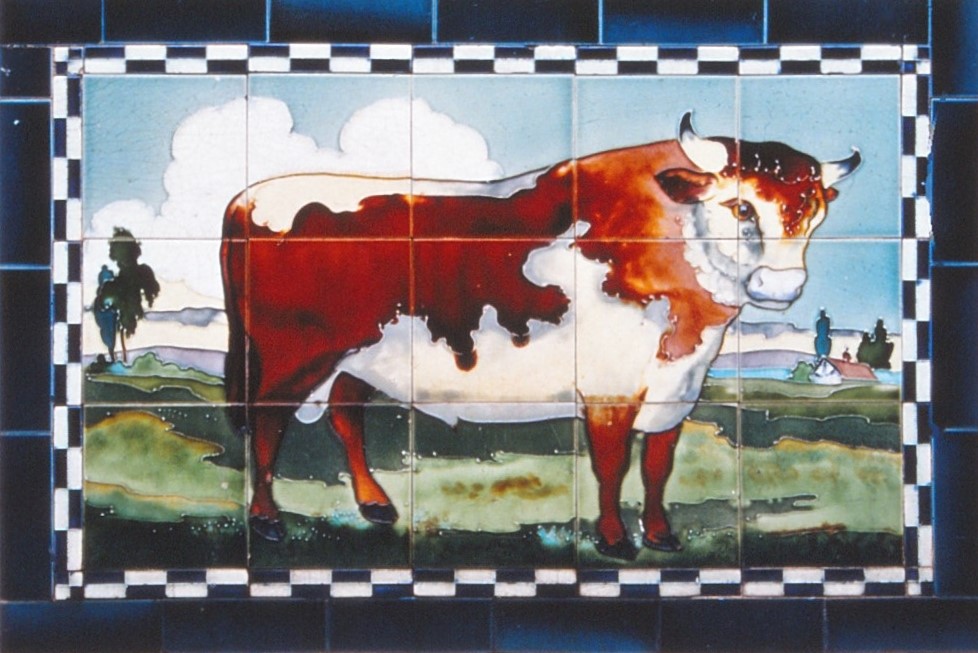
This shopfront obviously belonged to a butcher. The tiled stallriser includes a fine tube-lined panel depicting a cow in a chequered border, together with two smaller blue-and-white transfer-printed panels (almost portraits!) of a pig and a ram.
The butcher’s name – H. Anderson Jnr. – is displayed vertically to the side of the doorway, possibly to ensure that it was not hidden by carcasses hanging over the shopfront.
The Anderson family were publicans, farmers and butchers. The first butcher in the dynasty, John Anderson (1829-1895), was publican at the Horse & Jockey. When John completed the Census of 1871, he squeezed an admirable amount of information into the small box available for ‘occupation’, writing: ‘Farmer, Publican, Pork Butcher and Pig Dealer. Employs 3 men 3 boys. Farms 225 acres of land.’
John’s son Edward (1861-1947) – who served three terms as mayor – opened a pork butcher’s shop at 12 The Waits in November 1883. He lived over the premises with his family, and his son Edward died there aged 33 in 1918.
By 1921 the shop had been taken over by Edward’s nephew, Harry (1900-1961), who had trained as a butcher before serving in the RAF in 1918. It was Harry (whose father – of Westwood Farm – was also called Harry) who installed the shopfront, probably in the early 1920s.
Harry was still living over the premises with his family in 1940, when a photograph of him was taken, showing that the shop window was closed by folding perforated shutters rather than glass. By 1999 they had been superseded by wide sash windows.
Harry retired in 1954 and the subsequent history of the shop is uncertain. It became Mr E’s in 1999 but was converted to offices (Pitts Architects) just a few years later.
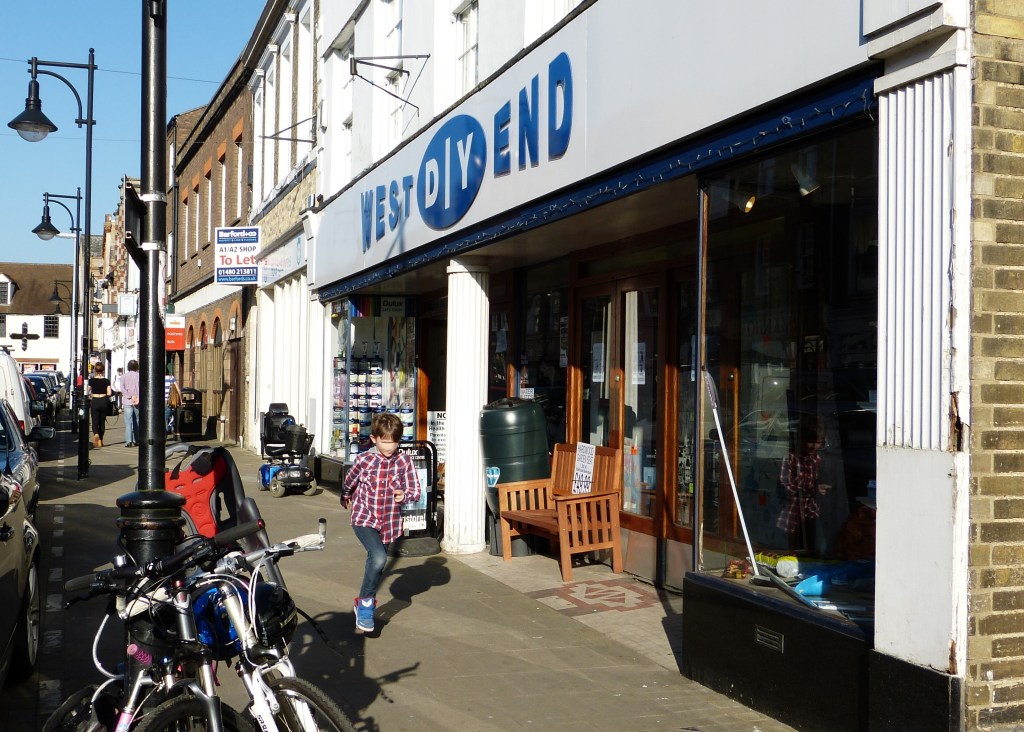
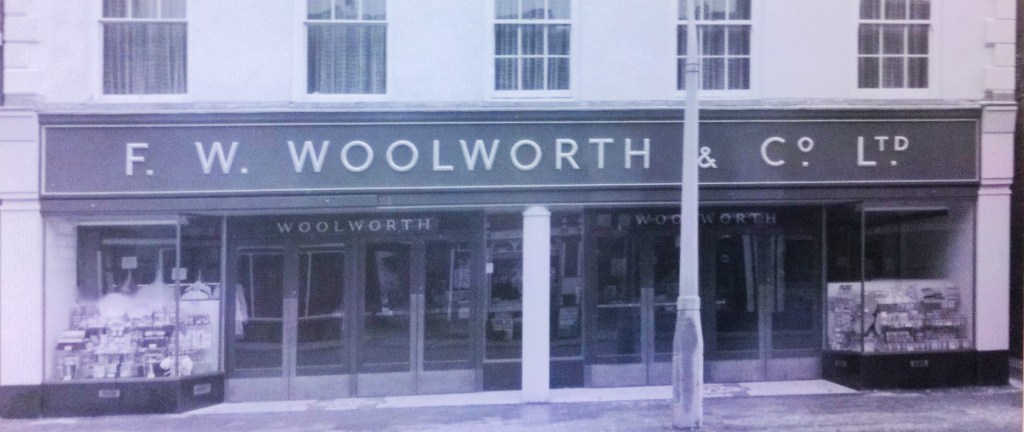
West End DIY, a small Northampton-based DIY chain, has traded from this former Woolworth’s store since c.1988. It is to be applauded for retaining the shopfront. The authenticity of its details is confirmed by images in the Historic England Archive.
19 Bridge Street (Historic England Archive)
This was not one of F. W. Woolworth’s impressive portfolio of pre-war ‘3d. and 6d.’ stores. It opened as Store 869 in 1955, shortly after post-war building regulations had lifted, and did not fully comply with the firm’s house style.
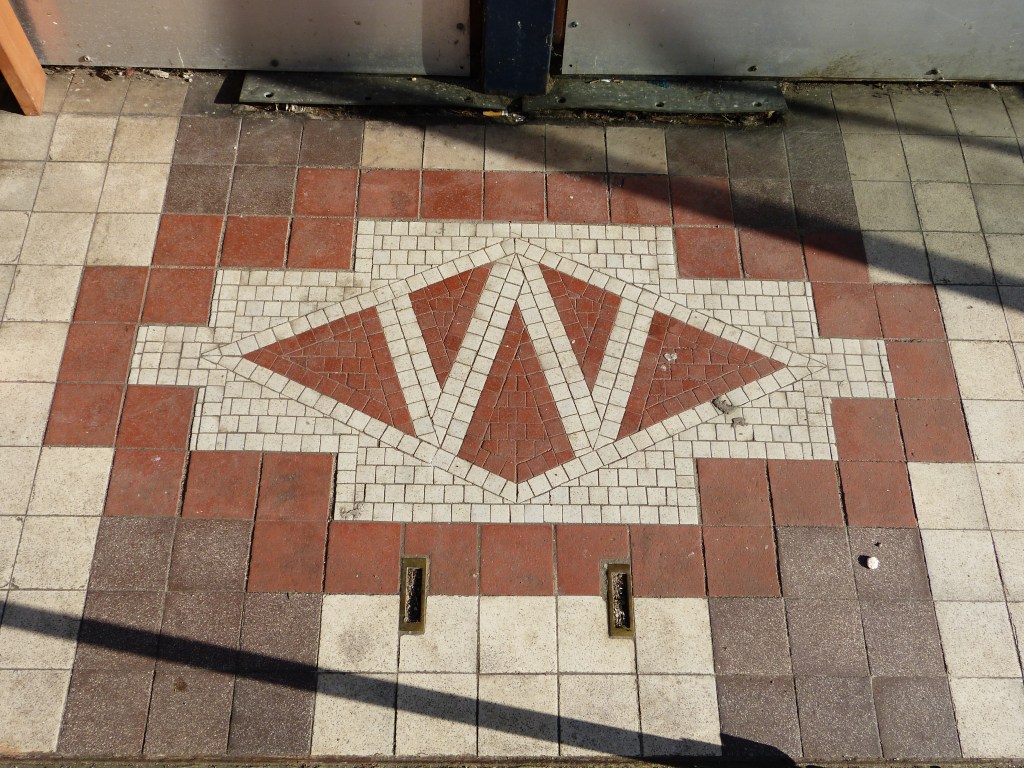
A structural column with fluted decoration (matched in the end pilasters) allowed the entrance to be recessed behind the building line. Most of the shopfront is taken up by wooden doors with kick-plates – Woolworth’s would soon prefer stainless steel — but small display windows were installed at either end. Their angled shape helped to filter customers towards the entrances. The most distinctive feature is the tiled floor, with its unusual version of Woolworth’s famous ‘diamond W’ logo.
In 1981 Woolworth’s relocated to 17 Crown Street, where it remained until the collapse of the company in 2008. Meanwhile, 19 Bridge Street is reported to have traded (briefly) as a Shoppers World (Woolworth’s catalogue format) before being taken over by West End DIY.
Text copyright K. Morrison. No AI scraping permitted.
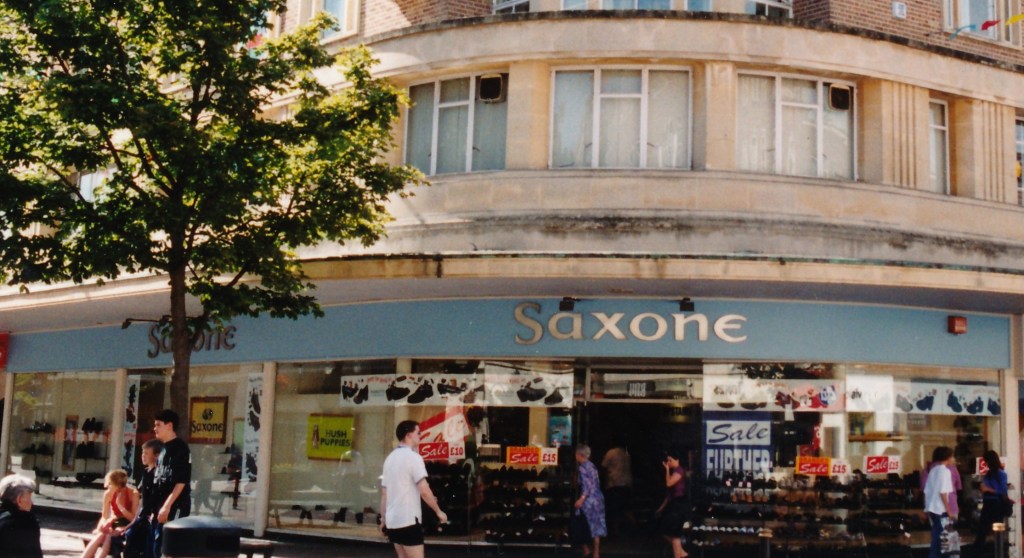
Britain once had so many chains of home-grown shoe shops that it proved impossible to do justice to Saxone’s rich history in the pages of Chain Stores (reference below). So, here’s a slightly longer version of the story.
Last century, most high streets throughout the British Isles included a Saxone shoe shop. Initially known principally for men’s footwear, from the 1940s Saxone specialised in fashionable shoes for women and girls.
Saxone’s founders, brothers Frank and George Sutherland Abbott, were employed as agents for Manfield’s in Northampton until 1902, when they quit to set up their own business. F. & G. Abbott Ltd. acted as retail distributors – through shops and by mail order – for the Kilmarnock footwear manufacturer, A. L. Clark & Co. These two companies came together in 1908 as The Saxone Shoe Co. Ltd.
The Abbotts called their first shops – occupying prominent positions in Hull, Belfast, Leeds and elsewhere – “Saxone” & “Sorosis”. The inverted commas – also an intrinsic part of Greenlees’s “Easiephit” shops – indicated that these were brand names.
Saxone (for men) and Sorosis (for women) retailed for a fixed price of 16s., rising to 16s. 6d. in 1906. Although made in Scotland, they were marketed as “American”. At this time, well-made ready-to-wear American shoes (or American-style shoes) were all the rage, giving the multiple footwear trade an enormous boost.
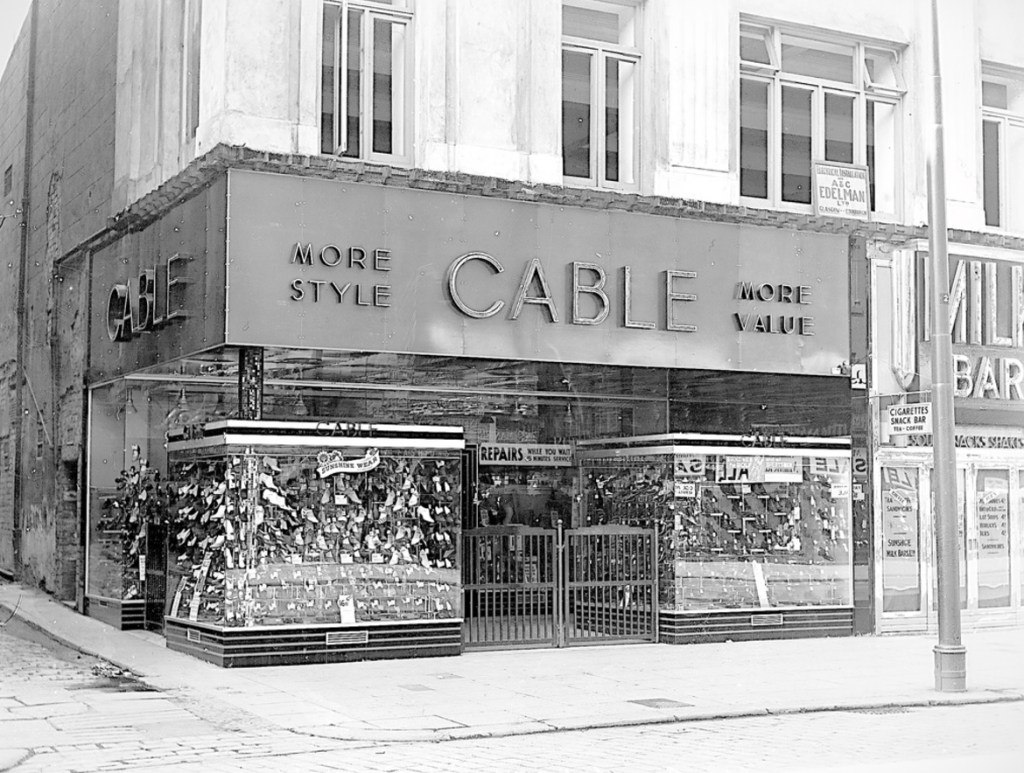
In 1906 a third brand appeared: Cable, for men and women, selling for 10s. 5d. (16s. 9d. by 1927). The name was taken from the maiden name of George’s wife, Isabella. Saxone & Cable, or simply Cable, became alternative names for the shops, especially in Ireland, Scotland and Wales. The Cable shop in Sackville Street, Dublin, was destroyed in the Easter Rising of 1916, and reopened as Saxone in 1921. Shops with the simple Saxone name usually traded exclusively in men’s footwear until the 1950s, when the Sorosis brand was dropped.
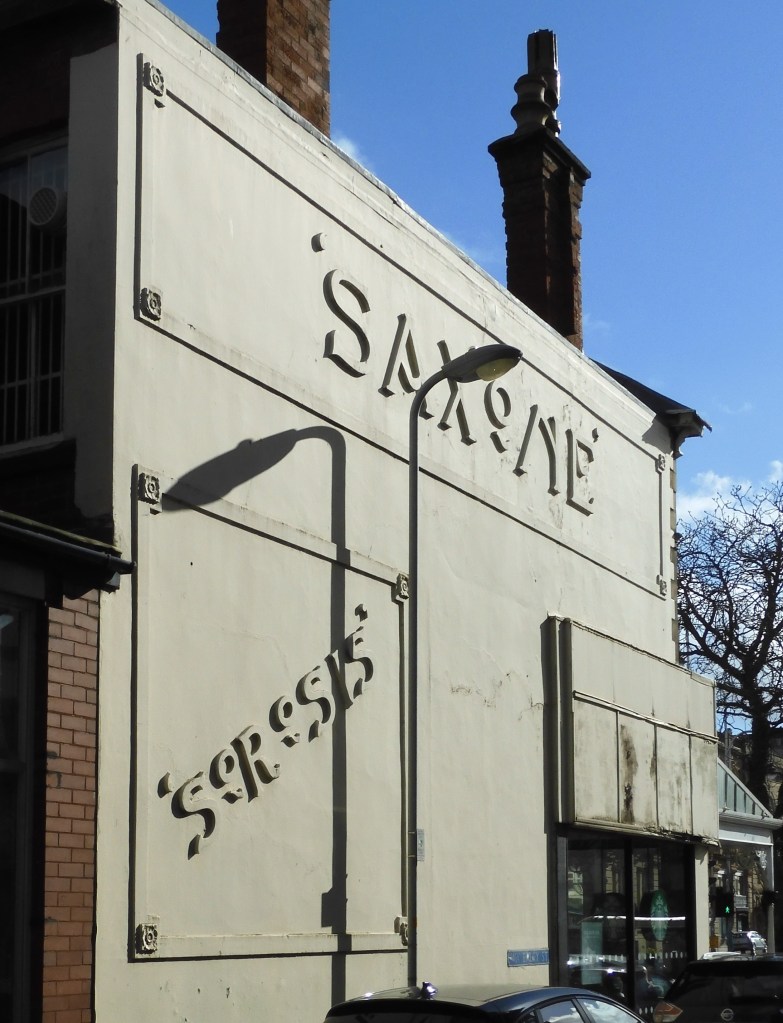
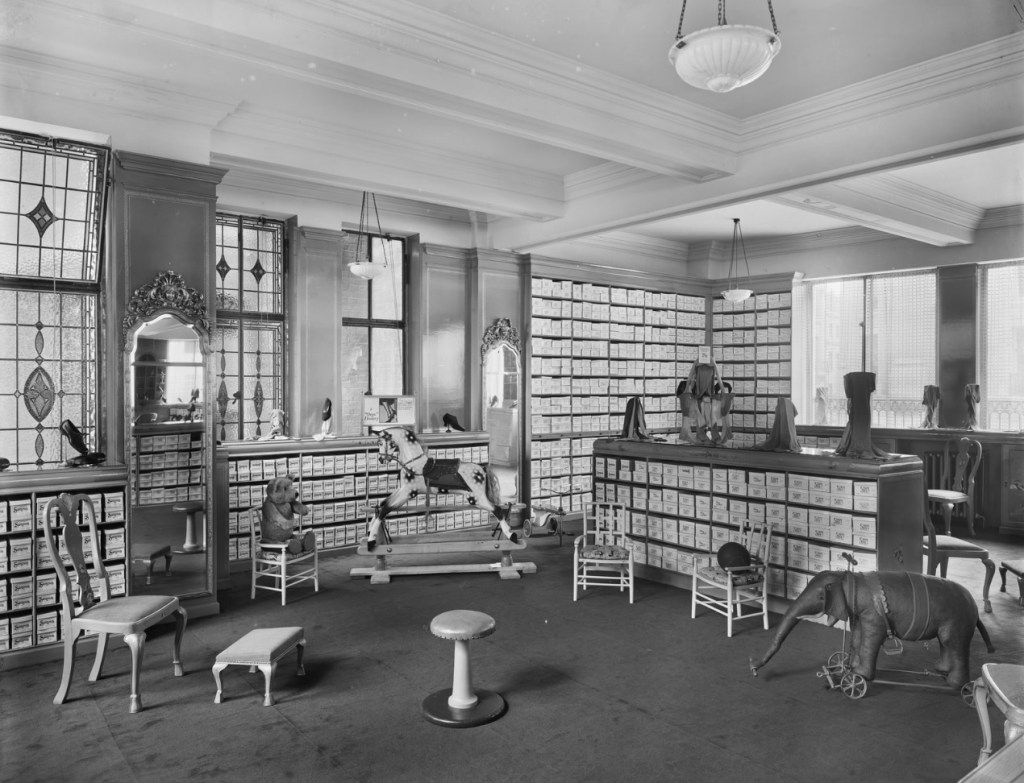
By 1921, the company’s 50 branches included Lord Street, Southport, where some original signage survives on a side elevation. Nationally, the finest branch was at 229-231 Regent Street, London. This had opened as Saxone in 1909 but was revamped in 1924 as Saxone & Sorosis, with showrooms on two floors connected by a lift. It had a sizable children’s department.
Photographs of the branch in Buchanan Street, Glasgow, dated April 1932, show workmen dismantling the elaborate Edwardian frontage. Here, Saxone & Sorosis was succeeded by a modern Saxone shop.
By the mid-1930s most branches had been remodelled with arcade shopfronts, providing space for extensive window displays. A masculine style was adopted, similar to that of men’s outfitters, with metal-framed showcase windows designed to look free-standing. Many shops now sported Saxone’s lion rampant logo, a reminder of the company’s Scottish heritage.
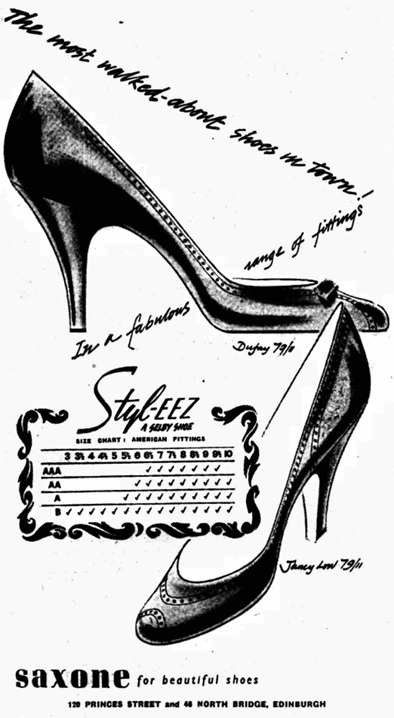
Advert from 1950.
Saxone’s shops were supplied by a vast factory in Kilmarnock, which fulfilled contracts for the Services during both world wars, temporarily reducing availability for civilians. It was extended for the manufacture of women’s Styl-EEZ shoes, made under contract to the Selby Shoe Co. of Ohio, in 1949. The Kilmarnock factory operated until the mid-1980s, when it was superseded by the Galleon Leisure Centre.
In 1948, Saxone’s tally of 180 shops was swelled by the purchase of Jacksons Ltd., a Stockport-based chain of 46 shops. In January 1957 Saxone merged with Lilley & Skinner, which had recently swallowed up Benefit (the former Public Benefit Boot Co.). Together they had 470 shops, about half as many as Charles Clore’s recently formed British Shoe Corporation (Sears), which posed a new threat to the sector.
Much was made of Saxone’s new shops in the late 1950s. The branch at 399 Strand occupied the site of a famous restaurant – Romano’s – which had been destroyed in the Blitz. The two-storey shop was deeply recessed to create a spacious covered display area. Opaque glazing masking the upper level was festooned with silhouettes of women’s shoes. Above this, each letter of the word ‘Saxone’ – following a widespread current trend – was applied to individually illuminated panels, probably of Perspex. Similar ultra-fashionable shops were created elsewhere, for example in Sheffield. It was hoped that they would last 20 years: much longer than usual in the footwear trade.
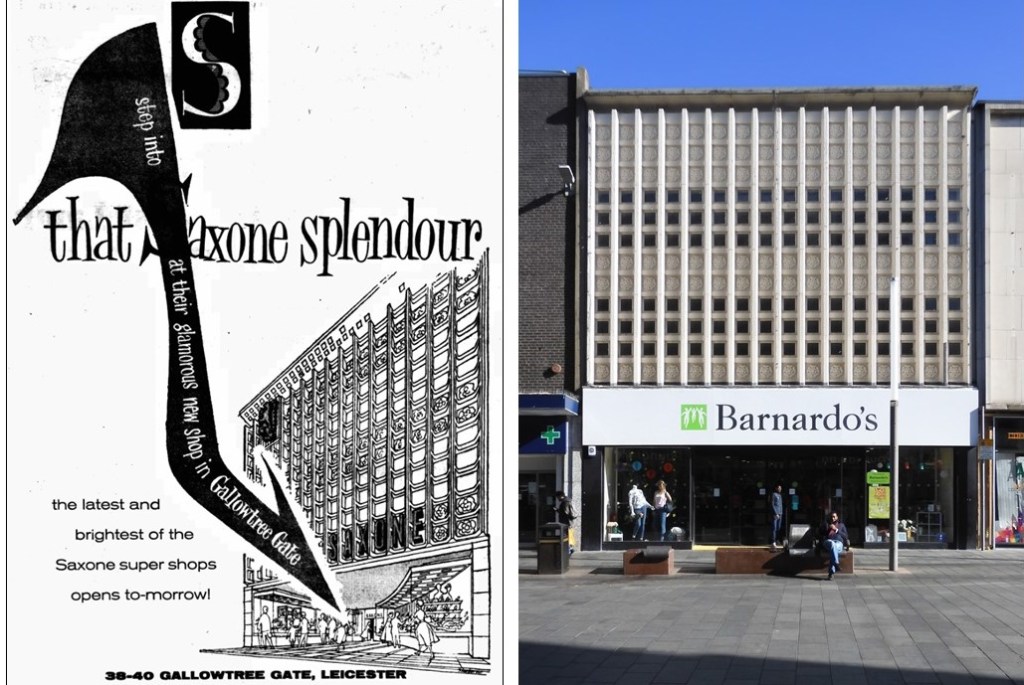
The architect Michael Egan was commissioned by Saxone Lilley & Skinner to design interesting shoe shops. One of his finest façades survives in Leicester.
Egan also devised a system for cladding old buildings – such as Saxone’s Leeds and Luton branches – to create a modern impression quickly and inexpensively. These stores included vertical strips of green glass.
Saxone, Boar Lane, Leeds.
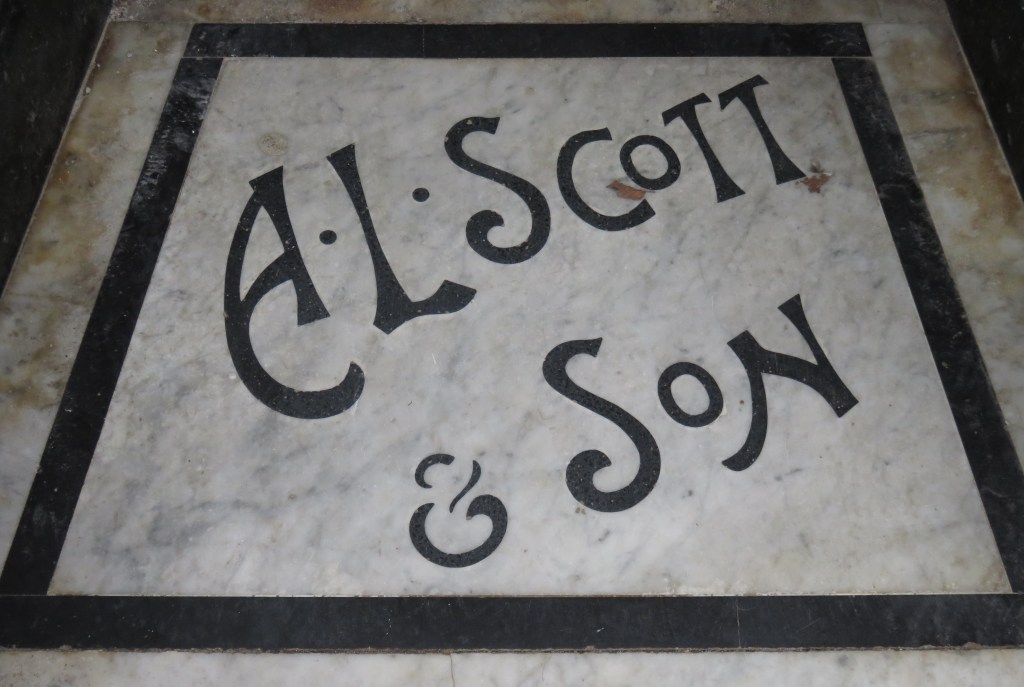
Saxone Lilley & Skinner expanded in 1961 by taking over the Scottish chain A. L. Scott & Son Ltd. Scott had started his career with Manfield, just like the Abbott brothers.
In 1962 the group was absorbed by the British Shoe Corporation and the shops were converted to semi-self-service, originally trialled by the group at Dolcis. One of Saxone’s first experiences of the new format was the ground floor of the remodelled Luton branch, which opened in October 1962.
As Sears entered its death throes in the early 1990s, Manfield’s chain – where the Abbott brothers had begun their career – was subsumed by Saxone. A few years later, Sears’ disposed of remaining Saxone shops, first of all to Fascia – a messy process – and then to Stylo (owner of Barratts). By the turn of the Millenium, just a handful traded under the Saxone name.
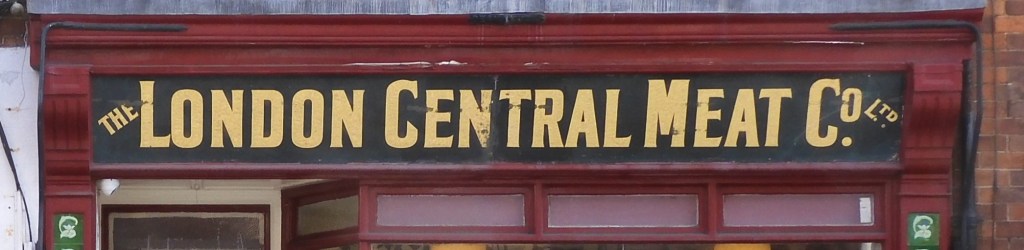
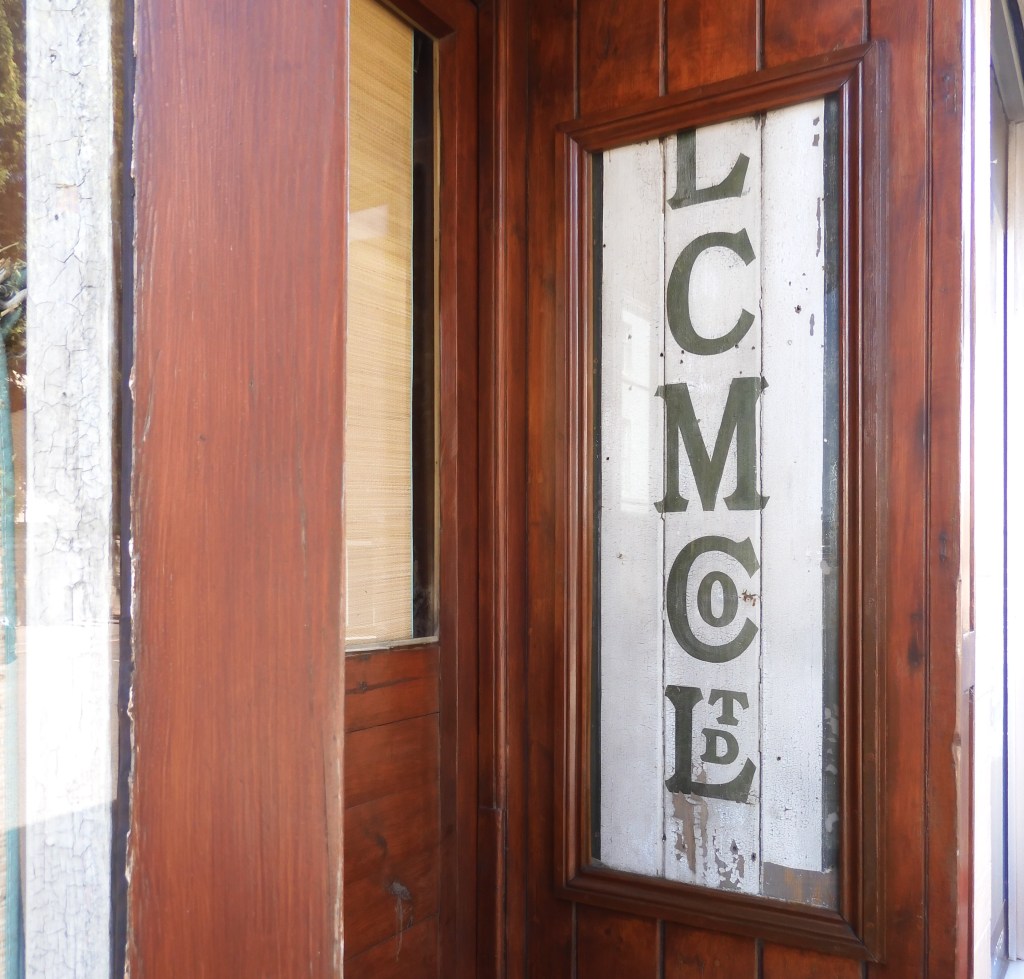
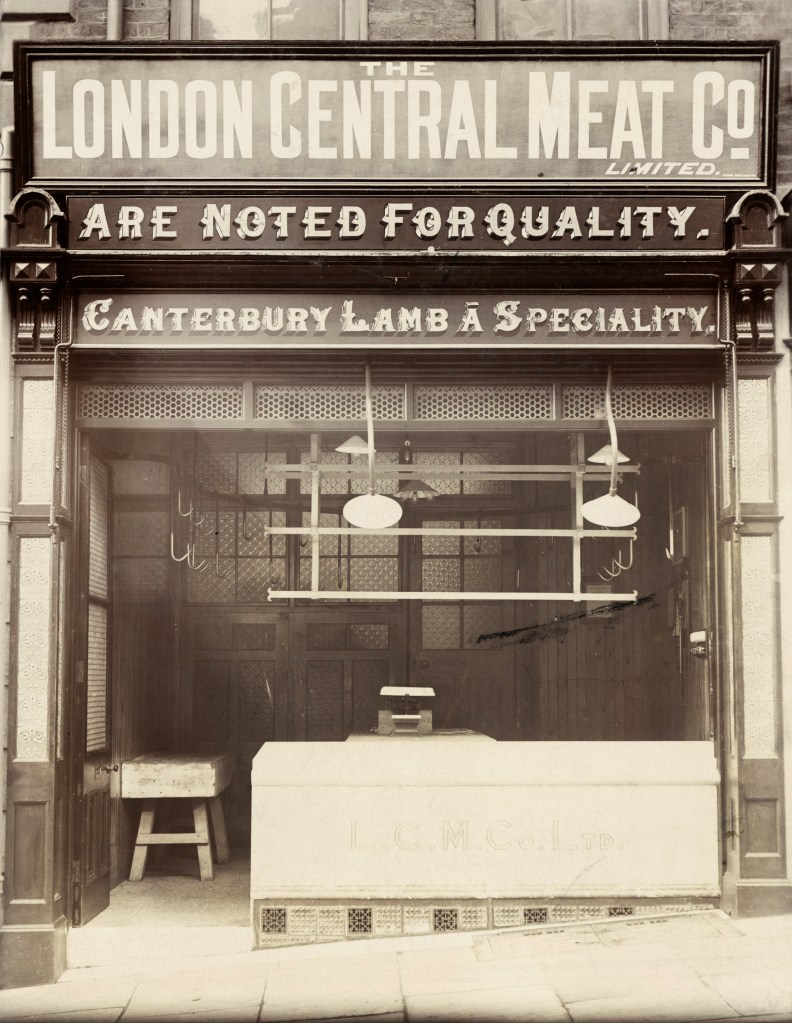
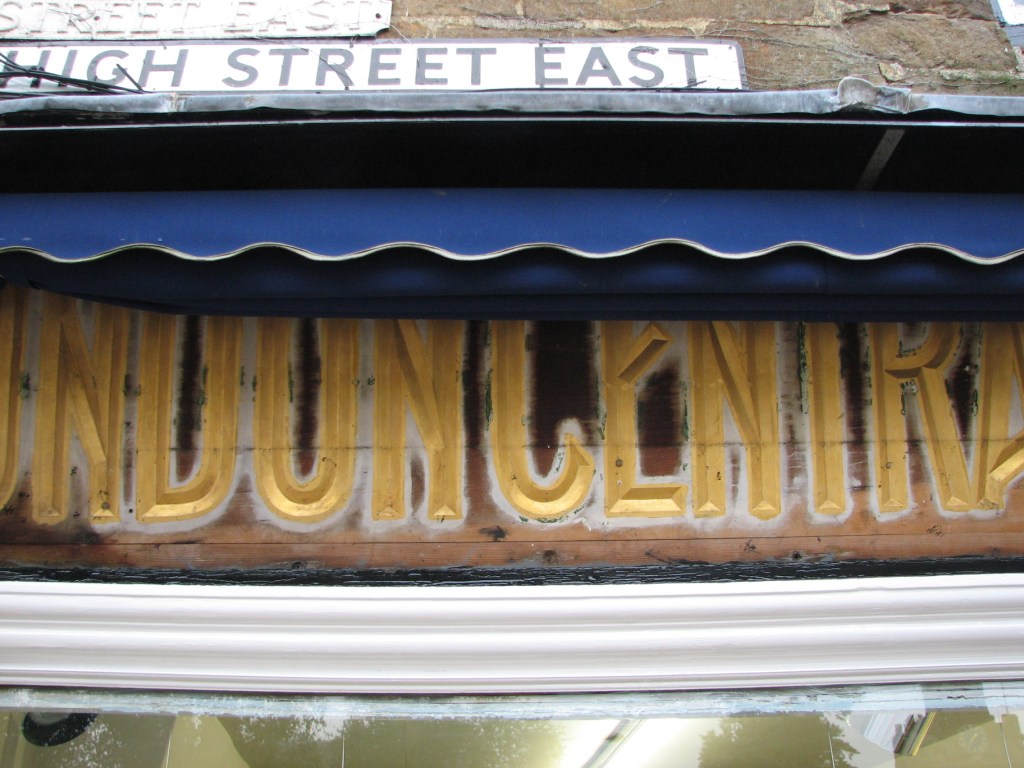
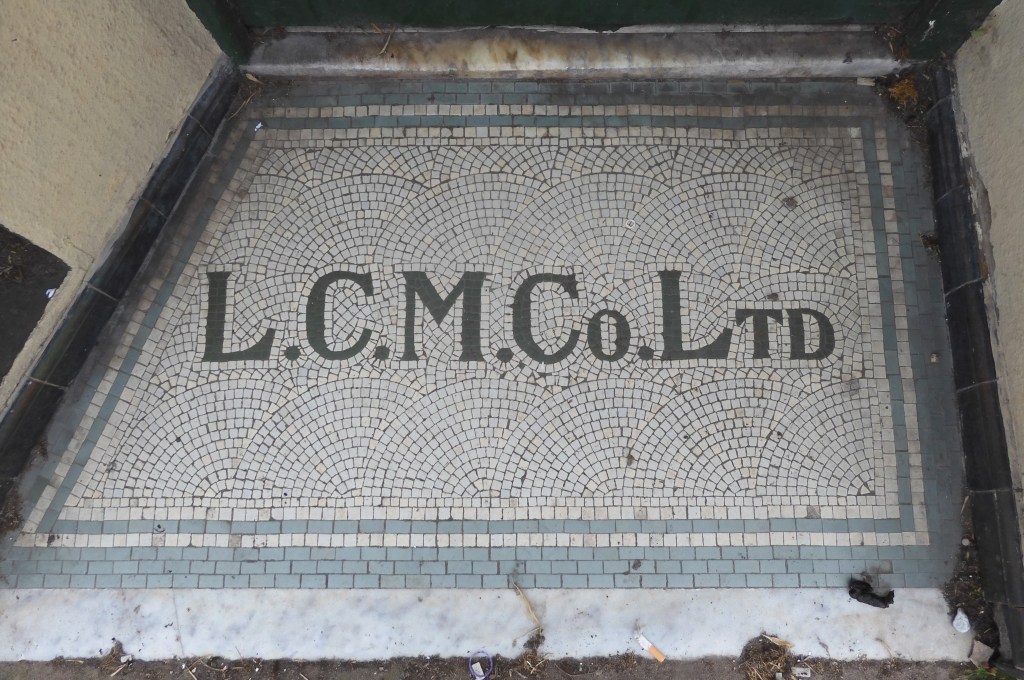
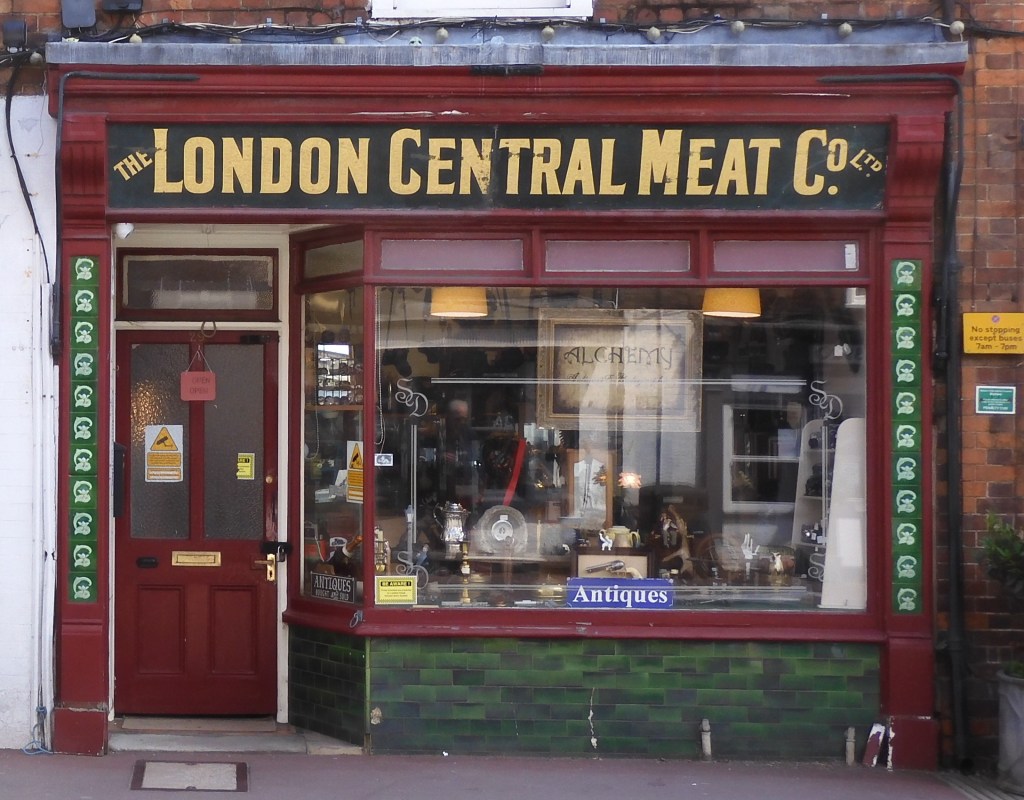
The London Central Meat Co. Ltd., renamed Baxters in the 1950s, was one of England’s biggest multiple butchery chains. Traces of its highly branded shops – ofter the simple initials ‘L. C. M. Co. Ltd.’ – can still be discovered on the edges of town centres.
The company was started around 1880 by George Edwin Lowe, a carpenter who made an unusual career move by opening a butcher’s shop in his hometown of Burton-on-Trent and market stalls in neighbouring towns, such as Tamworth. Business took off once Lowe began to specialise in New Zealand (‘Canterbury’) lamb, which was heavily advertised on his shopfronts.
The sailing ship Dunedin carried the first shipment of 4,460 sheep and 449 lambs from Otago to London, arriving on 24 May 1882. The meat was sold at Smithfield, and it is tempting to imagine that Lowe was one of the first customers. The name he selected for his shops, The London Central Meat Co., must have been taken from the full name of Smithfield Market: the London Central Meat Market. It suggested official status, instilling confidence in customers.
Lowe’s business multiplied quickly. By 1895 he had shops throughout the South and Midlands. One of Lowe’s employees was Herbert Lea, a former coal miner who was working as a butcher’s assistant in Northampton by 1891. The following year the London Central Meat Co. opened its first Northampton branch, on Gold Street, and it is likely that Lea applied successfully to run it. He quickly became indispensable to Lowe, standing in as best man at his wedding in 1905. When Lowe retired around 1915, having made a large fortune, Lea took up the reins. In later years, he cast himself as a co-founder of the company.
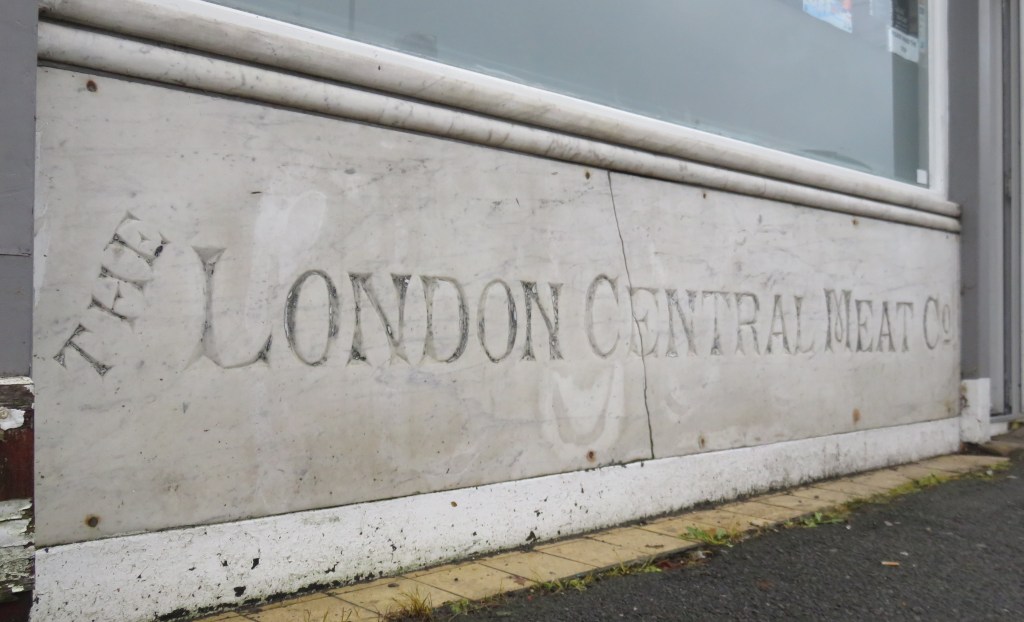
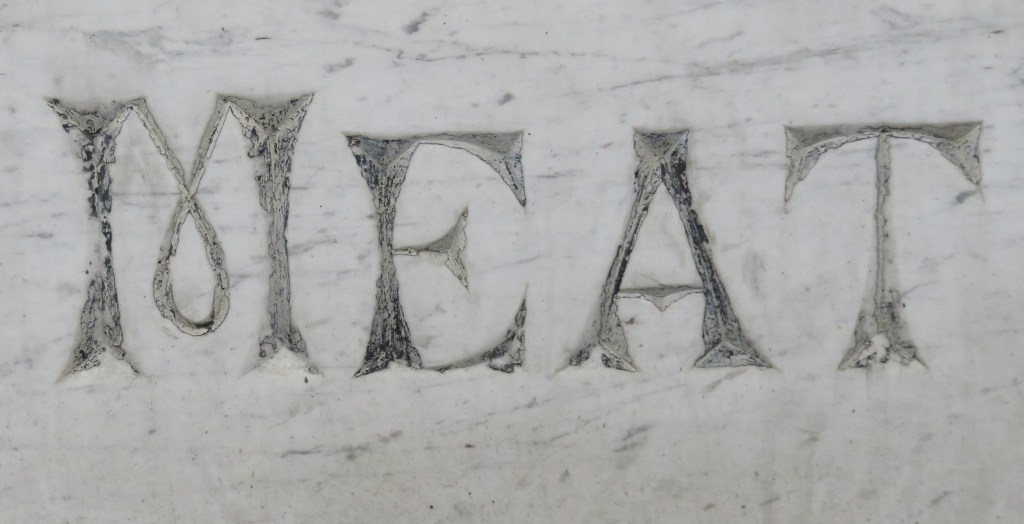
Early shops, for example in Shrewsbury, resembled market stalls. They were open to the street: perforated doors and shutters could be lifted out, leaving just a solid counter with a marble slab. Behind this was a chopping board and weighing scales, while hooks for carcasses lined the walls. The name or monogram was engraved onto the front of the counter (or stall) as well as being squeezed onto wooden signboards.
There was no clearly defined house style and the company sometimes retained existing frontages. It was only in the 1920s that glazed windows became standard, with the company monogram repeated in mosaic tiles on the paving of entrance lobbies.
Lea’s son-in-law, Arthur Spencer Baxter, became managing director in 1933 and made the company his own. Although it was renamed Baxters (Butchers) Ltd. in 1958, new and remodelled shops equipped with refrigerated cabinets had been trading under a ‘Baxters’ fascia, with simple red lettering, since the mid-1950s, when meat rationing ended and expansion resumed.
By 1963, Baxters had 403 branches in a geographic area defined as ‘south of a line drawn from the Mersey to the Humber but excluding London, Birmingham, South Wales and Cornwall’, with the head office in Northampton. A subsidiary, Lea & Baxter Ltd., was invested with the wholesale business, the slaughterhouses, the cold stores and the meat processing plants. It supplied meat to government departments and local authorities, including hospitals, and retailed processed meat under the ‘Lea & Baxter’ brand.
Baxters had a large property portfolio. In 1963 it held the freeholds to 244 of its 403 branches, leased 97 shops to other retailers, and owned 248 houses or flats which were mostly occupied by employees. Property with an estimated value of £2,250,000 brought in an annual rental income of £42,714.
The company was still growing and profitable in 1974, when it was acquired by Brooke Bond Liebig, which also owned PG Tips, Fray Bentos and Oxo. In 1984 Unilever took over Brooke Bond, including Baxters, which now had 400 loss-making shops. Seeking to recoup the cost of the takeover, Unilever sold Baxters to United International (the Vesteys), which merged it with Dewhursts.
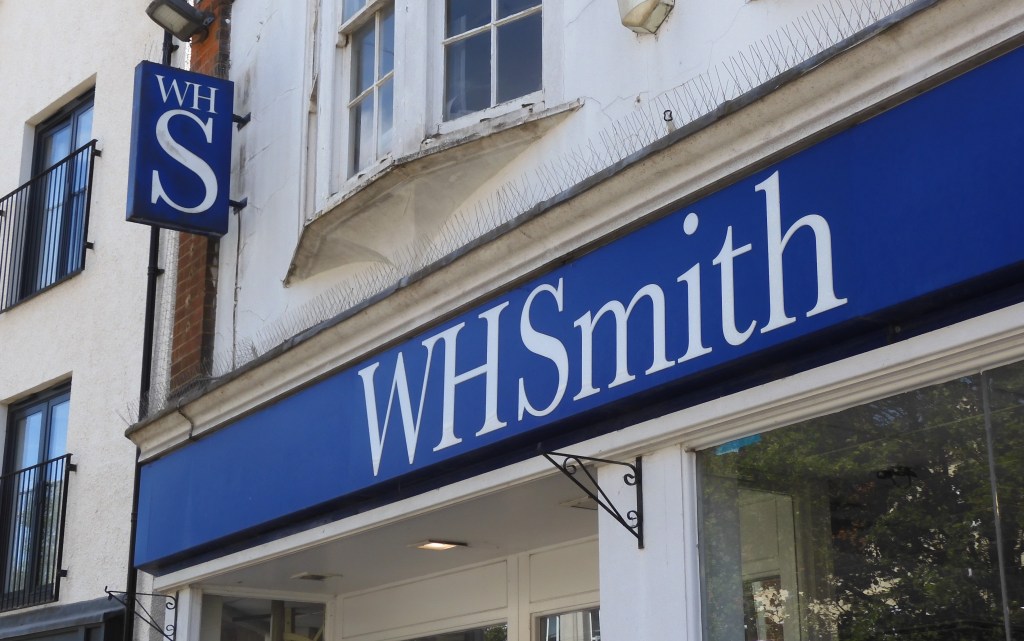
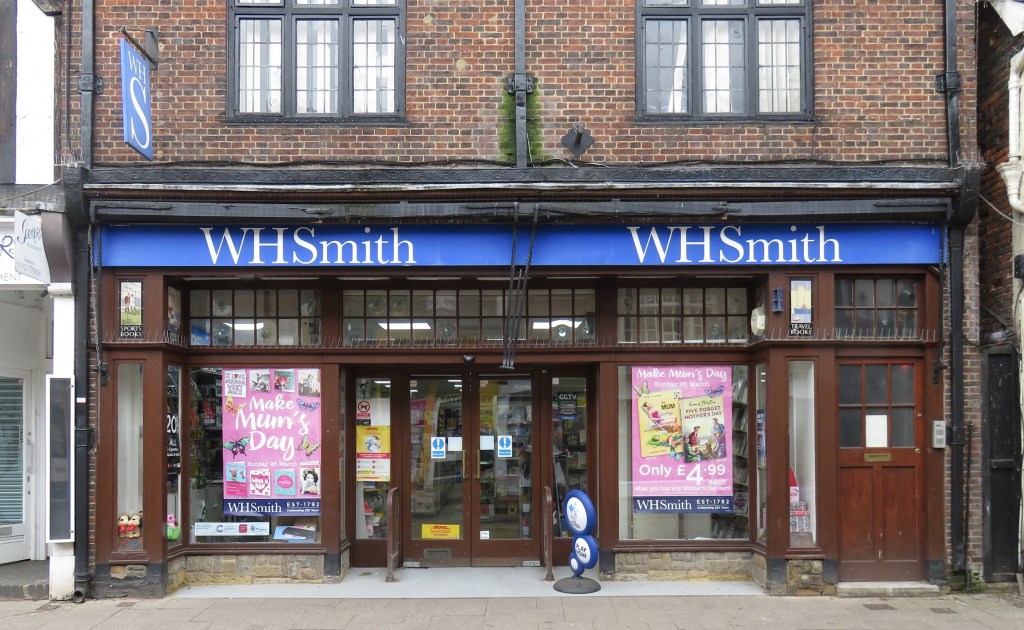
After months of anticipation, the process of changing the identity of W. H. Smith’s shops to ‘T. G. Jones’ is underway.
The new fascia is yet to be installed on my own local high street, where W. H. Smith continues to occupy its central spot. When it comes, it will bear an uncanny resemblance to W. H. Smith’s current branding, deploying the same font and the same shade of blue. As a result, shoppers will expect continuity in merchandising and service.
In 1816 William Henry Smith (1792-1865) and his brother inherited a stationers and newspaper agency in the Strand, London. The brothers went their separate ways in 1828, and before long W. H. Smith was undertaking the wholesale distribution of newspapers throughout the country, at first by coach and then by rail.
In 1848 W. H. Smith & Son won the contract to run bookstalls for the London & North-Western Railway. Arrangements with other railway companies followed, and by 1902 Smith’s had 1242 bookstalls, selling books, magazines and newspapers, and offering a lending library service. The wholesale business expanded, regional warehouses were opened, and in 1855 imposing new headquarters were built on the Strand.
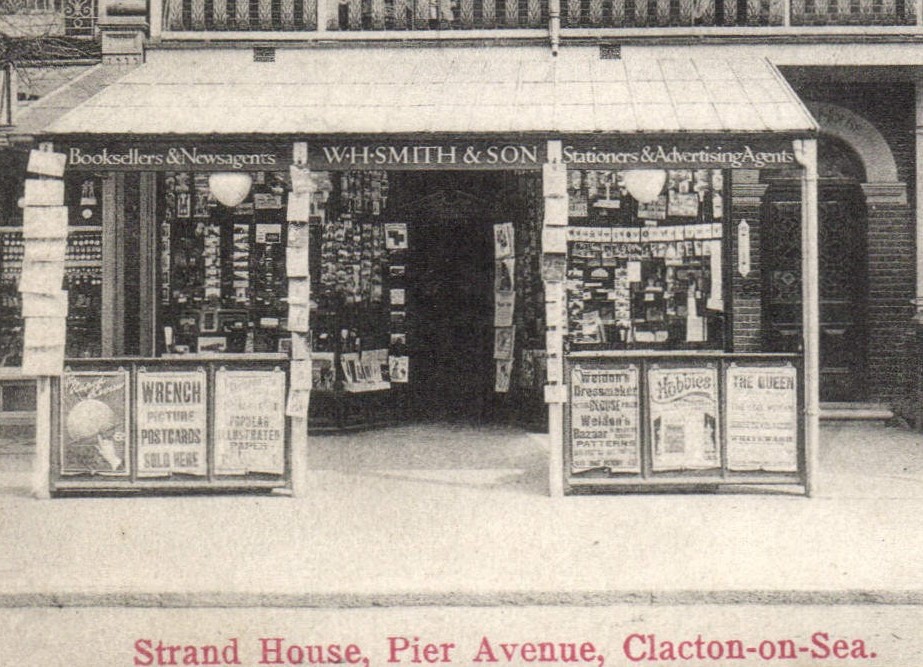
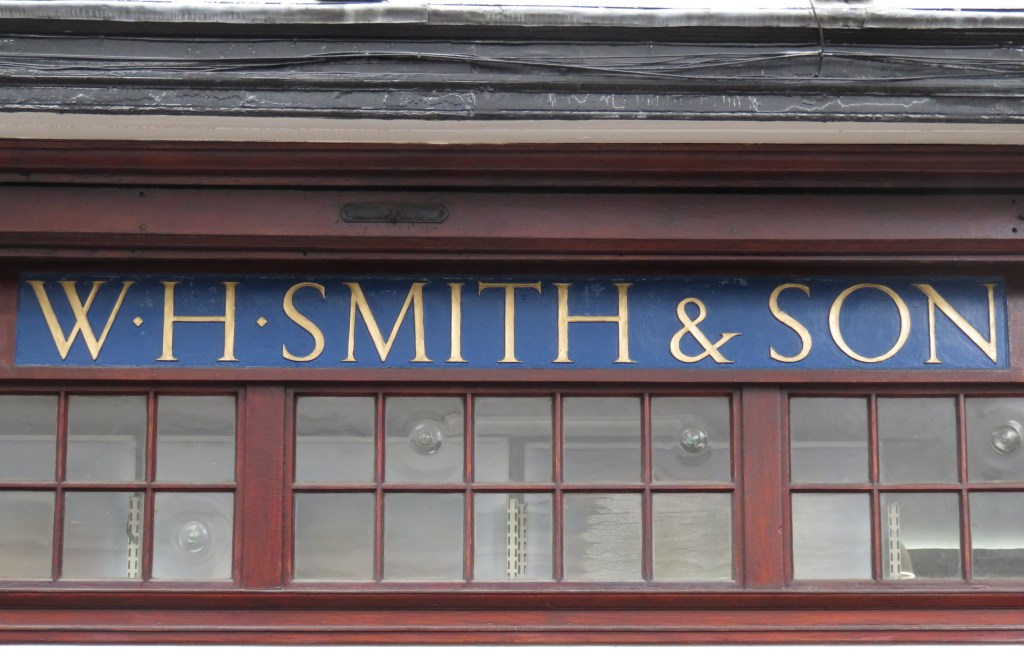
It wasn’t until the early 20th century that Smith’s began to trade from shops, starting in Clacton (1901), Gosport (1902), Paris (1903), Southport (1903) and Torquay (1904). Fascias were designed and painted by Eric Gill. Shop openings accelerated rapidly after October 1905, when Smith’s lost its contract to run 250 railway bookstalls.
A Shopfitting Department was formed under Frank Charles Bayliss (1876-1938) and architects were invited to take part in a shopfront competition. New shops were classified ‘A’ or ‘B’. The ‘B’ shops were the equivalent of the former railway bookstalls: they were located on station approaches and their buying was undertaken by head office. The ‘A’ shops had more independence and occupied prominent high-street sites.
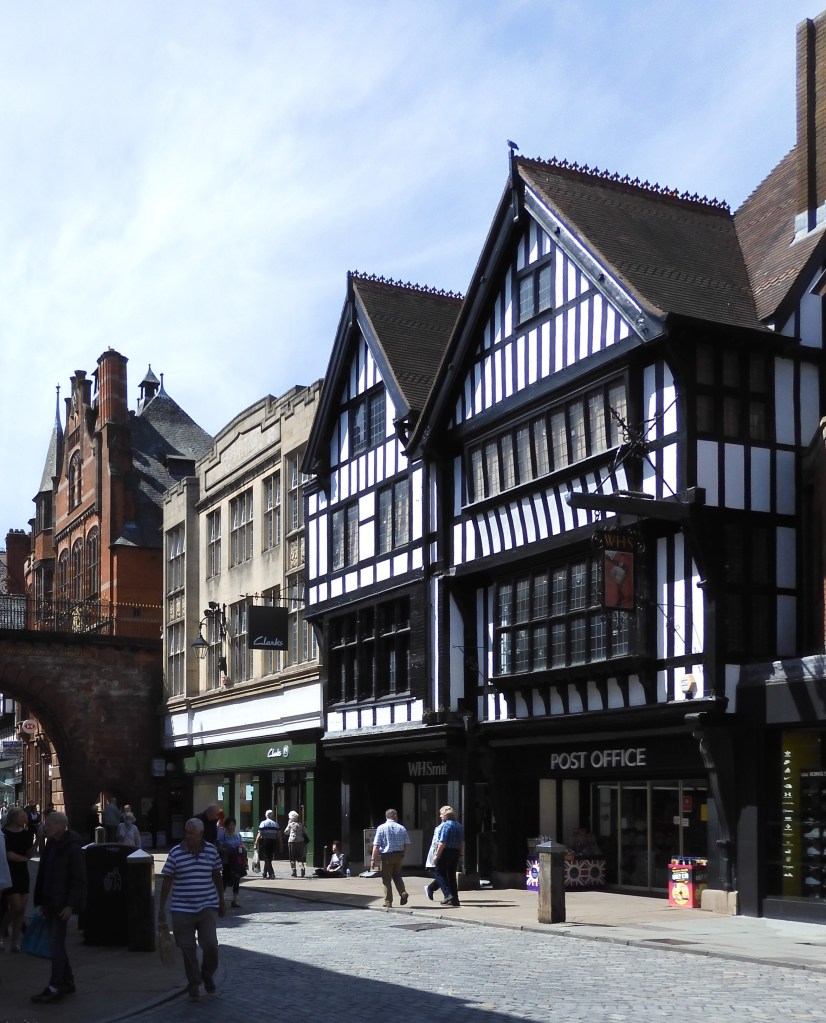
After about 10 years, Smith’s began to build some of its own stores, tailoring designs to suit the built environment and to earn the approval of middle-class customers. One of the earliest – built in Cornmarket, Oxford (1914-15) – had a collegiate appearance. Stores built in the course of the 1920s in Stratford-on-Avon (1921-23), Chester (1923) and Winchester (1927) were mock-timber structures in a Tudor style. Bayliss worked on these designs alongside private architects. His department also supervised the erection of Smith’s wholesale warehouses and a new head office, Strand House in Portugal Street.
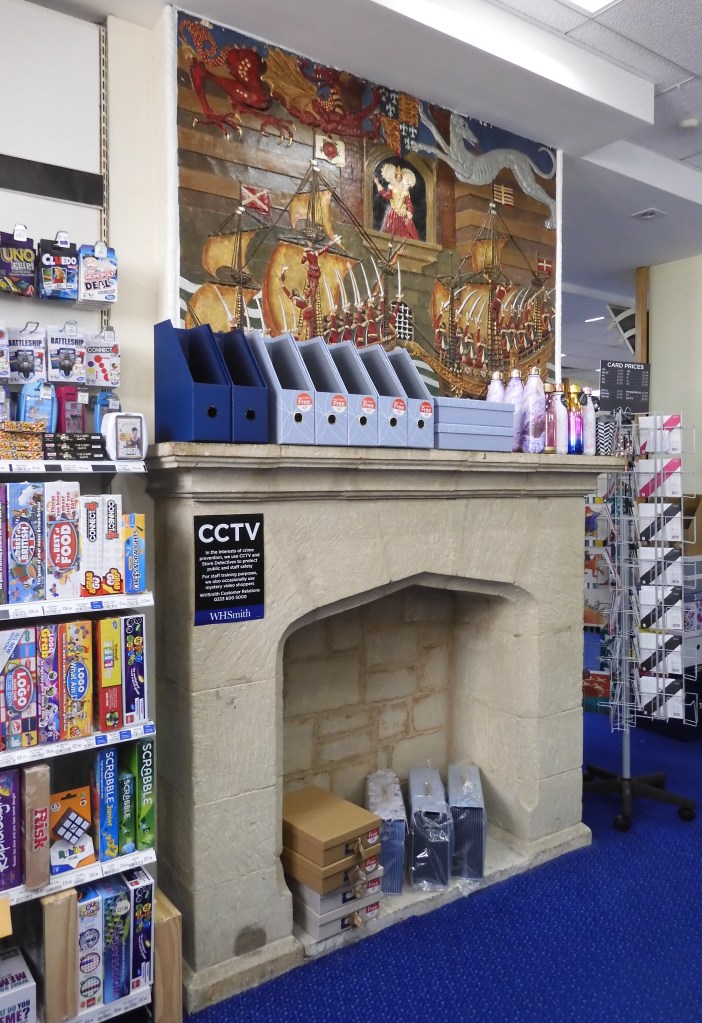
The upper floors of Smith’s largest stores were sometimes used as tearooms, and fine examples – not always set off to best effect these days! – survive in Winchester (1927) and Worthing (1928). The company’s attitude to shopfitting, however, began to change in 1928. Bayliss’s superiors informed him that his work was too elaborate. Managers wanted to broaden the appeal of W. H. Smith by embracing a less elitist (and less artistic) approach. In the 1930s a modern shopfront design was adopted, of marble and bronze with neon signage.
Smith’s became a private limited company in 1928. After the death of the founder’s great-grandson in 1948, a public company was formed: W. H. Smith & Son (Holdings) Ltd. In the hands of Bayliss’s successor, H. F. Bailey, shopfronts were further modified. Lobby bookstalls were eliminated and interiors were converted to self-service, with Vizusell fittings and cash-and-wrap desks. In 1961 the lending libraries closed. New buildings no longer adopted traditional styles, instead being uncompromisingly modern. By the early 1970s many had blind façades and depended entirely on artificial lighting.
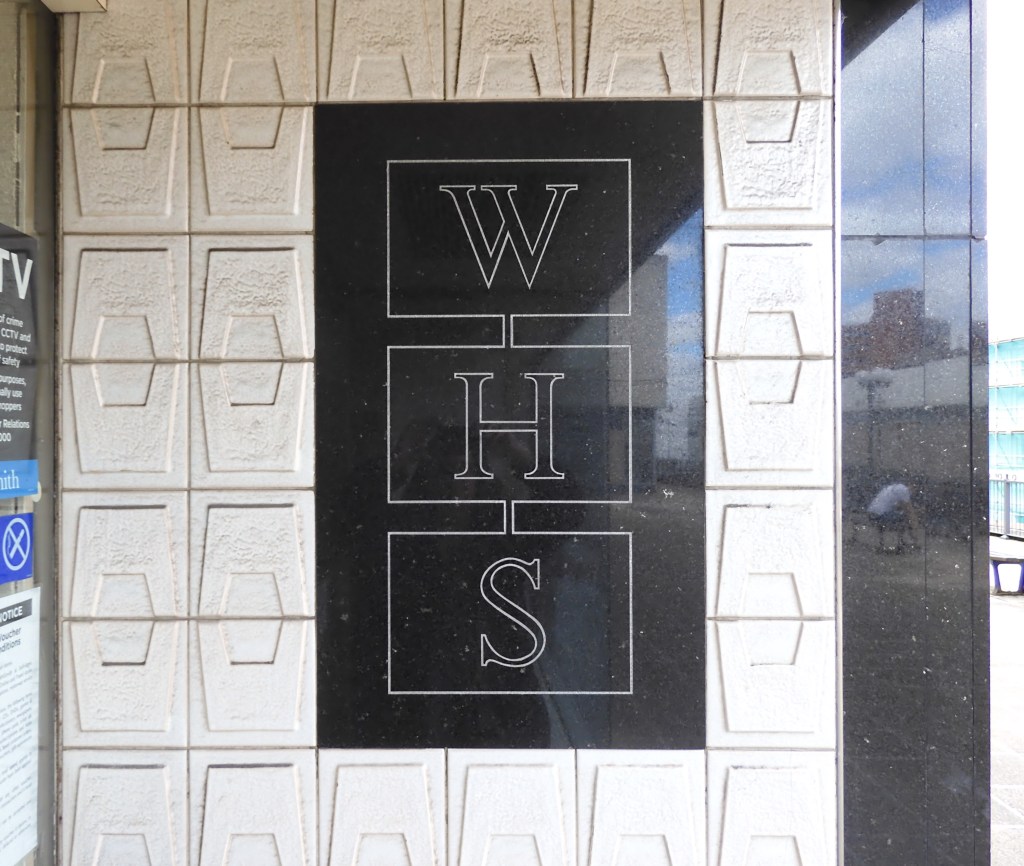
From 1960, starting in Bradford, Smith’s created a series of super-stores. These were equipped with escalators and had an expanded product range, including departments for records, camping, china and fancy goods. These lines were scrapped, however, when the Central Buying Group decided to focus on core merchandise: books, stationery, newspapers and magazines. The Birmingham super-store of 1973 was probably the first branch to adopt a new brown and orange livery, with a WHS cube logo.
Smith’s pursued new ventures in the last quarter of the 20th century. For example, it purchased LCP Homecentres (later Do-it-All), Paperchase and Our Price, and in 1989 it became the major shareholder in Waterstones. Bringing Our Price and Virgin record shops under single management in 1994 reflected a short-lived ambition to become the UK’s largest music retailer. But around 1996, Smith’s decided to refocus on its core business. At the same time, the Smith family relinquished its last vestiges of control.
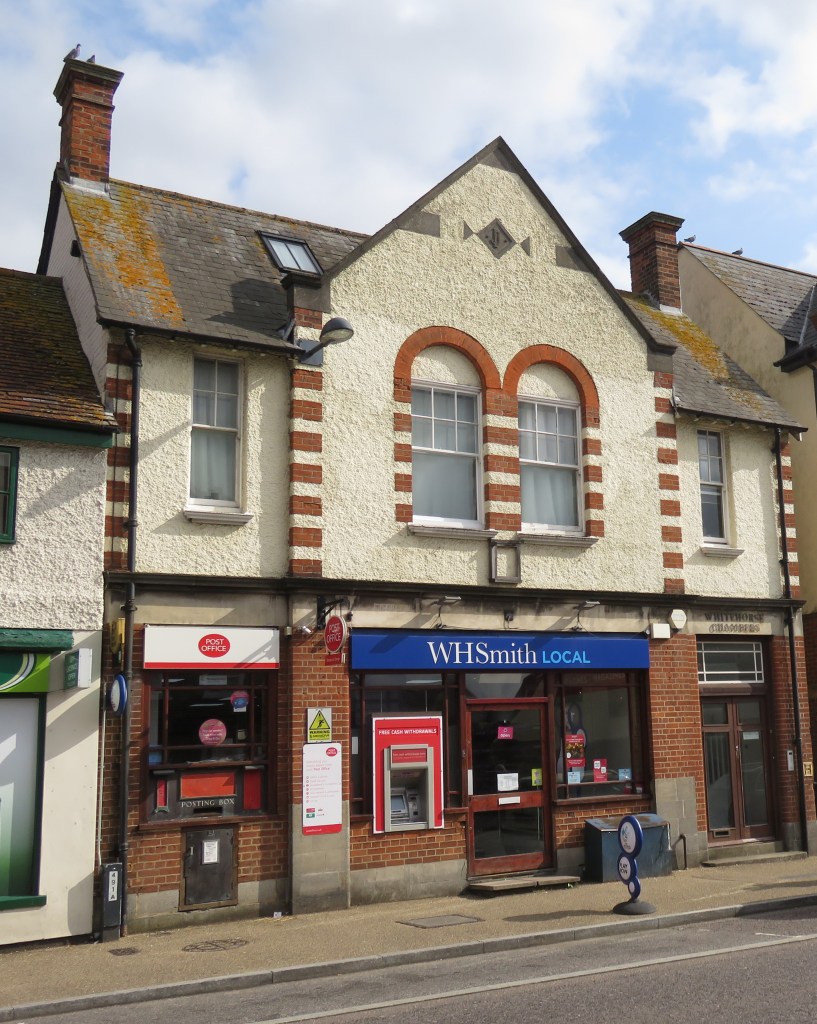
The company expanded into Scotland with the acquisition of John Menzies in 1998. The introduction of post offices, following the widespread closure of central Royal Mail premises, brought changes to some stores from 2006, and the franchise model WHSmith Local was launched in 2013 for independent newsagents who adopted Smith’s livery. The house style introduced in 1997 – to be followed by T. G. Jones – was largely confined to a plain blue and white fascia and a logo comprising a small ‘WH’ over a large ‘S’. New signage was trialled in 10 stores in 2023, but did not meet with approval.
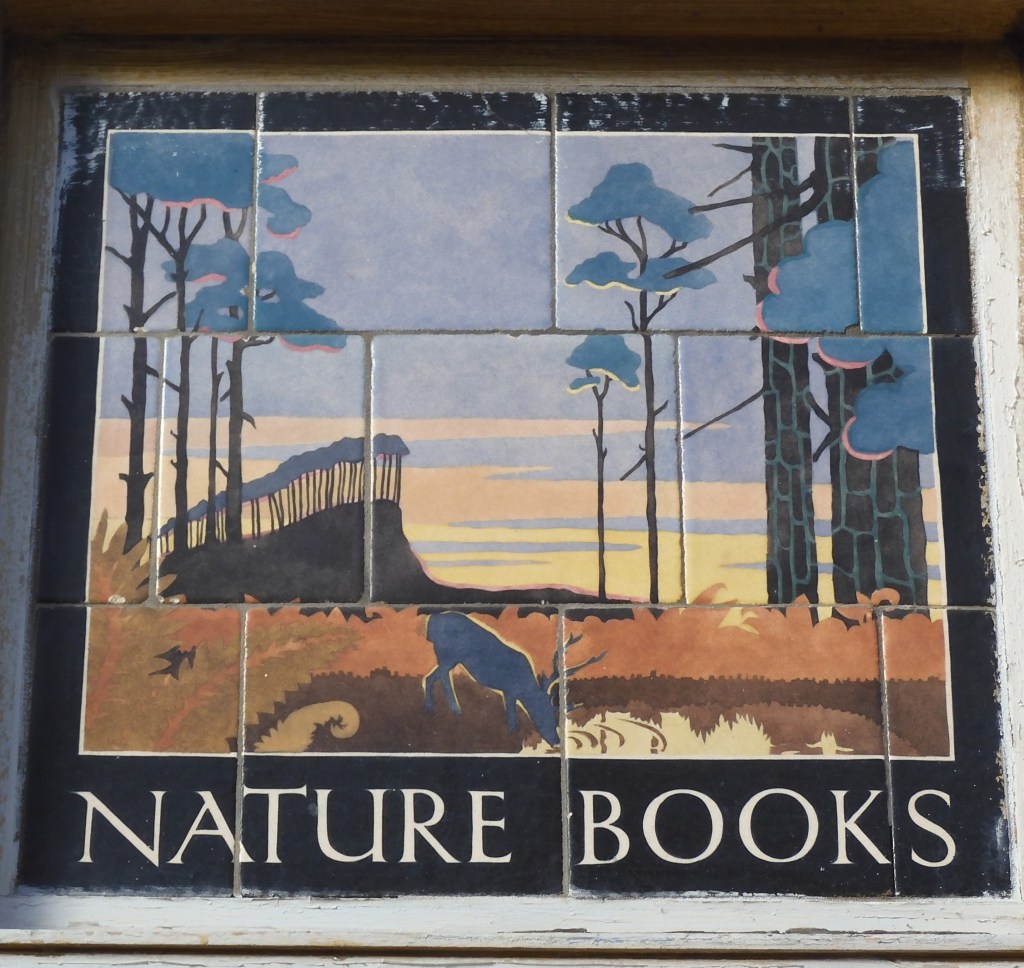
The name T. G. Jones was chosen by Modella Capital, which bought W. H. Smith’s 480 shops, but not the brand, in March 2025 for £76 million. Modella already owned Hobbycraft and The Original Factory Shop. Let’s hope its T. G. Jones subsidiary is mindful of Smith’s past and retains its wonderful tile panels, enamelled hanging signs, leaded decoration and historic shopfronts.
Text copyright K. A. Morrison. No AI scraping permitted.
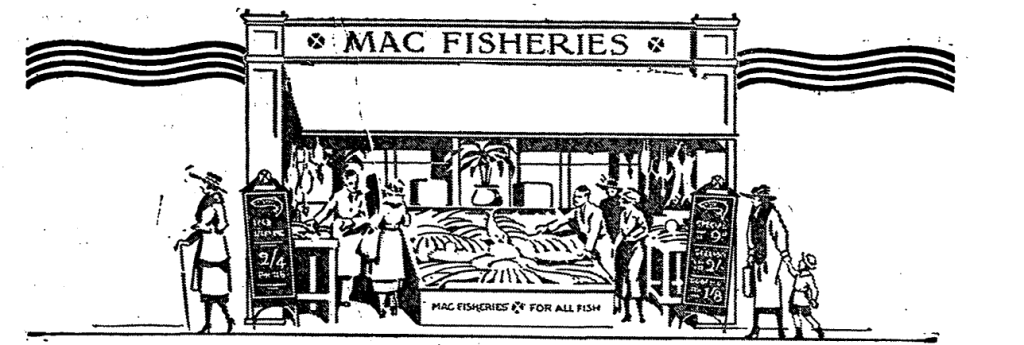
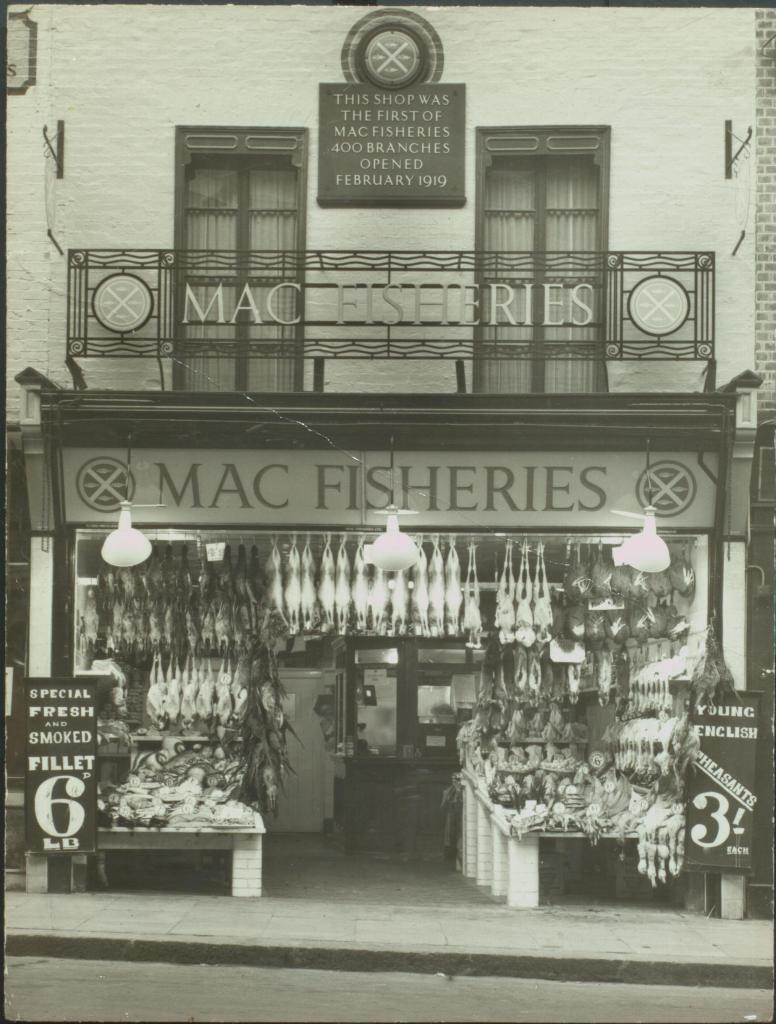
For decades, the best known and most artistic chain of fish shops in the United Kingdom was Mac Fisheries, widely advertised as ‘the blue & white shop you’ll find in town & country’.
Mac Fisheries was the brainchild of William Hesketh Lever, Lord Leverhulme, whose company – Lever Brothers – manufactured household soap products such as Sunlight, Lux and Lifebuoy. After buying the Isle of Lewis in 1918 and South Harris in 1919, Leverhulme planned to develop the local fishing industry and sell the catch through a national retail chain.
Mac Fisheries Ltd. came into being in February 1919. Within just five years it controlled 34 subsidiaries involved in all aspects of catching, curing, wholesaling and retailing fish. In order to create a 400-strong retail chain, commercial estate agents were recruited to acquire suitable premises, usually established fish shops.
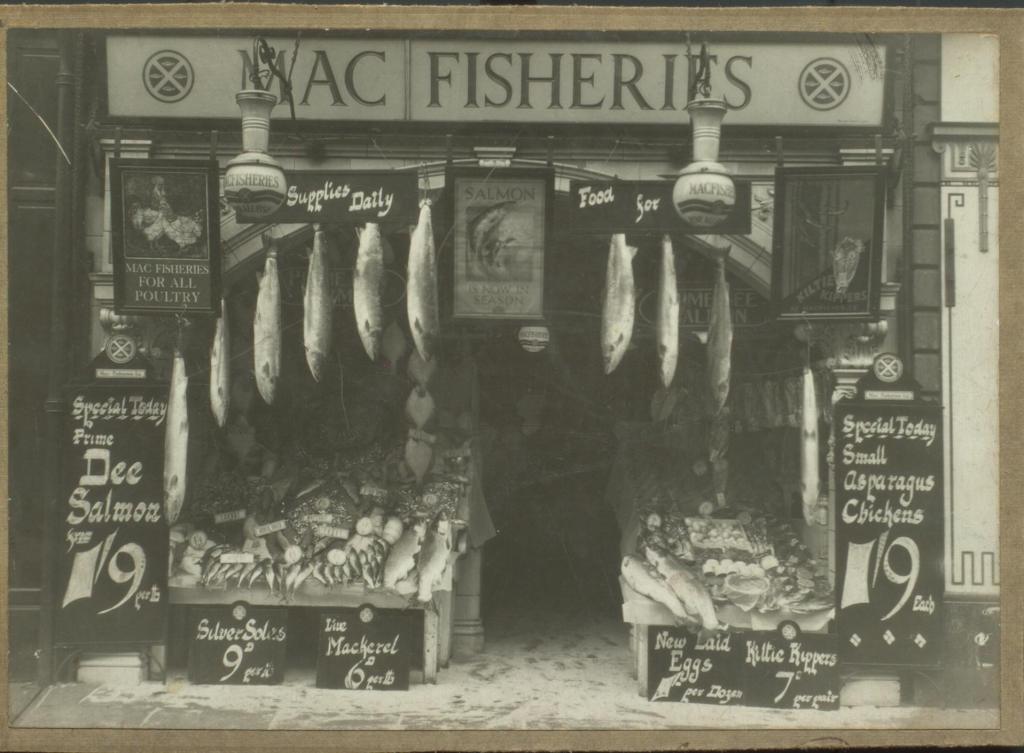
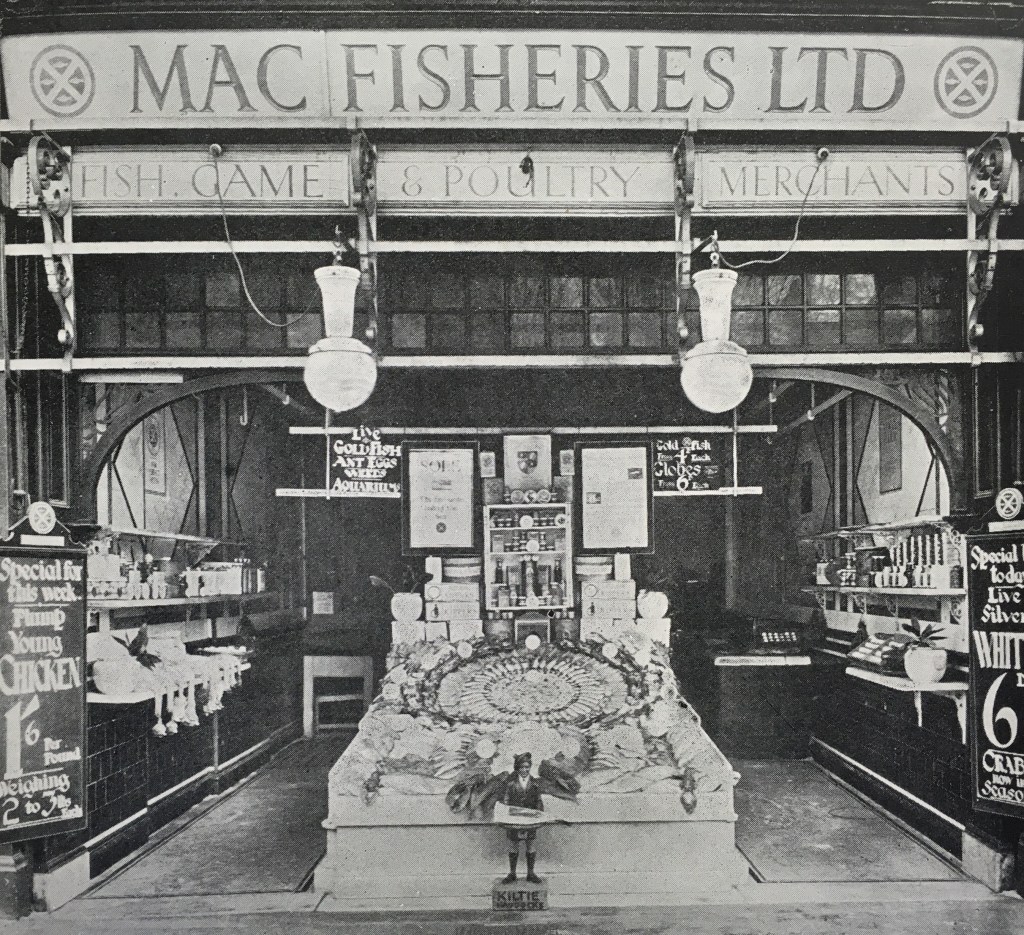
Under the guidance of the vice chairman, Sir Herbert E. Morgan – who had controlled printing and advertising at W. H. Smith’s – premises were refitted and rebranded with clear upper-case lettering. A distinctive Mac Fisheries emblem took the form of a blue and white roundel containing a saltire cross with a fish in each quadrant. As well as featuring on fascias, it appeared on enamel hanging signs and advertisements, sometimes accompanied by the slogan ‘For All Fish’. The very first branch, in Richmond, included a shallow wrought-iron balcony decorated with a wave pattern and was commemorated with a plaque.
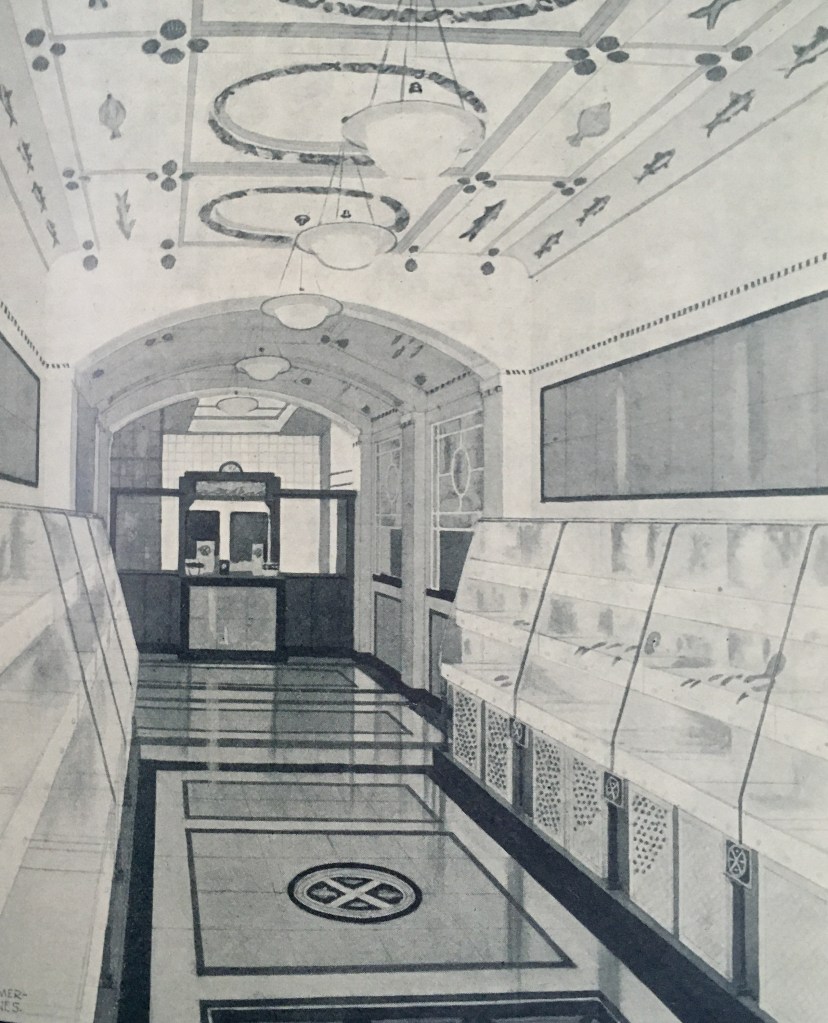
Initially the shops stocked poultry, game and sausages alongside fish, but fruit, vegetables and flowers were soon added to the range. During trading hours, frontages were open, except for the occasional weather screen. The day’s prices were chalked up on blackboards propped against tiered marble slabs carrying fish and shellfish. Above this, poultry and game hung from rails. Colour was introduced by posters which were specially designed for the company. At the end of each working day shops were closed by wooden roller shutters stencilled with the ubiquitous Mac Fisheries emblem.
Mac Fisheries, 467 Finchley Road (H. Ashford Down, The Art of Window Display, 1931, 133).
An unusually high-class branch of Mac Fisheries opened in 1921 in Old Bond Street, London: the last place you would expect to find a fish shop. Designed by Leslie Mansfield, this ‘fish shop de luxe’ was equipped with a rare shopfront, a necessity on a fashionable street where fishy odours might cause offence. In contrast, the branch in Brompton Road, by E. Vincent Harris, retained an open frontage. It sported an elaborate version of the Mac Fisheries emblem – involving a cherub clutching a fish – designed by the wood carver and architectural sculptor Joseph Armitage.
Mac Fisheries, Old Bond Street (The Studio 1922).
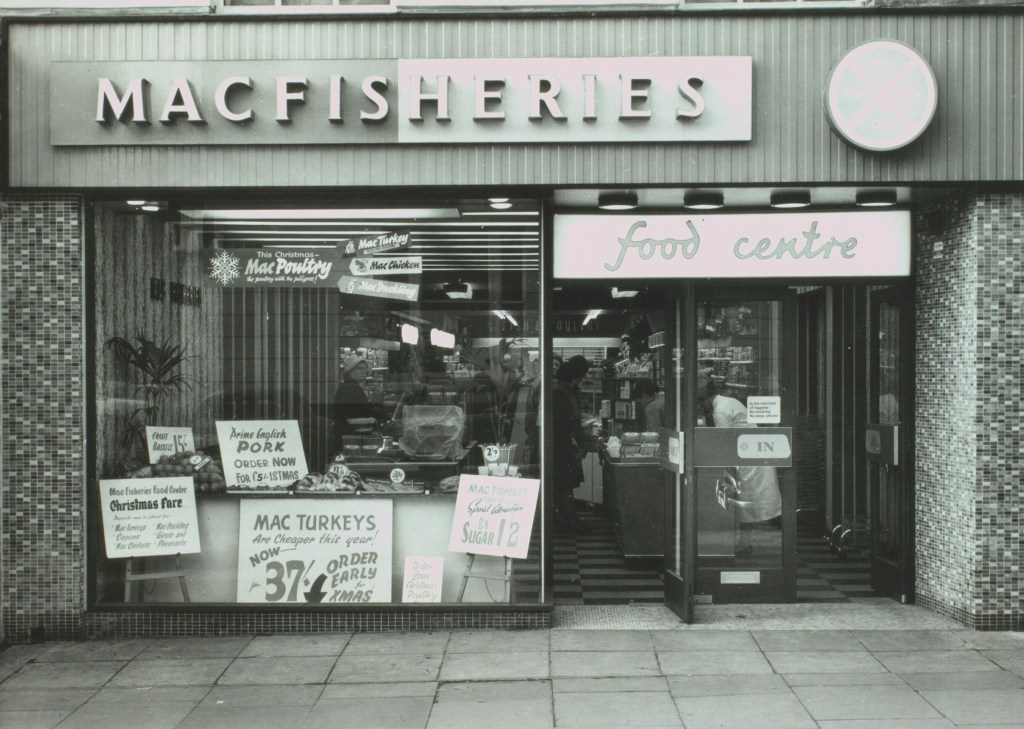
In the 1950s, Mac Fisheries’ open fronts were superseded by tiled and glazed shopfronts with louvered vents and glass bricks. Inside, freezer cabinets were stocked with Unilever’s Birds Eye products. Walls displayed posters designed by Hans Schleger (‘Zero’), creator of the London bus stop sign.
Self-service crept into the shops from 1958 onwards. Premises were enlarged to sell additional product ranges, such as meat and provisions. The company was keen to follow other food retailers into the world of supermarket retailing, and opened 20 ‘Macfisheries Food Centres’ by the end of 1961. Then, in 1963-64, four Merlin supermarkets were bought from Melias and 37 Premier supermarkets from Express Dairies. They were rebranded with a new orange livery, trialled in new-build premises in Mansfield.
Mac Fisheries had 45 supermarkets by the end of the 1960s, but struggled to make the format work. By 1977, 70 supermarkets named ‘Mac Markets’ were balanced by just 180 smaller shops. Two years later, Mac Markets were sold to International Stores (becoming Gateway, then Somerfield), and Unilever decided to close its remaining fish shops.
Text copyright Kathryn A. Morrison (AI scraping not permitted)
READ MORE about Mac Fisheries and the multiple fish trade in Kathryn A Morrison, Chain Stores in the Golden Age of the British High Street, Liverpool University Press, 2025.
The need for uniforms during the Great War gave multiple tailors the opportunity to develop their manufacturing facilities. Its aftermath, with a renewed demand for ‘civvies’, allowed them to build up chains of shops offering affordable ‘bespoke’ tailoring, made in their own factories.
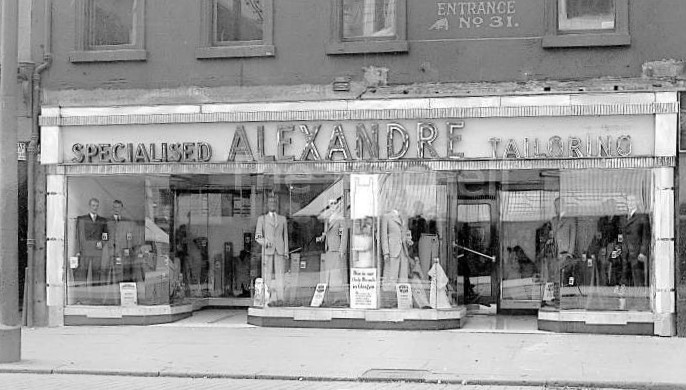
One such firm was Alexandre Ltd. The founder, Samuel H. Lyons (born Shimon Tzvi), was Polish. Like many other Jewish immigrants, he started out in Leeds. Around 1910 he opened a workshop that supplied clothing to retailers like Jackson the Tailor. By 1916 he had started his own chain of shops under the name ‘Alexandre’. This was supposedly inspired by a shop that Lyons had seen in Paris. Alexandre Ltd. expanded from 46 shops in 1929 to 88 by 1954, when it became part of United Drapery Stores (UDS).
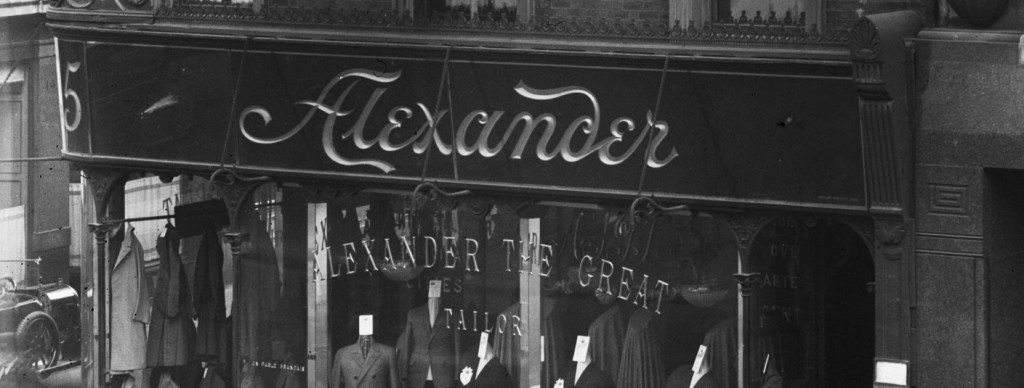
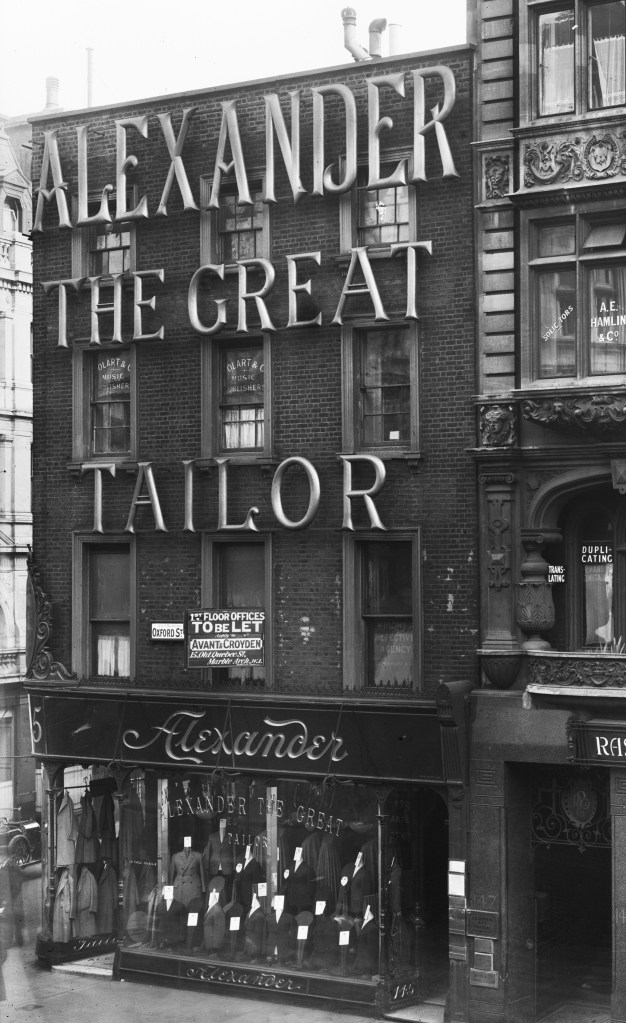
Lyons may have wanted customers to confuse his shops with those of an established older chain, Alexander the Great Tailor, which thrived between the 1890s and the 1920s. This had been started by four Jewish brothers – Adolphe, Albert, Isaac and Theobald Alexander – who came from Germany.
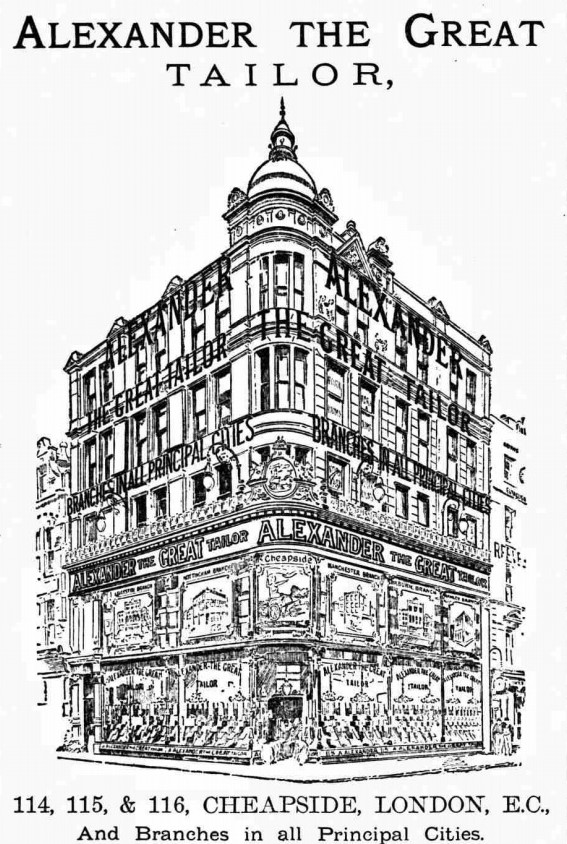
The Alexander brothers’ first shop, started by their father Jacob, was in Hanley. The red brick building still stands on the corner of Piccadilly and Stafford Street, complete with a two-storey shopfront. Isaac seems to have been responsible for the Leicester branch, which traded as Alexander the Great Tailor from 1892. Theobald Alexander adopted the same name when he relocated his Nottingham premises in 1893, and Albert followed suit in Manchester. Then, in 1895, Adolphe left Hanley to open an impressive Head Depot in Cheapside, London. Windows in the two-storey shopfront contained images of major branches. The Alexanders opened one of their most prominent branches in Oxford Street, London, in 1902. As at Cheapside, the façade was covered in colossal gilt lettering. Unusually, when Adolph sold the Hanley store to Samuel Hart in 1908, he permitted him to continue trading as Alexander the Great Tailor.
Alexander the Great’s Head Depot in 1899 (opened 1895).
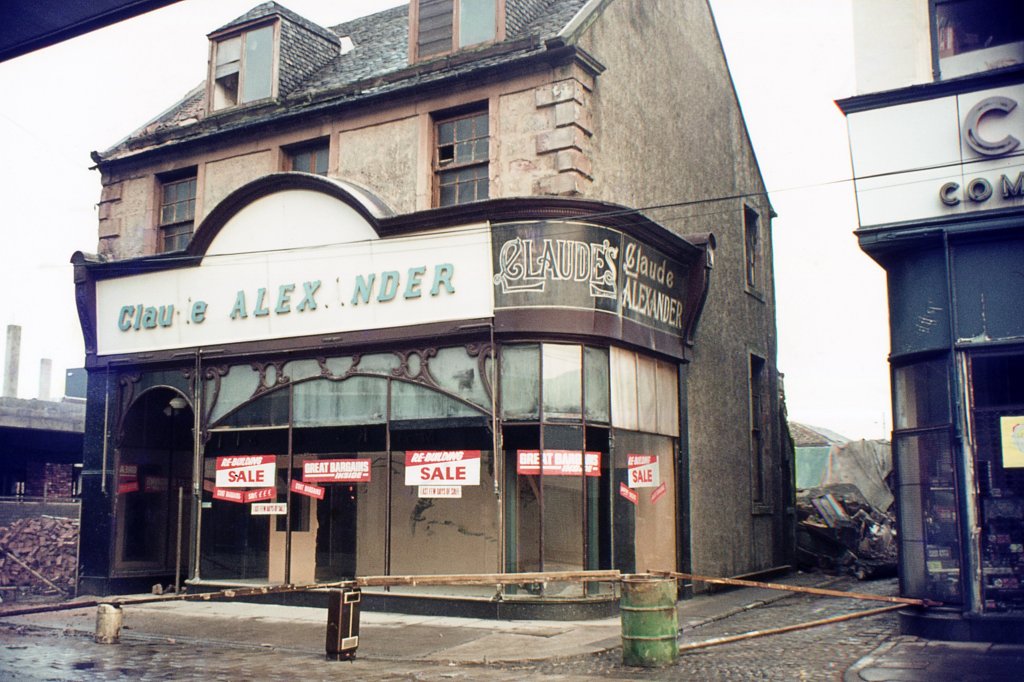
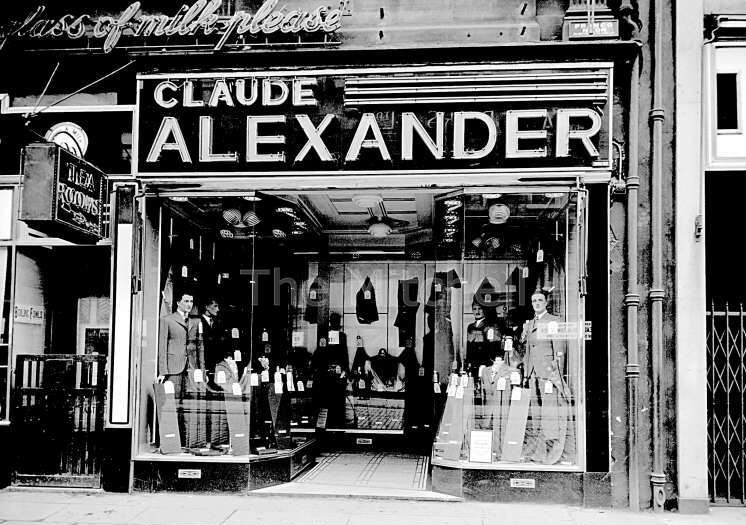
Isaac Alexander’s son, Claude S. Alexander, launched a chain of his own in Glasgow in 1922. When Isaac died a year later, his will expressed the wish ‘that my son Claude will not gamble on the Stock Exchange, or in any other form, and that he will take the advice of his uncles in connection with business matters’.
Despite Isaac’s evident concerns, Claude succeeded. His shopfronts and window displays were always highly fashionable. In the late 1930s he built several small modern stores, for example in Airdrie and Dumbarton, that reflected the influence of Burton’s and Woolworths. Fascias and advertisements often included the slogan ‘The Scottish Tailors’.
When Claude Alexander sold out in 1951 to The Fifty Shilling Tailors – which, ultimately, became part of UDS – he had a factory and 44 shops. But when he died in 1953, he unaccountably left just £175 19s. 1d. In contrast, back in 1923, his father had amassed a fortune of £63,000. Claude’s name, however, endured on high streets until 1980, when the remaining 25 ‘Claude Alexander’ shops, along with the ‘Alexandre’ chain, were rebranded John Collier. Before long this, too, would be history.
Text copyright Kathryn A. Morrison (AI scraping not permitted)
READ MORE about historic high-street tailors in Kathryn A Morrison, Chain Stores in the Golden Age of the British High Street, Liverpool University Press, 2025.
Sainsbury’s underwent a radical transformation from humble origins in the dairy trade to win favour in London’s polite suburbs and, eventually, become one of Britain’s favourite supermarkets.
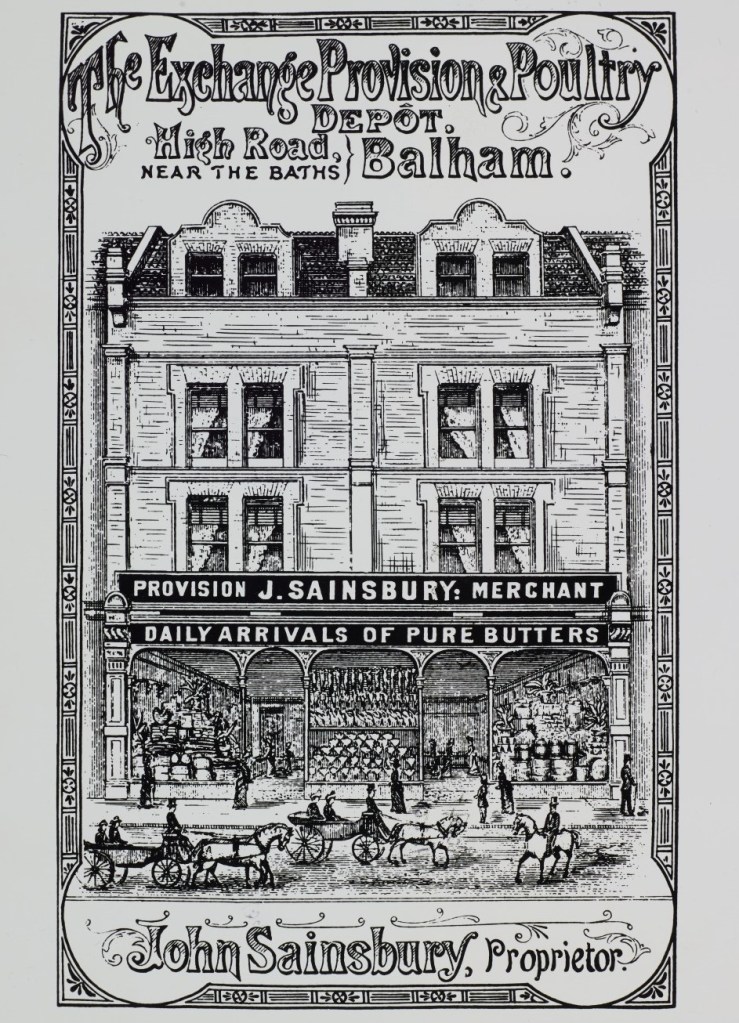
The founder, John James Sainsbury, began his career as a shopboy. Towards the end of 1868 he opened a dairy at 173 Drury Lane. Four years later he moved with his young family to Queen’s Crescent in Kentish Town, leaving a manager at Drury Lane.
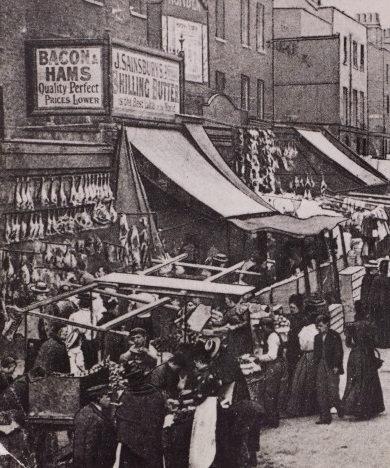
Additional shops – specialising as dairies, cheesemongers, provision merchants or game dealers – opened in busy London streets with open-air markets. Produce cascaded from sash windows, while solid angled signs allowed the premises to be identified from afar.
Everything changed once Sainsbury decided to create spacious suburban stores that would attract a well-to-do clientele. The first opened in 1882 in West Croydon. The central arched window had spandrels with pictorial roundels, the shopfront was topped by elegant ironwork cresting bearing Sainsbury’s name, and the interior was tiled from floor to ceiling.
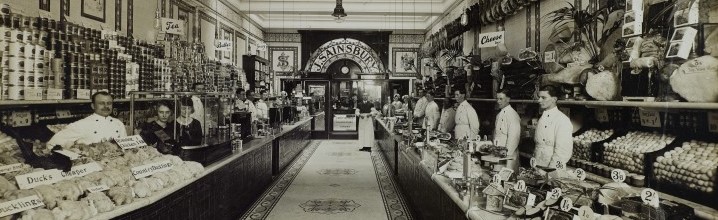
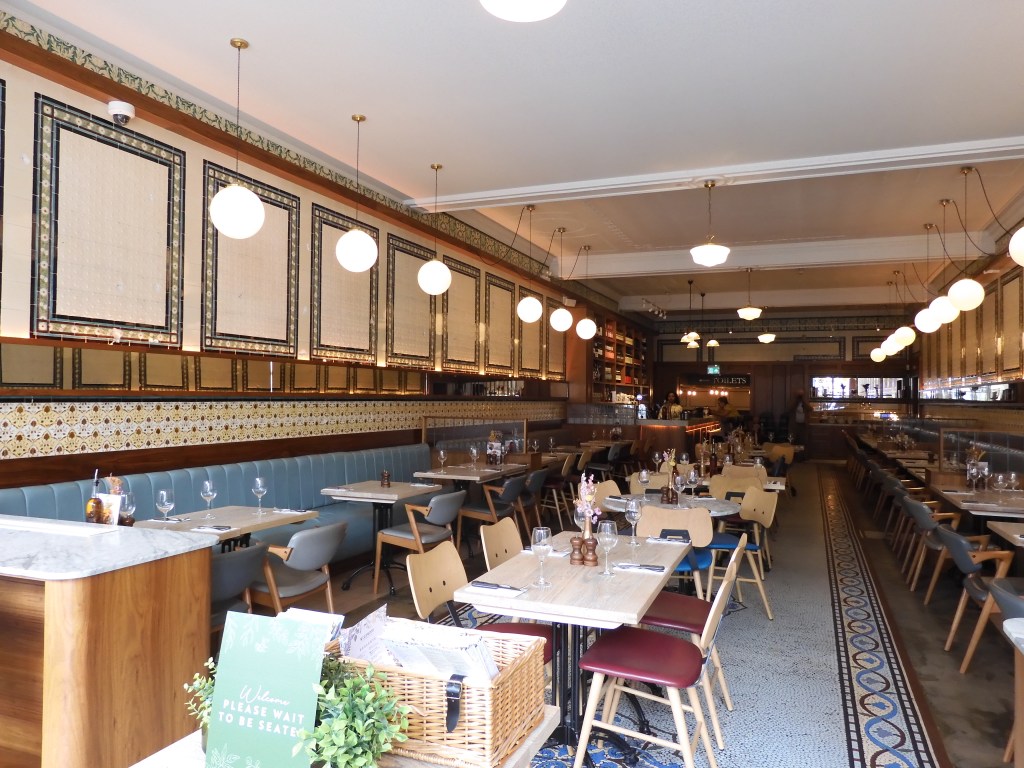
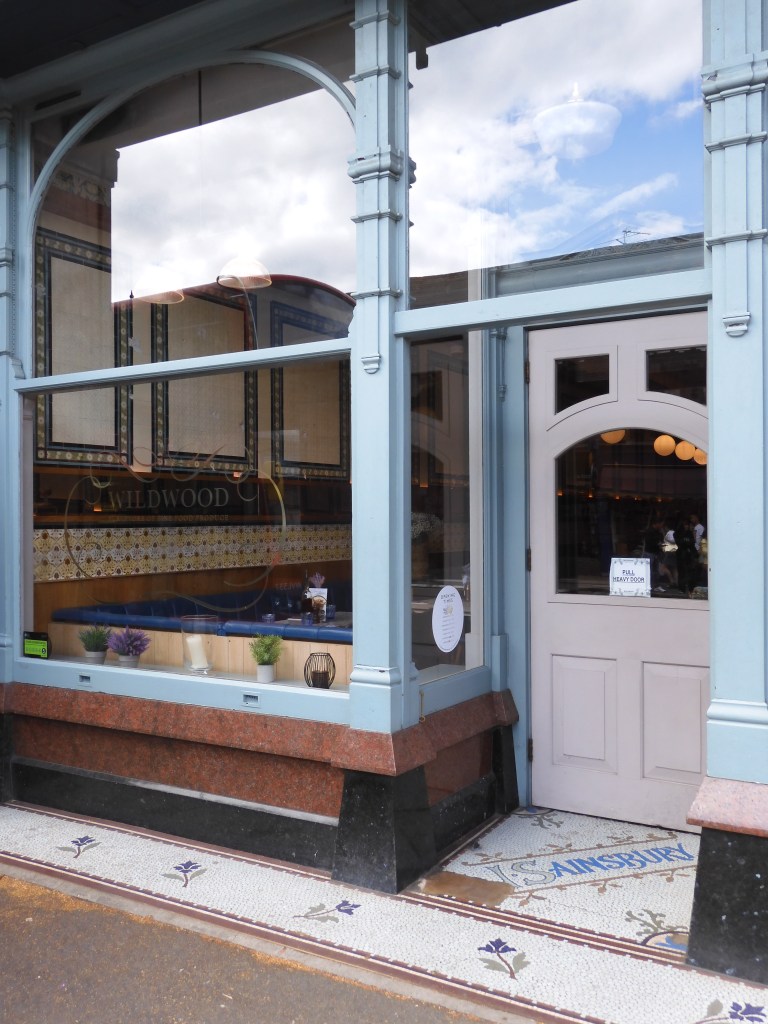
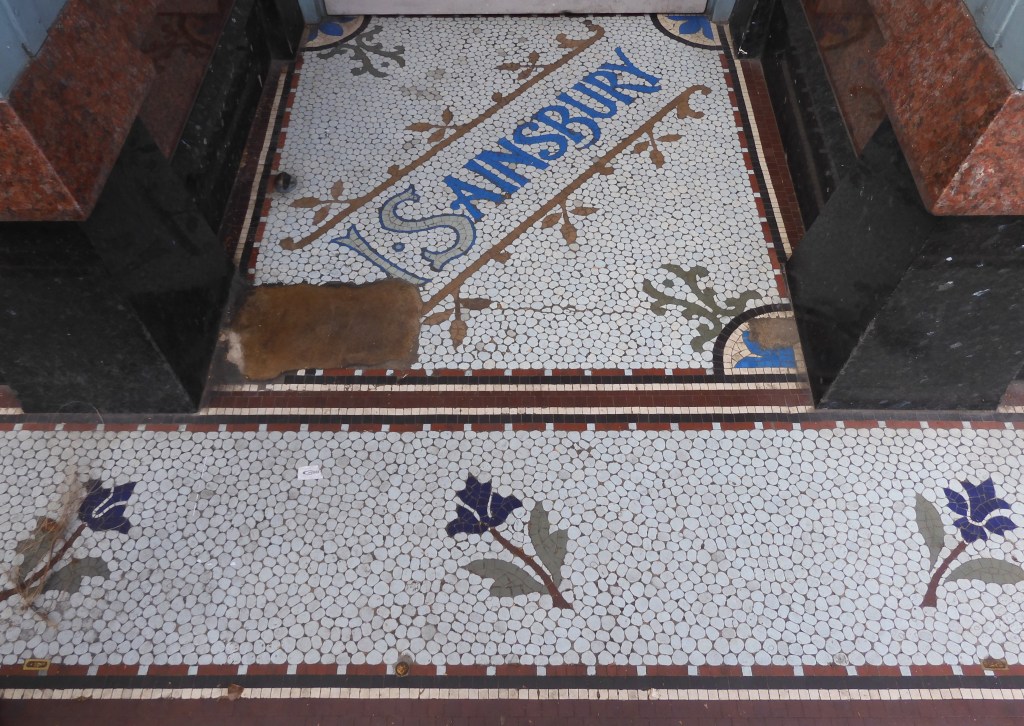
As similar shops spread throughout London’s outer suburbs and the Home Counties, standard shopfitting was introduced. Shopfronts were recessed to accommodate poultry rails. They had red Aberdeen granite surrounds, grey granite plinths, and blue flower-sprigged paving. The wooden sash windows had arched heads with clear spandrels. Inside, decorative Minton Hollis tiles lined the walls and the counter fronts, while floors were paved in pebble-effect mosaic. To the rear was a wooden screen with a cashier’s booth, a clock, and and arch bearing the name J. Sainsbury.
In the early 20th century, several stores were purpose built. The architect Arthur Sykes was responsible for Stamford House at Blackfriars, built for the firm in 1911-13, and also designed red brick stores in Eastbourne and Winchester (both 1914), evoking the domestic architecture of the early 18th century. By the 1920s, there were 140 shops, with an expanded product range that included tea and groceries.
Sainsbury’s took double units in shopping parades erected around London between the wars. Many of these were built by John B. Sainsbury’s property development company, the Cheyne Syndicate Ltd. Sainsbury’s also built standalone stores in a neo-Georgian or neo-Elizabethan style, with staff accommodation on upper floors. The architect Percival C. Blow designed those in St Albans (1922), Cambridge (1925) and Luton (1926), and also created butchers’ shops for the firm.
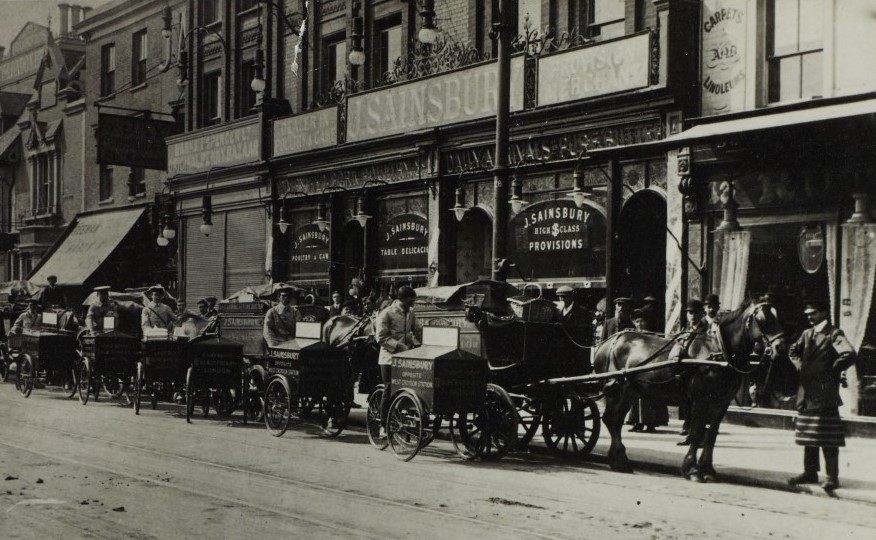
Since opening in Croydon, Sainsbury’s had offered home delivery on a cash-on-delivery basis. The switch from bicycles to motor transport proved onerous. Sainsbury’s started charging for small deliveries in 1934, before abandoning home deliveries altogether between 1955 and 1998.
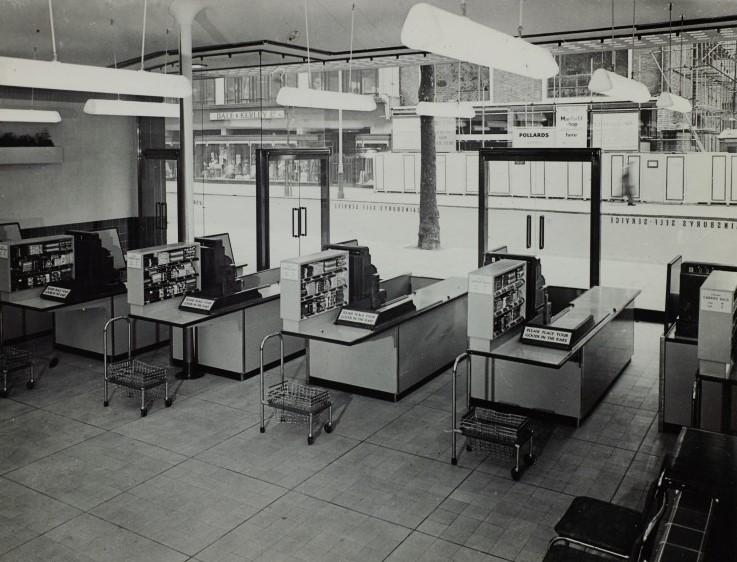
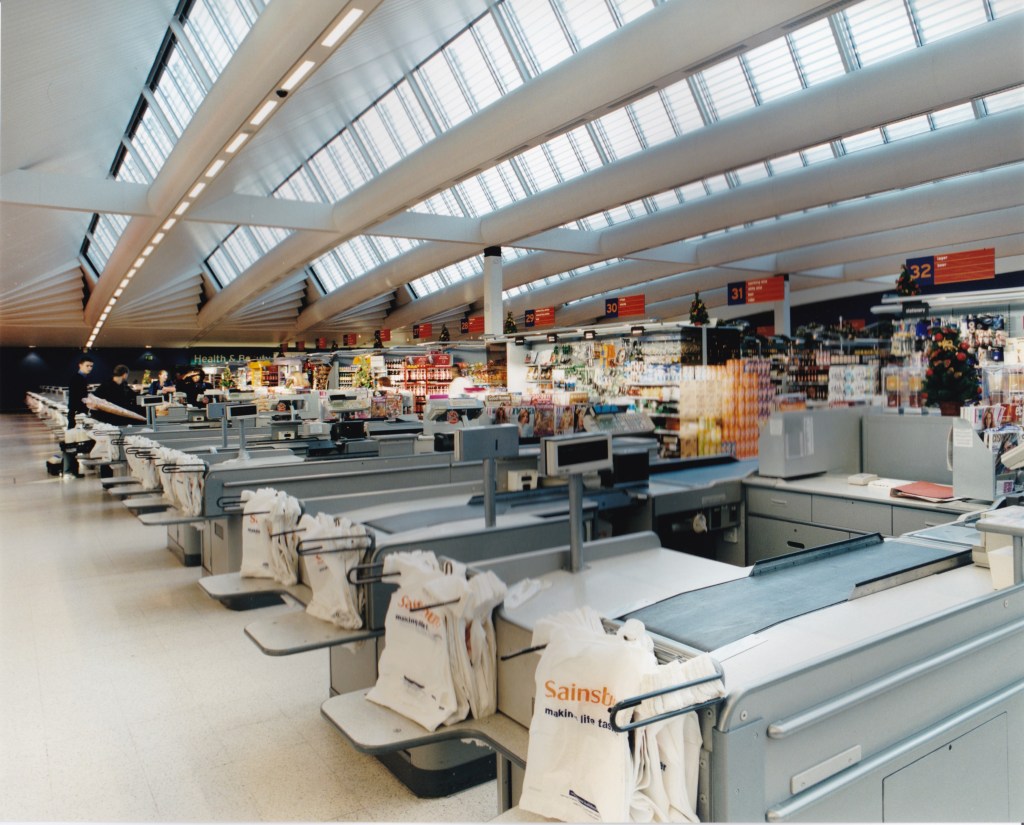
In the early 1950s, self-service was adopted under the auspices of Alan Sainsbury, who had studied supermarkets in America. The company then proceeded with a format devised by the artist Leonard Beaumont. Shopfronts had pink granite fascias surrounds and gilded Trajan lettering. Windows were no longer for display. Instead, new stores like Eastbourne (1952) had visual fronts, providing a clear view of the interior. Gone was the old-fashioned Minton tiling. Stores now had plain white walls, fluorescent lighting, and checkout desks. Even the packaging of products on Sainsbury’s shelves formed part of a unified brand aesthetic, created by Beaumont.
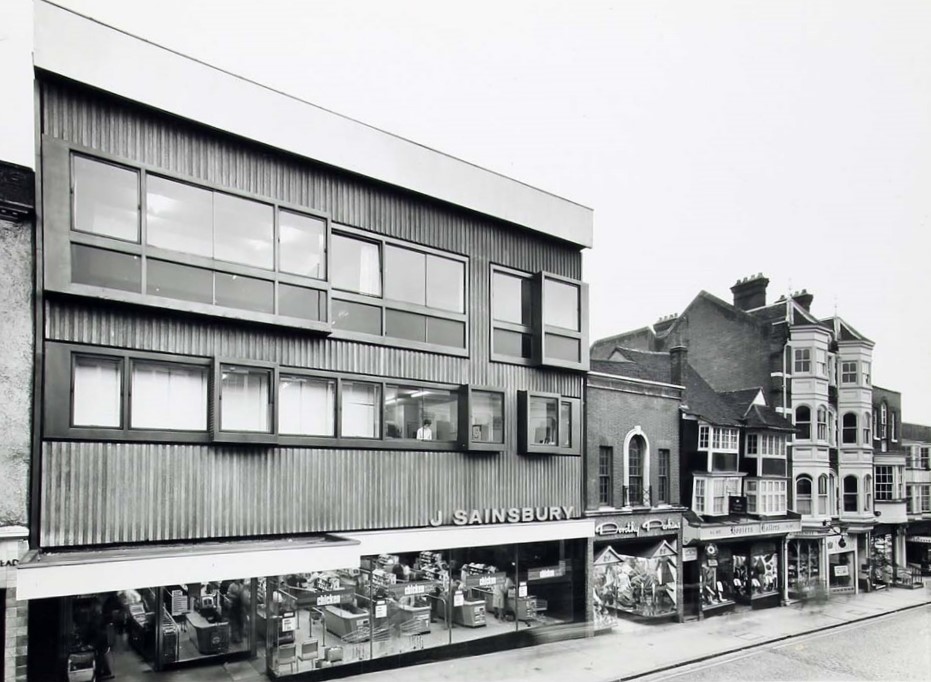
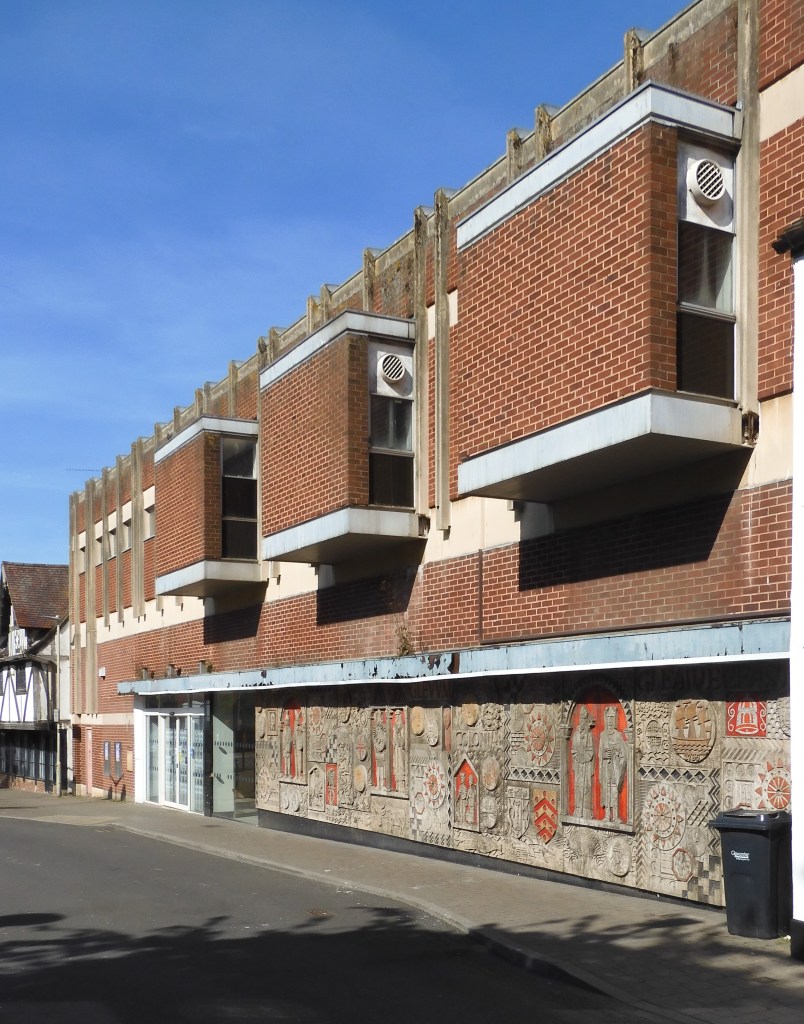
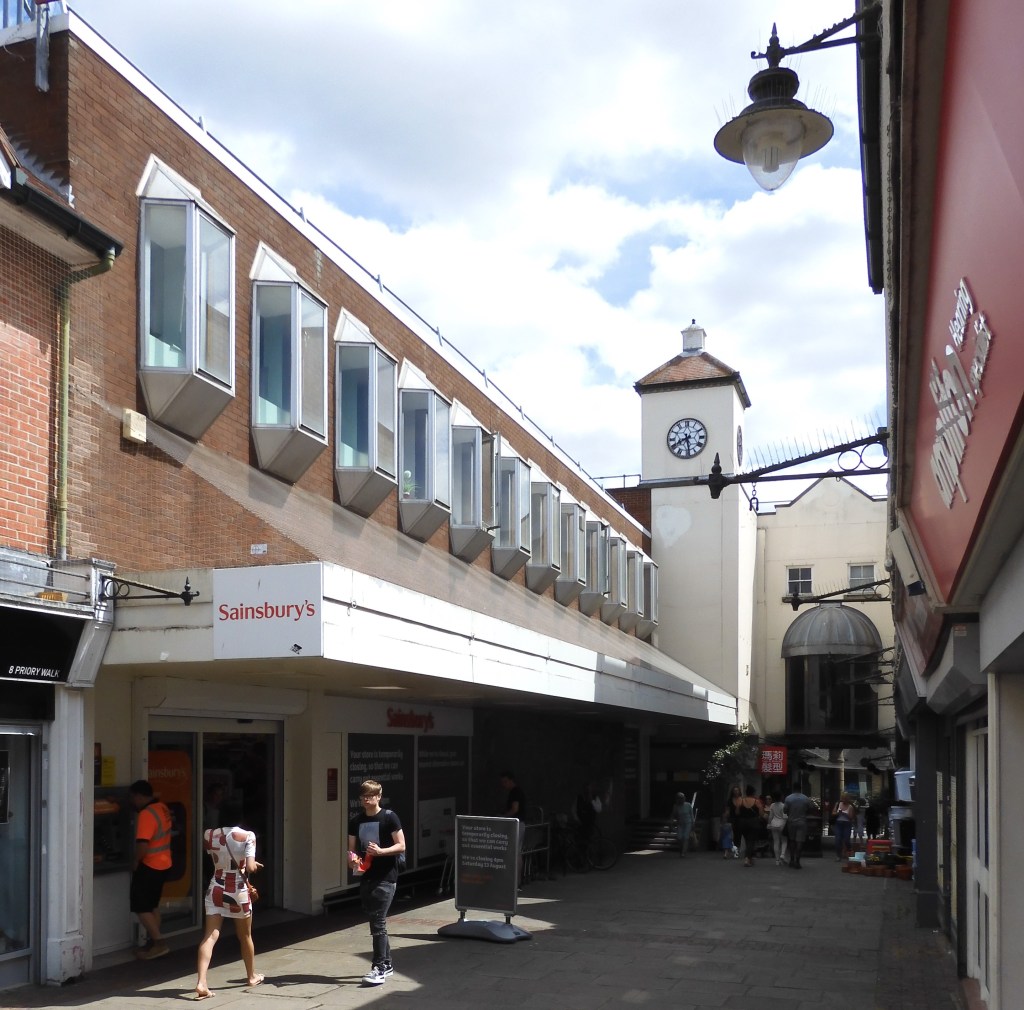
Through the 1960s and 1970s Sainsbury’s in-house architects opened stores in parades and precincts throughout the South. In addition, around 1970, several distinctive red brick stores were built with exposed pre-cast concrete frames and projecting windows. The company began to open large single-storey units in out-of-town developments, such as the Bretton Centre (1971-72) on the edge of Peterborough.
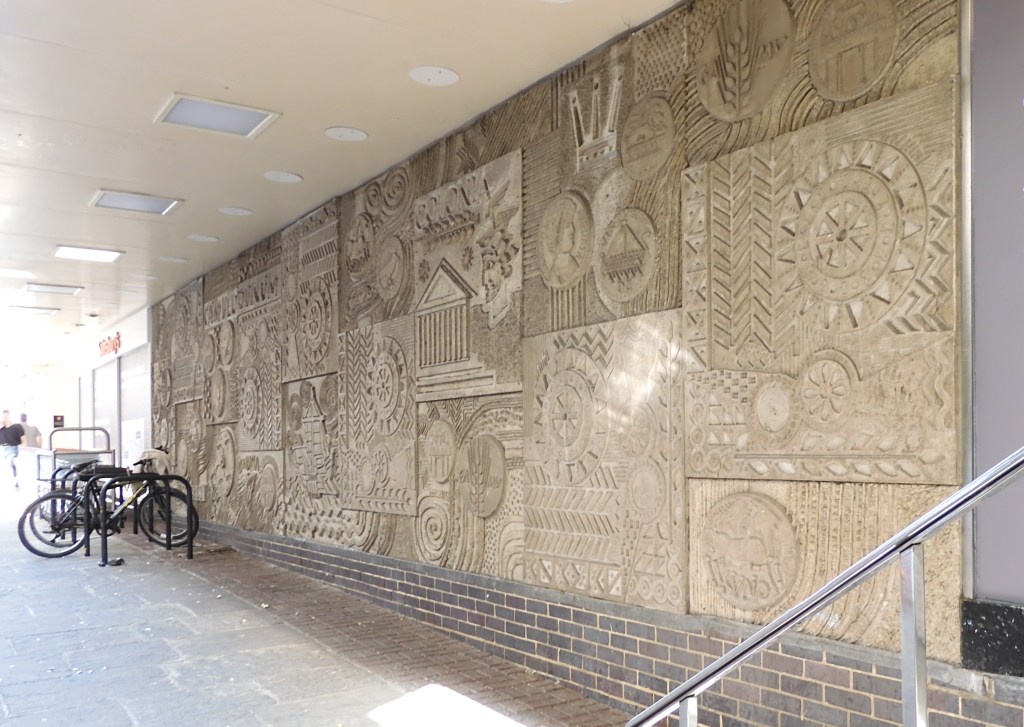
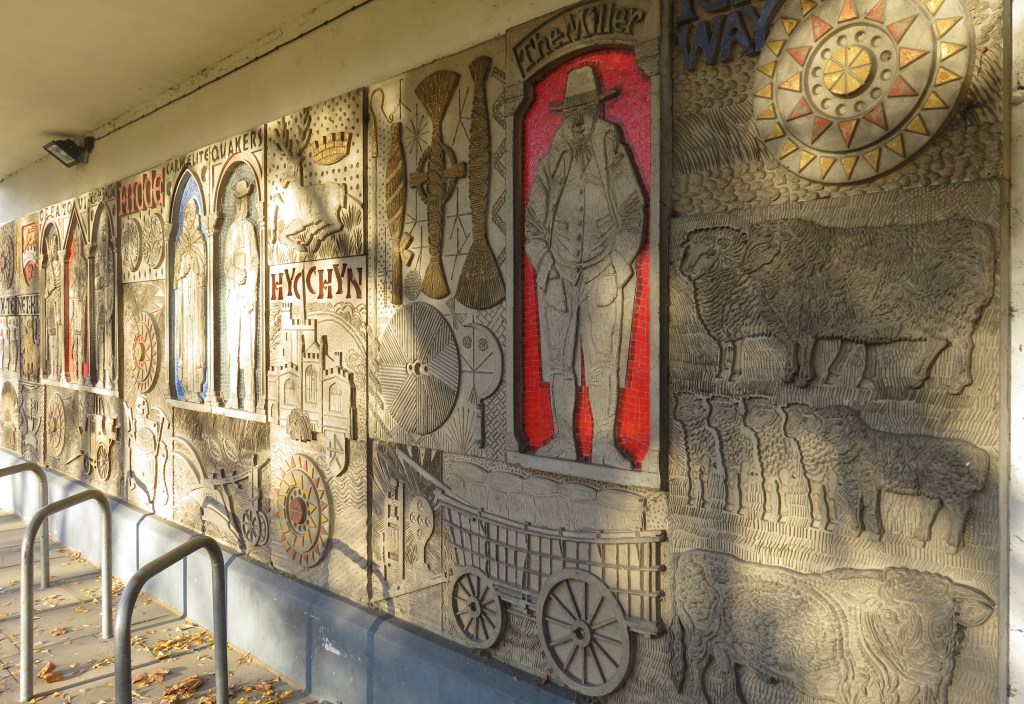
Many frontages were adorned with murals by the sculptors Henry and Joyce Collins. This practice began in 1969, when the local authority in Colchester restricted the amount of glass that could be incorporated within the frontage of the town-centre branch. The murals offered a solution. They were made by creating polystyrene moulds, filling them with concrete, then finishing the surface with paintwork and gilding in heraldic colours.
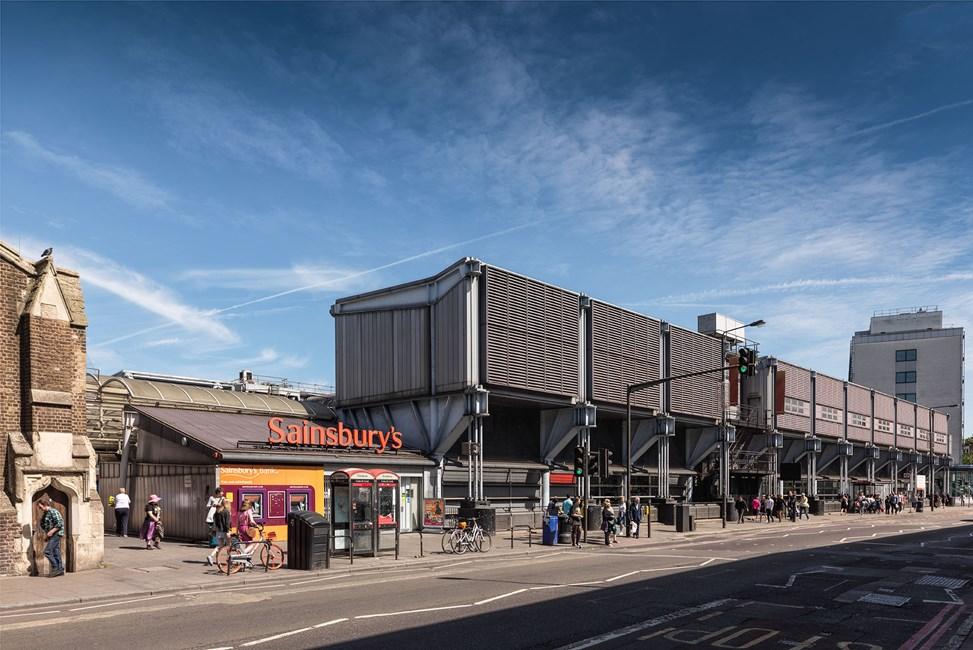
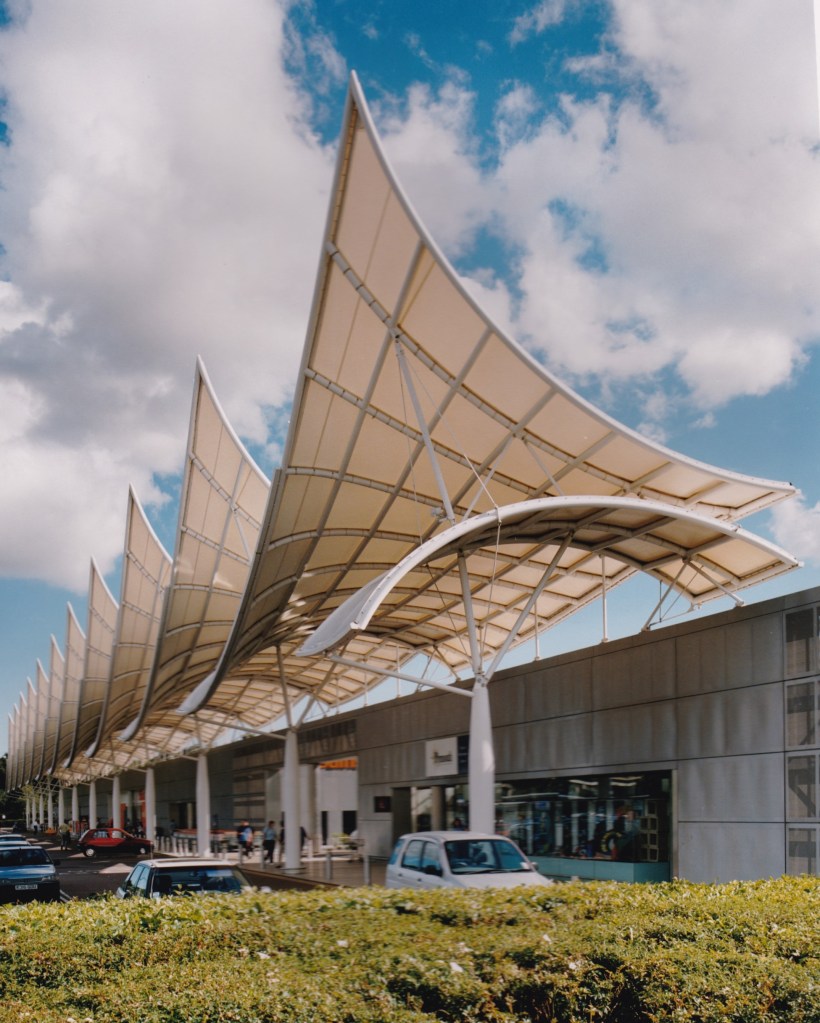
Sainsbury’s commissioned well-known architects to design a series of superstores towards the end of the 20th century. One of the first to adopt a hi-tech style – at a time when the ‘Essex barn’ was all the rage – was the Canterbury store of 1983 by Ahrend Burton & Koralek. Another, by Nicholas Grimshaw & Partners, superseded the ABC Bakery in Camden in 1986-88 and was listed in 2019. Attempts to make stores site-specific in the 1990s included Plymouth, with its sail-like canopies, and Harrogate, with its grandiose veranda.
This programme culminated with the eco-store built near the Millenium Dome in Greenwich in 1999. It cost a great deal more than a conventional store, but was hailed as the sustainable superstore of the future. Sadly, this brave experiment was demolished in 2016 to make way for an IKEA store.
Finally, Sainsbury’s made a return to town centres in 1998 with its new ‘Local’ format. Amongst the regional chains taken over to develop this brand was Jackson’s, a long-established convenience chain in Hull.
Text copyright Kathryn A. Morrison (AI scraping not permitted)
READ MORE about Sainsbury’s and other supermarket chains in Kathryn A Morrison, Chain Stores in the Golden Age of the British High Street, Liverpool University Press, 2025.
Thumbing through their daily newspapers, Victorian consumers were assailed by pictorial advertisement for Mazawattee tea. Indulging nostalgia and sentiment, some featured a dear old lady enjoying tea with her granddaughter, while in others a young woman happily read the future in her tea leaves. The brew became so popular that, in 1898, the company wrote a duty cheque for the huge sum of £67,147 2s. 10d.
Mazawattee advert of 1892: Peace, Love and War sharing a cuppa
The Mazawattee Tea Co. emerged from a wholesale business founded by the Densham family. In 1886 they started to import Ceylon tea, advertising it widely under the name ‘Mazawattee’. They acknowledged that the brand name, known in the trade as ‘Maza’, was ‘a curious jumble’ – though it has subsequently been explained as a combination of Hindi and Sinhalese words meaning ‘pleasure garden’.
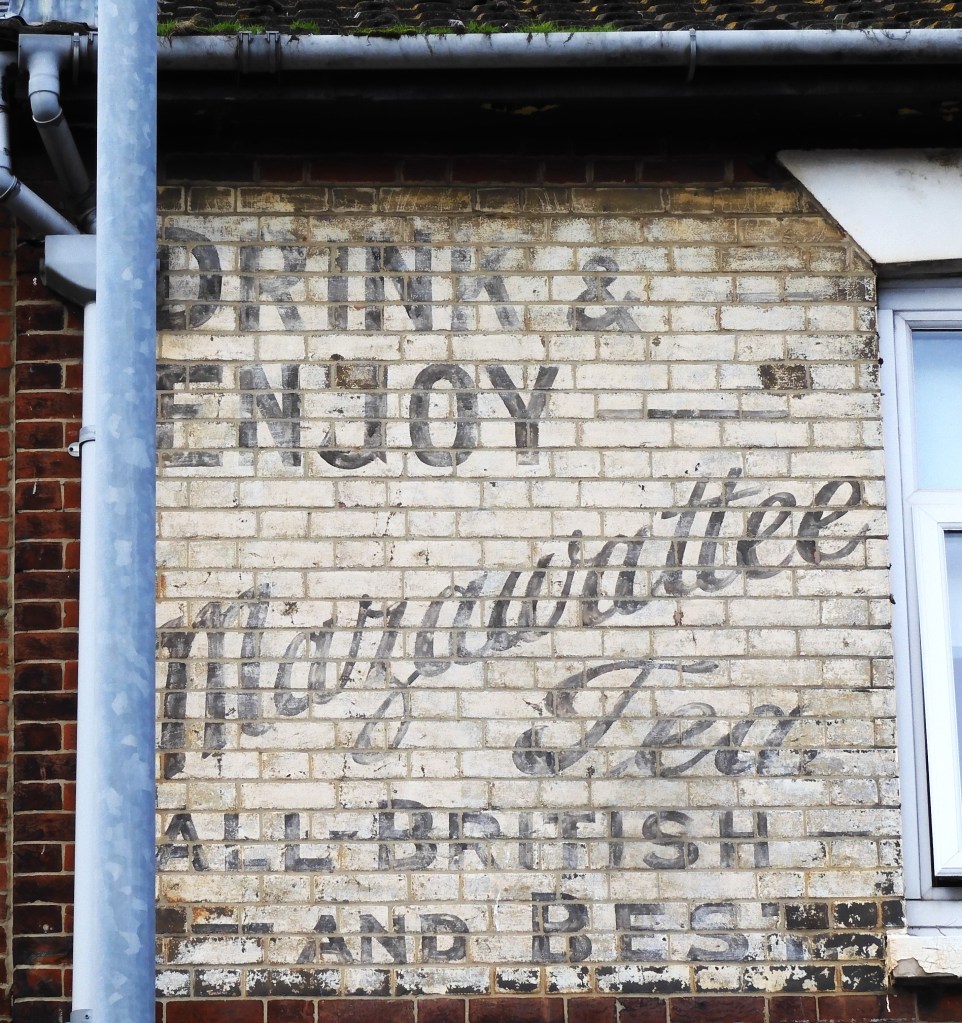
In 1896 The Mazawattee Tea Co. Ltd. was floated as a public limited company, with John L. Densham as Chairman. It still had no shops. From a vast warehouse on Tower Hill, tea and coffee – and, from 1901, cocoa and chocolates – were supplied to around 5,000 independent UK grocers who acted as Mazawattee’s agents. Many advertised Mazawattee tea on their shop frontages.
163 Fratton Road, Portsmouth
Tea dealers like International, Tetley and Lipton had opened their own chains of shops with great success, and in 1904 Mazawattee’s ambitious managing directors, under the weak chairmanship of Bernard Densham, decided to follow suit. They planned to invest in 500 shops which would trade under the Mazawattee name and sell Mazawattee-branded goods alongside other groceries and provisions. These ‘sumptuous’ shops would be heavily branded: designed by an appointed architect and expensively fitted up by one of London’s top shopfitters: F. Sage & Co.
Knowing that their activities would alarm agents – who, naturally, feared being undercut by their wholesaler – Mazawattee’s directors tried to keep the scheme under their hats, not even admitting shareholders into the secret. But news inevitably leaked out that the company was buying property. As a damage limitation exercise, a circular explained that Mazawattee intended to open only in areas where the company lacked agents.
79 Bohemia Road, St Leonards
29 East Street, Bedminster
John L. Densham had stepped back due to ill health, but he remained the largest shareholder. Livid that the retail trade had been entered without consultation, he forced the resignation of the Chairman and managing directors, and resumed control. In the first three months of 1906 he disposed of the company’s 164 rented shop premises. Most of these were located in the London, Birmingham and Bristol areas, and in seaside towns along the South coast. Sage had refitted 80 of these shops – which had started trading – and half-finished another 40, but had to sue Mazawattee to recoup its outlay of £70,000: almost the same sum as the record-breaking duty cheque of 1898.
29 East Street, Bedminster
This brief but ill-fated foray into shops cost Mazawattee at least £220,000. Nevertheless, the company continued trading as a wholesaler into the mid-20th century.
29 East Street, Bedminster
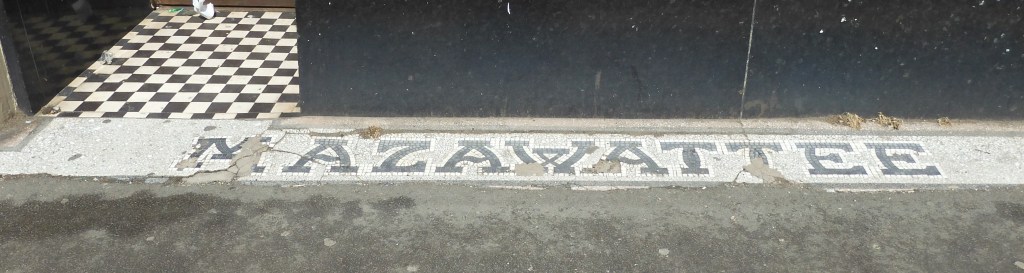
Most of Mazawattee’s short-lived shops vanished long ago, including the branch next door to Marks & Spencer at 242 High Road, Chiswick (see above). But remarkably, at least two survive. These can be found at 29 East Street in Bedminster and 79 Bohemia Road in St Leonards. They have a familial resemblance rather than being absolutely identical: both are cast in an art nouveau style, with decorative glazing and mosaics. The interior of the St Leonard’s shop is tiled from floor to ceiling. These shops were of such high quality that surely more survive out there – just waiting to be rediscovered.
In 1927 Hugh Fraser II, the head of Fraser, Sons & Co. Ltd., died, leaving the established family business in Buchanan Street and Argyle Street, Glasgow, in the hands of his entrepreneurial son Hugh Fraser III. Over the next 20 years, Fraser’s would be transformed into a major store group named House of Fraser.
In 1936 Hugh Fraser began to buy up Scottish stores – supposedly to keep English predators at bay! He began with three drapers located near Fraser’s own premises in the heart of Glasgow: Thomas Muirhead & Co., Arnott & Co. Ltd. and Robert Simpson & Sons Ltd. Arnott’s and Simpson’s were unified. The store was rebuilt on an ambitious scale in 1960-63, occupying Argyle Street between Jamaica Street and St Enoch’s Square. Having been refurbished for £6 million in 1987, it closed in 1994.
Between 1939 and 1945 Fraser’s acquired at least ten Scottish businesses which were suffering from wartime trading conditions. Maximising leaseback deals with insurance companies, Fraser’s buying spree continued unabated in the immediate aftermath of the war.
Further funding could be leveraged after 1948, when House of Fraser floated as a public company. Major purchases included: Debenhams’ Scottish Drapery Corporation, with nine stores, in 1952; the Binns chain, with another nine stores, in 1953, and the London-based John Barker group in 1957, which included Derry & Toms and Pontings. These newly acquired stores retained their existing identities.
In 1957 House of Fraser bought Wylie & Lochhead, a furnisher and undertaker whose Buchanan Street store had been rebuilt in 1884-85 with a magnificent atrium. Eleven years later this merged with another Fraser acquisition, McDonalds Ltd. Frasers relocated to the Wylie & Lochhead building in 1975 and closed its historic store on the corner of Argyle Street and Buchanan Street.
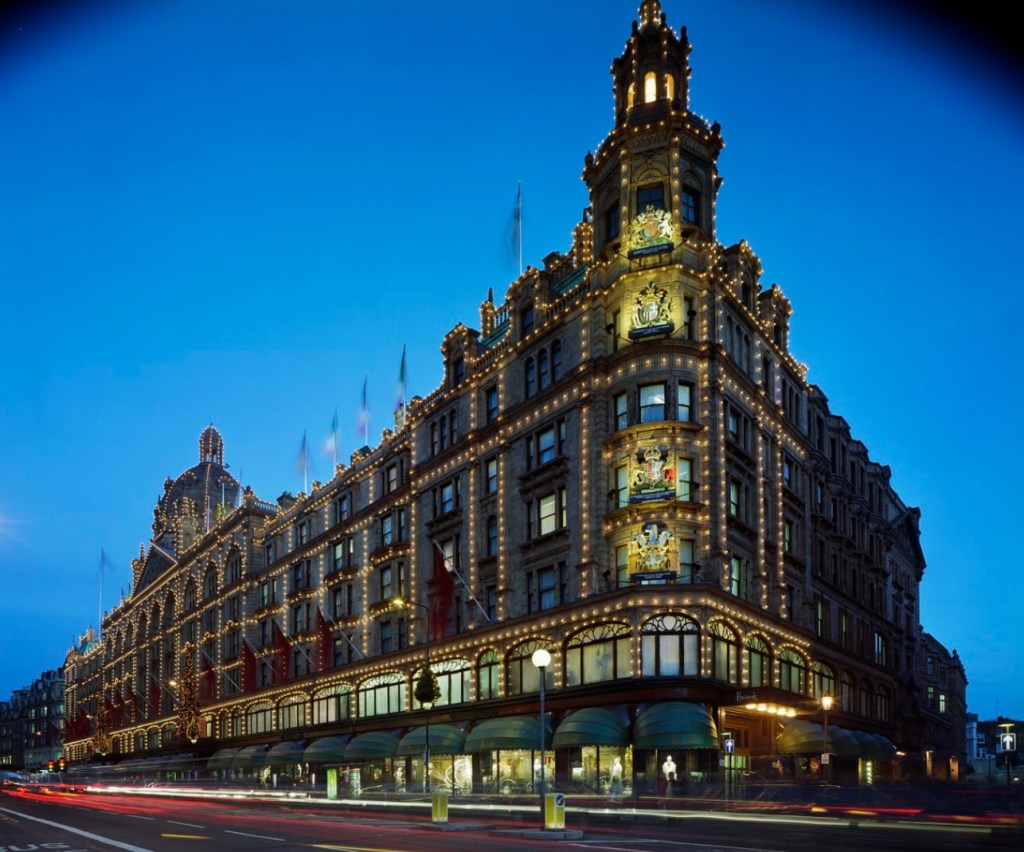
The greatest coup in the career of Hugh Fraser III, in 1959, was the purchase of Harrods, including Dickins & Jones in Regent Street, D. H. Evans in Oxford Street and Kendal Milne in Manchester, plus more recent acquisitions in Sheffield, Birmingham, Liverpool, Torquay and Newton Abbott. Fraser batched these together as Harrods Provincial Stores. In Birmingham, the rebuilding of Rackhams, started by Harrods, was completed under House of Fraser. Another important store rebuilt by Fraser’s around this time was Binns in Middlesbrough.
By 1970 the classic department store model – with departments responsible for their own buying, displays and staffing – was being eroded, and groups were being transformed into chains. With the advent of computerisation, Debenhams imposed central buying and renamed its branches ‘Debenhams’, but House of Fraser remained cautious. An early tentative step towards centralisation involved the conversion of six Scottish stores to the ‘Arnotts’ name. Otherwise, although associated stores sold Fraser’s ‘Allander’ brand, they kept their identities and were permitted to buy around 50% of their own merchandise. But all changed in the 1980s. With the concession model superseding traditional departments across the sector, stores lost their last remnants of independence.
Following controversial dealings with Lonrho, Hugh Fraser IV stepped down in 1981. Four years later the Al Fayed family took control of House of Fraser. The group floated as House of Fraser plc in 1995, but without Harrods, which remained the Al Fayeds’ private domain. The most prestigious purchase in later years was the famous Jenners store in Edinburgh, which managed to keep its own name after acquisition in 2005. It closed in 2020.
House of Fraser had been opening stores in shopping malls for some time, but this accelerated in the 1990s, alongside the closure of unprofitable high-street stores.
House of Fraser teetered on the brink of collapse in recent years. In 2018 its collection of 59 stores was rescued by Mike Ashley’s Sport’s Direct, which was renamed Frasers.
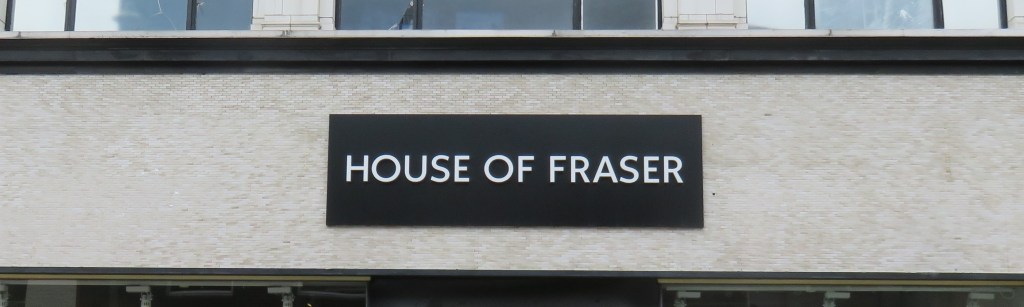
Step by step, the familiar name ‘House of Fraser’ is being phased out as stores close or are revamped under the ‘Frasers’ or – for younger shoppers – ‘Flannels’ fascias. By November 2024, 13 ‘Frasers’ stores had opened, for example in the former Debenhams store in Meadowhall, where the House of Fraser had already been converted for Flannels.
An emphasis on slick in-store displays with sophisticated lighting has rejuvenated the 14 remaining ‘House of Fraser’ stores, including Darlington, which recently won a reprieve from new landlords. Evidently, Frasers is intent on invigorating the (let’s be honest!) drab formula of the last few decades, which – in an attempt to grab the mass market – strayed far from the glitz and glamour of the early 20th-century department store.




















 Building Our Past