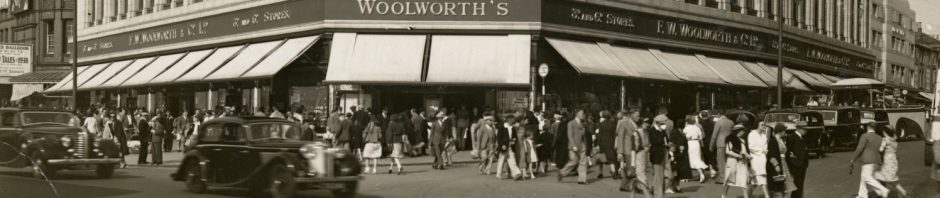

In 1823 the drapers Clark & Debenham of Cavendish House, Wigmore Street, London, opened a branch in Cheltenham. This precocious move did not trigger the birth of Debenhams’ store group. Instead, in 1883, the Debenham family withdrew from the Cheltenham venture to focus on their extensive wholesale and export trade, and their imposing London store, Debenham & Freebody.


Harvey Nichols & Co. in Knightsbridge and Marshall & Snelgrove Ltd. in Oxford Street were both purchased by Debenhams in 1919. However, it was through the activities of the Drapery Trust that Debenhams became a powerful retail force, not just in London, but throughout the United Kingdom.

The Drapery Trust was established in 1925 by the financier and company promoter Clarence Hatry, who acquired over 50 stores in the space of two years. In 1928 the Drapery Trust was taken over by Debenhams Securities Ltd., a new subsidiary of Debenhams Ltd. At this point Sir Ernest Debenham ended his family’s long association with the firm. Shortly afterwards, Hatry was imprisoned for fraud, including the forgery of Drapery Trust shares.
Debenhams’ good name was tarnished, yet it emerged as an unprecedentedly large retail group. Its stores included the south coast store groups of Bobby & Co. and Plummer Roddis, Spooners in Plymouth, and the northern group of Marshalls Ltd. Scottish stores were bundled into the Scottish Drapery Corporation, which was eventually sold to House of Fraser.

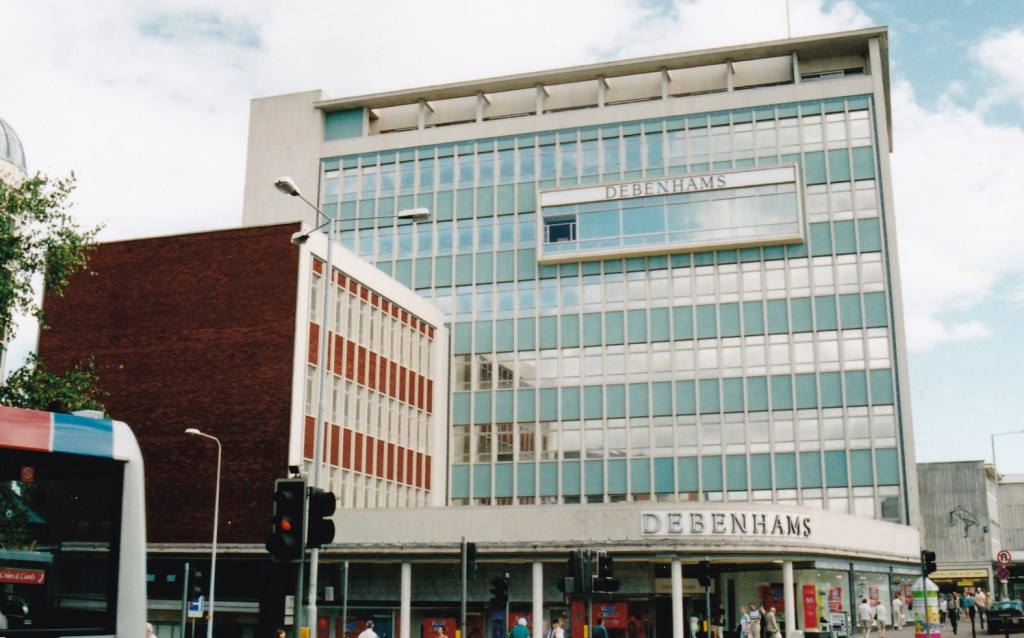

(Creative Commons © N. Chadwick).
Several of Debenhams’ stores were destroyed during the Second World War. One of the first to gain a new building was Spooners (Healing & Overbury; 1950-54) in the devastated city of Plymouth, where department stores were allocated sites along the north side of Royal Parade. After Debenhams bought the neighbouring John Yeo store in 1963, the two were linked by a walkway.

Purchases continued, and in 1958 Debenhams acquired Busby’s in Harrogate. The store was extended c.1960-62 by George Baines & Syborn, an architectural practice much favoured by Debenhams, for example in Taunton, Exeter, Guildford and London. One of their signature touches (hidden to the rear in Taunton) was an expanse of curtain walling with pale blue spandrel panels.

A significant later acquisition, in 1962, was the Matthias Robinson group of stores, with stores in Darlington, Leeds, Stockton-on-Tees (The Coliseum), and West Hartlepool.
Debenhams’ stores were categorised according to the income of their target customers: A (upper), B (middle) or C (lower). Some of the C stores opted to take advantage of central buying for fashions from the 1930s. After the war, central buying became compulsory for footwear, radios and electricals. Then in 1966 – when a new computer centre opened in Taunton – the decision was taken to centralise buying across all stores and introduce more self-selection.
The logical outcome, in the early 1970s, was to jettison historic identities and rebrand the stores ‘Debenhams’. Branches now sold much the same merchandise. Increasingly, new stores were linked with town-centre shopping malls and adopted a chunky, utilitarian aesthetic, with few windows on upper floors.


In 1985 Debenhams, with 67 stores, was bought by The Burton Group. Terence Conran, then an ally of Burton’s, developed the ‘galleria’ concept, with specialist ‘shops within shops’ (notably Burton’s and Conran’s own chains) that would be visible from a central atrium ringed with galleries, an architectural form that had been outdated for stores since the late 1930s. The first major store to be remodelled along galleria lines was Oxford Street. While this was in progress, in 1986, a new store with a central atrium opened in a shopping centre in Preston. In 1998, however, The Burton Group split in two: while Debenhams floated as Debenhams plc, Burton’s was reinvented as Arcadia.

In the first two decades of the 21st century Debenhams opened around 20 new stores, often in shopping centres or retail parks. Two of the most interesting were in Bury St Edmunds and Liverpool.
Perhaps influenced by Selfridge’s futuristic ‘blob’ in Birmingham’s Bull Ring, Debenhams built its own ‘blob’ in the Arc Shopping Centre, which was grafted onto the centre of Bury St Edmunds. The building (Hopkins Architects; 2007-08) had a rounded shape with arched entrances and was clad in aluminium lozenges. The much larger anchor store designed for Liverpool One (Groupe 6/BDP; 2008) also displayed a fondness for curves, while glass panels distracted from the mass of the building on Lord Street.

(Creative Commons © Bob Jones).

One of the very last purpose-built Debenhams’ stores to open was a two-level block in Roaring Meg Retail Park, Stevenage (McDonald Architects; 2017). While the exterior was dark and brooding, the bright interior was arranged around a central void ringed by galleries with glass balustrades. The contractors, Simpson York, had worked on over 20 projects for Debenhams over a 15 year period.

Debenhams entered administration twice: first in April 2019 and then again, during the first Covid lockdown, in April 2020. On the second occasion it was announced that the company would be liquidated, though the brand and website were bought by Boohoo. The last of Debenhams’ 124 UK stores closed in May 2021.
Slowly but surely, as former stores are remodelled or redeveloped, fewer traces of Debenhams’ long history remain on British high streets.
Text copyright Kathryn A. Morrison (AI scraping not permitted)
READ MORE about Debenhams and other department store groups and chains in Kathryn A Morrison, Chain Stores in the Golden Age of the British High Street, Liverpool University Press (to be published May 2025).

 Building Our Past
