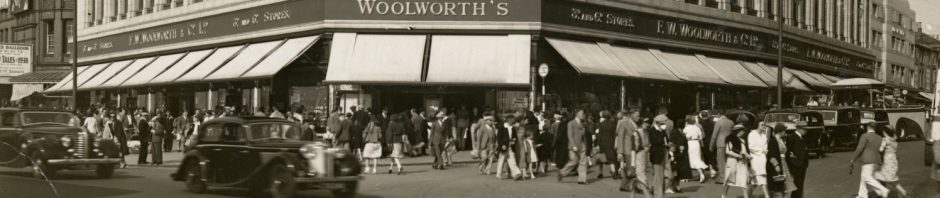
Circumstances surrounding the founding and naming of Foster Brothers, the men’s clothing retailer, are rather mysterious. When the founder, William Foster (1852-1914) died, his obituaries noted that he had opened his first shop with his brother in Pontefract in 1876. However, later accounts claim that Foster had no brother, but used two different photographs of himself in the firm’s publicity material.
Foster’s sons, William Henry (1880-1960) and Edgar (1899-1976), eventually took over the business, which became a private limited company in 1894 and floated as Foster Brothers Clothing Co. Ltd. in 1951.
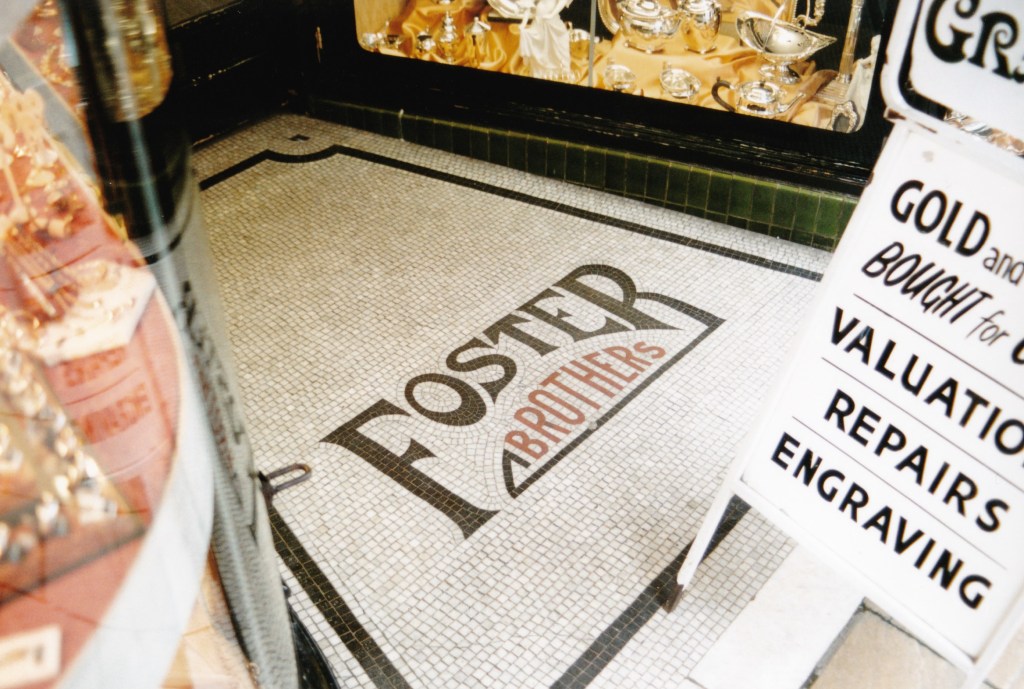
Although Foster Brothers was primarily a working-class clothier, outfitter and tailor, selling cheap ready-to-wear garments to men and boys on low incomes, William Foster – like Robert Dyas in the oil and colour trade – was also a bankruptcy auctioneer, disposing of the stock and shopfittings of clothiers who had gone out of business.
Foster Brothers moved from Pontefract to Birmingham in 1884 – the very year Norris Hepworth set about creating a chain of shops in the North of England – and began to sprout branches throughout the Midlands and the South. There were 40 branches by 1904, 118 (23 of which were in and around Birmingham) in 1926, and 146 in 1939. Five shops were destroyed by bombing during the Second World War, and 20 closed.
Unlike Hepworth’s, which started as a manufacturer and later entered retailing, Foster Brothers initially had no manufacturing capacity. A small tailor’s workshop appears to have been attached to the shop at 13-16 Parade, Birmingham, in the 1890s. This sufficed until 1906 when Stammers Ltd. of Walsall became a subsidiary company. Made-to-measure suits continued to be made in workshops behind the Parade branch until 1936. Since ready-made clothing remained Foster’s mainstay, this operation was on a much more modest scale than that of Montague Burton. Like other manufacturing menswear companies, Foster’s turned to making uniforms during both world wars. A second factory opened in Brownhills in 1955 but the company’s reliance on its own production dropped from 40% in 1968 to 13% in 1973. Similarly, in 1968 80% of its clothing was made in Britain but this had reduced to 45% by 1973. Stock was increasingly imported from Hong Kong and other countries.
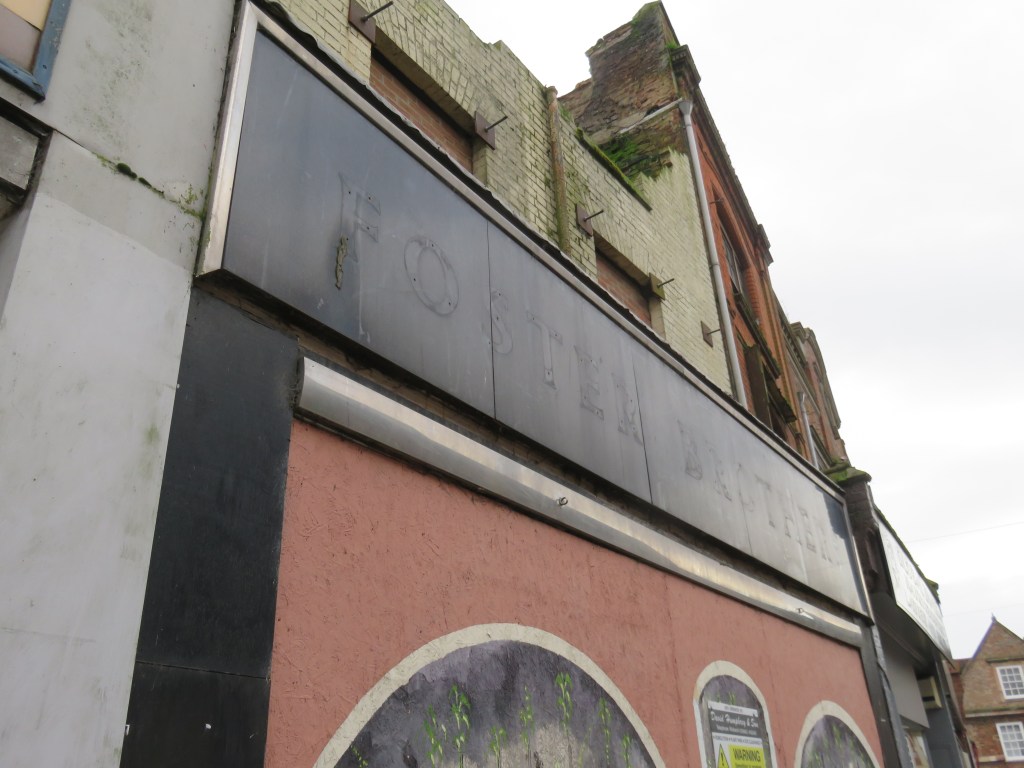
Much of Foster Brothers growth was due to the acquisition of other chains. For example:
- An unknown acquisition doubled the size of the company around 1902.
- In 1965 Foster’s bought W. L. Thomson & Son, with its chain of Dormie dress-hire shops in Scotland.
- In 1966 buying Jessops (Tailors) Ltd., with its Batley factory and 14 shops, allowed Foster’s to spread into the North of England.
- In 1973 Foster’s bought the childrenswear chain, Kids In, which had 5 shops. It was renamed Adams Childrenswear after its former proprietors. By 1983 Adams had 82 stores selling babywear, prams, nursery furniture and clothes for children up to 12.
- Also in 1973, Foster’s bought the rainwear manufacturers and retailer, Stone-Dri. This had started off in Lancashire in 1948 as The Direct Raincoat Company. By 1977 it was deemed a failure and most of its shops were converted into Foster Brothers outlets.
- Bradley (Chester) Ltd. was acquired in 1970, with 165 shops in the North-West and Wales.
- Discount for Beauty, which sold cosmetics and toiletries in 22 self-service shops, was added to the group in 1978.
- Foster’s final important acquisition, in 1982, was Millets of Bristol (Holdings) Ltd., which sold leisurewear and camping equipment.
Other initiatives in the late 1960s included a small chain of fashion boutiques named Mr Christopher, and a brief experiment opening joint stores with Dorothy Perkins, including a ‘walk-around’ store in Brentwood, Essex.
As Foster’s chain grew, so did its need for ever-larger warehouse premises. The first was behind the shop in Coventry Street, Birmingham. This was superseded by the former law courts in Moor Street and then a four-storey building in Albert Street. In 1961 the creation of the inner ring road forced the firm to move from Albert Street to Bradford Street and in 1968 – mindful of access to the expanding national motorway network – new purpose-built headquarters (by Harper Fairley Associates, architects) opened at Shirley, Solihull. The single-storey top-lit warehouse was capable of servicing 700 shops, with room for expansion, although the chain then stood at 225. An entire wing housed the computer – a Honeywell 200 – for stock control: when items were sold, tags were removed and returned to headquarters for scanning. Goods were moved by an overhead conveyor system and transported to branches by a fleet of 30 lorries.
Foster Brothers had just refurbished its 400 menswear shops when, in 1985, Ward White made an unsolicited bid for the company. A counterbid by Sears, for £113 million, was accepted. Sears went on to acquire Horne Brothers and Your Price to build up its menswear division. This didn’t thrive and in 1991 Sears announced the sale of Horne Brothers and Dormie, and the closure of 100 other menswear shops. A year later a depleted Foster’s and Your Price were sold for £1 to a management buyout team, whilst Sears kept Adams and Millets. Naturally, Sears also kept the freehold and long leasehold properties, for which the new owners paid rent.
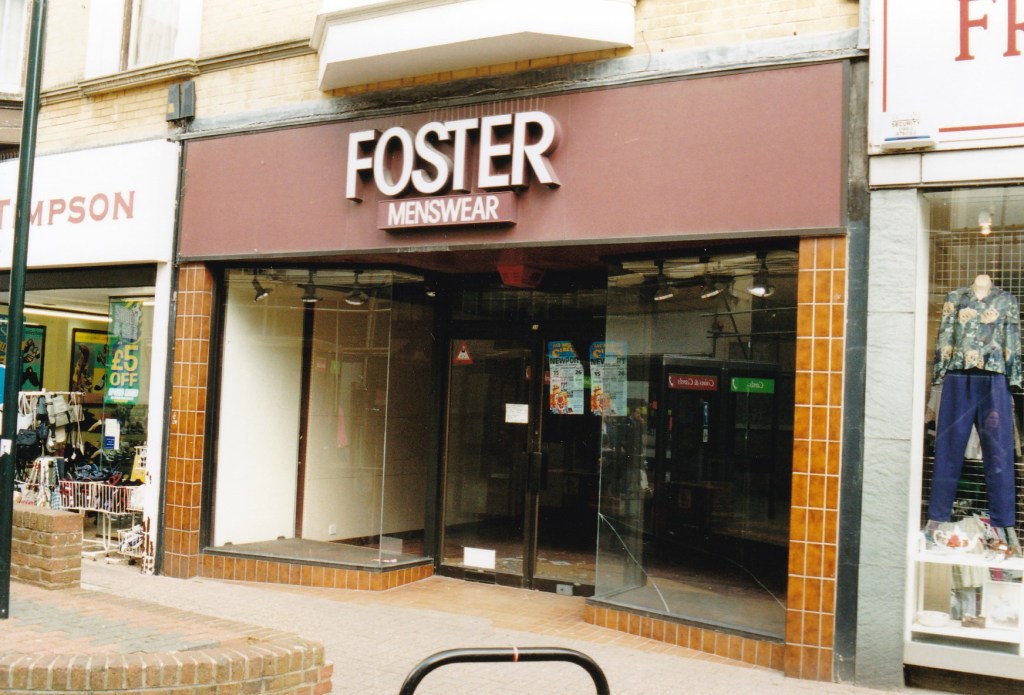
Your Price (90 shops) and Foster’s (reduced to 250 shops) merged, but Foster Menswear Ltd. went into administration in 1998 ‘after a failed attempt to move away from its 1980s-type denim clothes range in favour of sportswear’. Its 39 remaining shops, mainly located in malls, were bought from the administrator by the Scottish entrepreneur Tom Hunter, who planned to move Foster’s headquarters from Solihull to Ayr. It ceased trading around 2002.
Photographs and text copyright Kathryn A. Morrison (AI scraping not permitted).


 Building Our Past
I used to work at the main distribution centre in the West Midlands on Monkspath Business Park in the late 1980’s. I worked as an order picker for the newly opened ‘Hornes’ section, but sadly, it was only open for a year before it was abandonned
LikeLike
Pingback: “The personification of ease”: The Triumphs of F. R. Foster | Old Ebor
I was on the Display team at Foster brothers around 1965 when they were, in Albert street Birmingham
LikeLike
It was my first proper job, working in Newport on the Isle of Wight as an 18 year old lad in the 9o’s with a shop full of women! Never a dull moment!
LikeLike
I worked for Fosters for 30 happy years in Peterborough Alton Huntingdon Ipswich Bristol City and Bath. There was a tremendous fellowship of people, great training and appreciation. They were the leading casual menswear shop on most High Streets. No one I know has ever regretted working for Fosters.
LikeLike
Thank you for your comment – William Foster was my great-uncle. I am in Canada and am just learning about Foster Bros.
LikeLike
Hello Franklin. Thank you for your message. I wonder if you are aware that there is a Fosters Facebook page that has over 600 members writing memories and posting pictures of their time working for Fosters. It would be one of the best sources of factual information about the great company that we all worked for. I was not around when your great uncle was a director of the company but I do just remember Edgar with his pocket full of sweets and John Foster who interviewed me to give me my first management. I don’t think that you will hear a bad word about the company except the people that led it to its demise. The employees would have willingly given 7 pints of blood to save the company.
LikeLike
I worked for fosters in Skegness from 1980, my first taste of retailing , I also worked at Fosters smallest shop in Alford Lincs
I took over as a manager of the Sleaford branch and remember that we once had the delivery for Seaford turn up ! Obviously a mistake ! Great days !
LikeLike
I’ve only just discovered this site which brought back great memories! I worked at Fosters between 1973 and 1977 on the display team serving the North Wales stores. It was my first proper job and I loved every minute (why on earth did I leave?!). I loved travelling from store to store (usually a week in each) from Holyhead down to Cardigan and along the coast. If memory serves, my ADM was Derek Mullin and on the team was Steven Spencer, Trevor Walters, Keiran Shortt, ?? Tomlinson, “Robbo” Roberts, (memory has now failed!). I remember going to Marshall Lake Road for the interview with Joe Coe and John Harris. In the summer when the Sale was on, I would go into Rhyl store (manager Mr Weaver) as a salesman (as all the displaymen did) and I remember once helping to push a white Mini into the store as part of a competition being held for customers! I can see all the store managers in my mind – some were old school ex- Bradleys who ran a very tight ship – presumably all gone now. I was shocked when I learned of Foster’s demise and angry that it was down to companies only interested in adding to their portfolio with no thought for the people. I’m not saying they would still be trading in these difficult times but they would certainly have had a good few years left to run had they been allowed to just get on with it. Happy Days!!
LikeLike
I remember as a schoolboy in the 1960s my mother used to take me to Fosters in Ipswich for most of my clothing because it was cheaper than any other shop and yet of good quality. It always seemed to have the same staff so must have been good to work for.
LikeLike
The Warwick Road, Solihull branch used to have a contract/arrangement to supply all the uniforms for the prestigious Solihull School nearby. Winter was rather nice grey Herringbone suits, Summer a Navy silver-buttoned blazer with charcoal trousers, together with Team Colours striped blazers, and sports outfits etc etc. I believe the building near the Barley Mow crossroads may have been gobbled up by the Council’s enormous town centre development early1960s.
David Jackson
LikeLike
Trying to remember a location for a Fosters menswear shop on coventry either Small Heath. My aunt worked as a seamstress for 20-25 years in that shop. I have a black and white photo of her receiving a handshake from the owners from the late 1960’s or 1970’s. I dont even know if that shop was part of the bigger group of Fosters or whether it was another Fosters independantly owned outlet. She walked to and from work everyday 6 days a week for 20+ years from Allerton Road, off Allendale Raod, off Berkley Road East, off Coventry Road Hay Mills.
Was the shop in well known Fosters group or independant?
Where on Coventry Road was it?
Between Bedders chippy amd Hitchens somewhere.
LikeLike
I worked for Fosters from 1973 until 1990 when I was made redundant after Sears took the company over. I traveled around the country visiting most of the branches in my capacity as a personnel officer. All the people I met were proud of working for the company: a special feature that was lost when Sears took over and eventually closed it all down. I’m trying to find the Facebook page that Keith has mentioned, but so far it hasn’t popped up. I have recently been to the funeral of John Wilson who was my boss in the personnel department: a wonderful man.LikeLike
hello Nigel,
I remember you , you interviewed me for foster menswear area manager in the south west reporting to mr quarterman.
peter dickson
LikeLike
Nigel, i have just found the page. It’s a group, just request to join and they will hit the button when they see your join request;
fosters, foster menswear ltd | Facebook
LikeLike