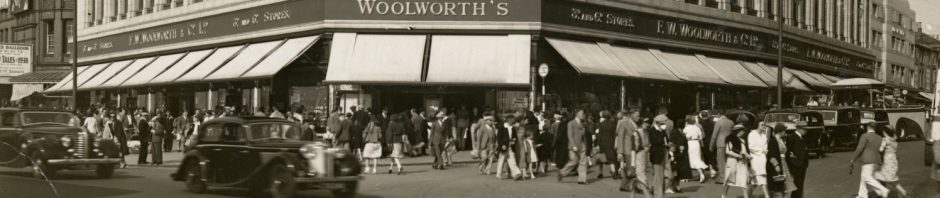
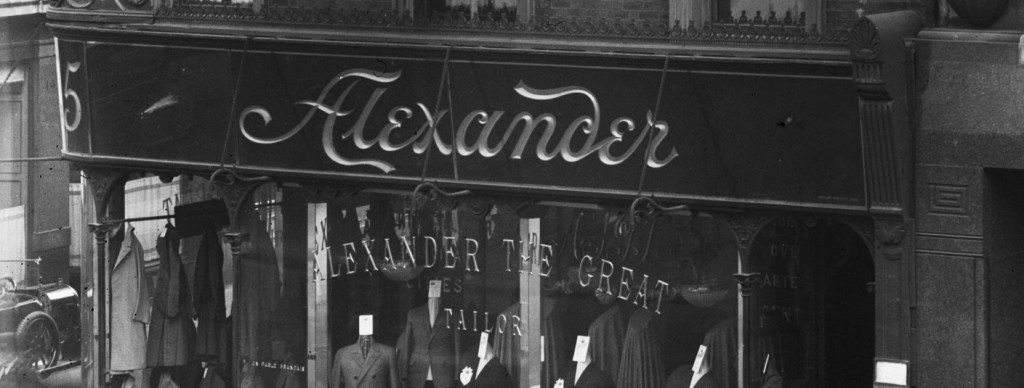
The need for uniforms during the Great War gave multiple tailors the opportunity to develop their manufacturing facilities. Its aftermath, with a renewed demand for ‘civvies’, allowed them to build up chains of shops offering affordable ‘bespoke’ tailoring, made in their own factories.
One such firm was Alexandre Ltd. The founder, Samuel H. Lyons (born Shimon Tzvi), was Polish. Like many other Jewish immigrants, he started out in Leeds. Around 1910 he opened a workshop that supplied clothing to retailers like Jackson the Tailor. By 1916 he had started his own chain of shops under the name ‘Alexandre’. This was supposedly inspired by a shop that Lyons had seen in Paris. Alexandre Ltd. expanded from 46 shops in 1929 to 88 by 1954, when it became part of United Drapery Stores (UDS).
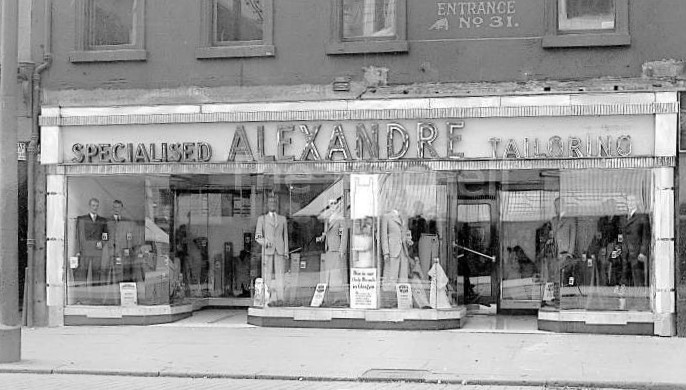
Lyons may have wanted customers to confuse his shops with those of an established older chain, Alexander the Great Tailor, which thrived between the 1890s and the 1920s. This had been started by four Jewish brothers – Adolphe, Albert, Isaac and Theobald Alexander – who came from Germany.
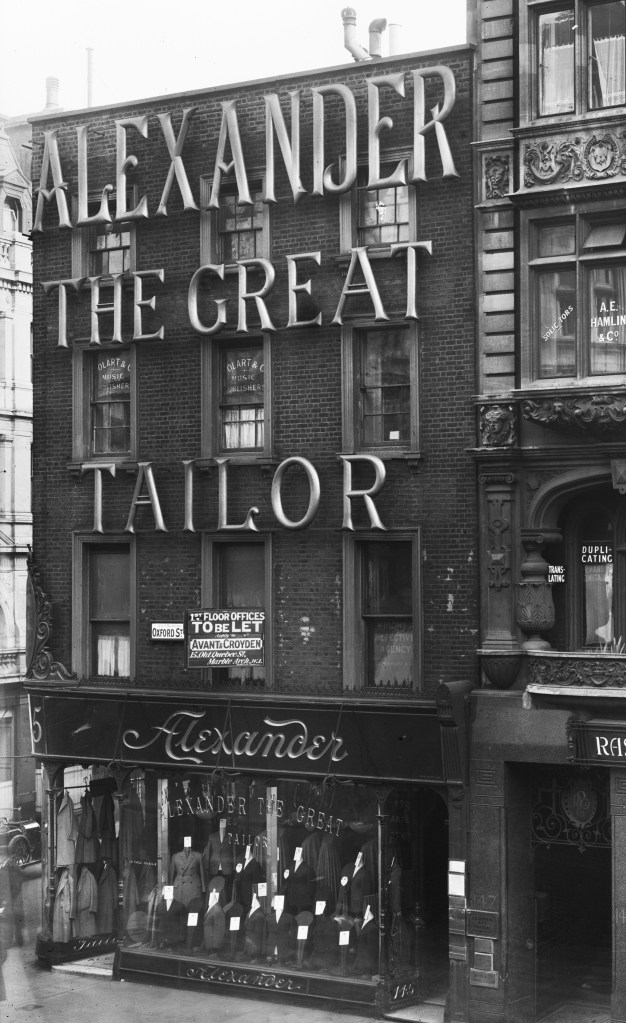
The Alexander brothers’ first shop, started by their father Jacob, was in Hanley. The red brick building still stands on the corner of Piccadilly and Stafford Street, complete with a two-storey shopfront. Isaac seems to have been responsible for the Leicester branch, which traded as Alexander the Great Tailor from 1892. Theobald Alexander adopted the same name when he relocated his Nottingham premises in 1893, and Albert followed suit in Manchester. Then, in 1895, Adolphe left Hanley to open an impressive Head Depot in Cheapside, London. Windows in the two-storey shopfront contained images of major branches. The Alexanders opened one of their most prominent branches in Oxford Street, London, in 1902. As at Cheapside, the façade was covered in colossal gilt lettering. Unusually, when Adolph sold the Hanley store to Samuel Hart in 1908, he permitted him to continue trading as Alexander the Great Tailor.
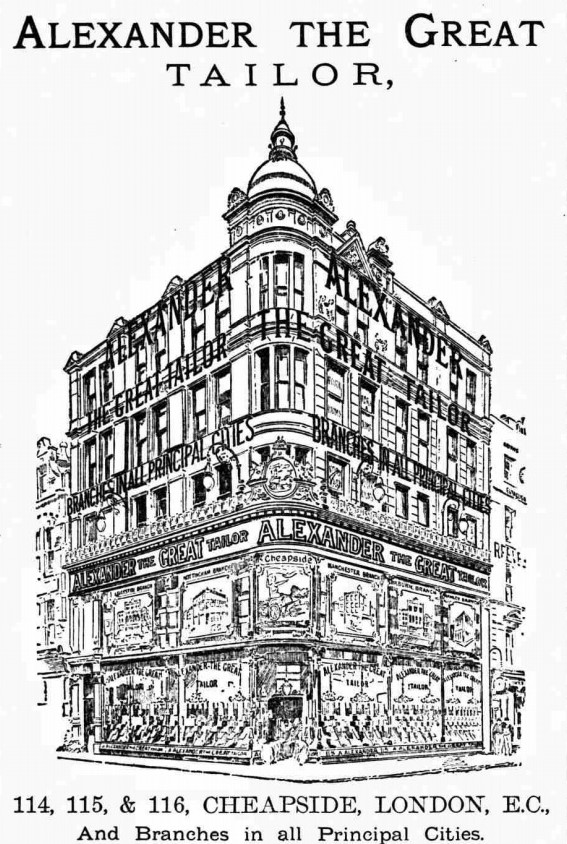
Isaac Alexander’s son, Claude S. Alexander, launched a chain of his own in Glasgow in 1922. When Isaac died a year later, his will expressed the wish ‘that my son Claude will not gamble on the Stock Exchange, or in any other form, and that he will take the advice of his uncles in connection with business matters’.
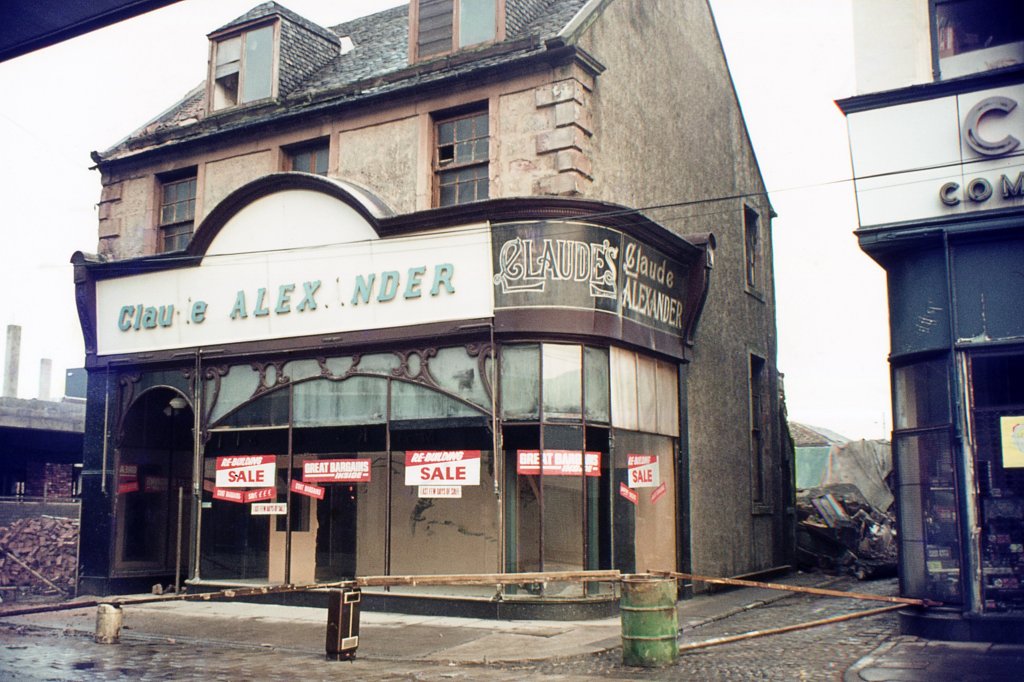
Despite Isaac’s evident concerns, Claude succeeded. His shopfronts and window displays were always highly fashionable. In the late 1930s he built several small modern stores, for example in Airdrie and Dumbarton, that reflected the influence of Burton’s and Woolworths. Fascias and advertisements often included the slogan ‘The Scottish Tailors’.
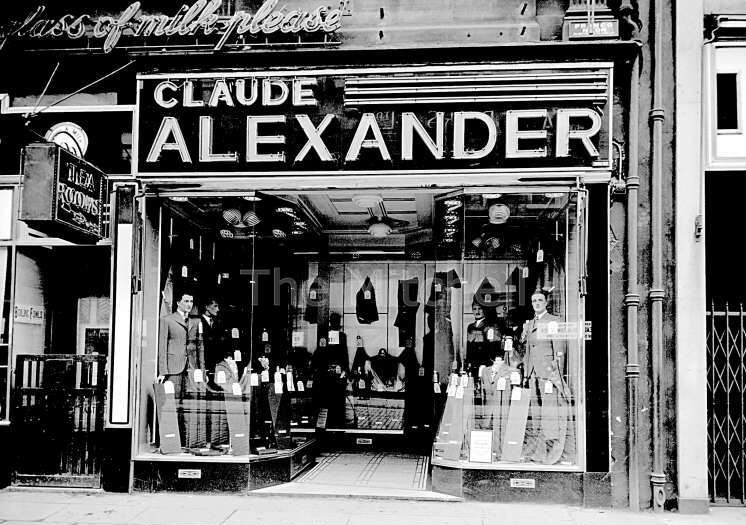
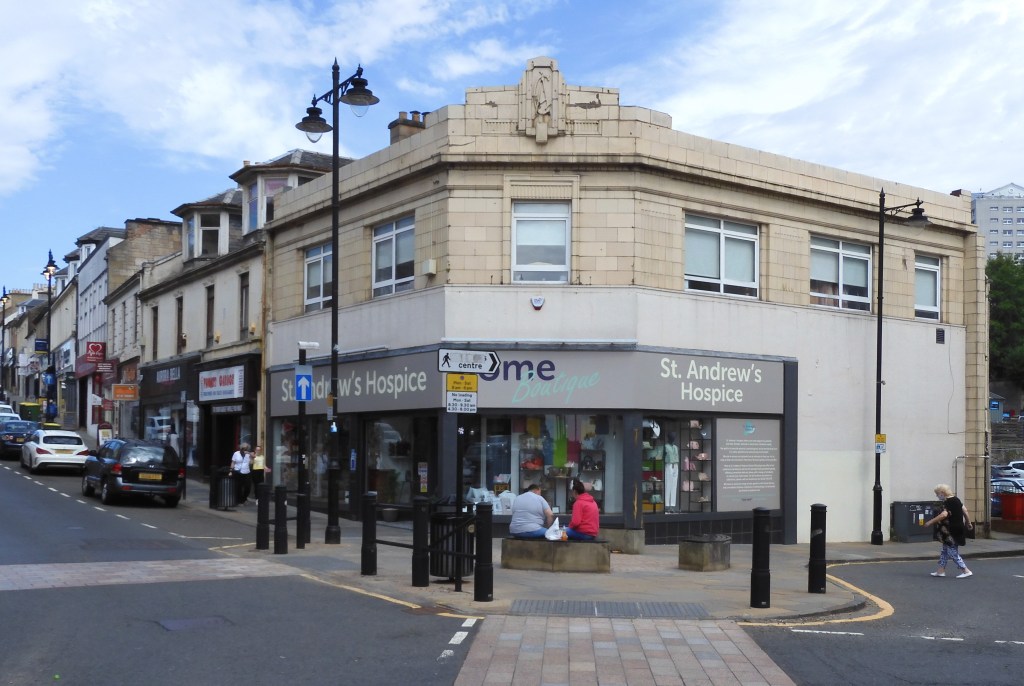
When Claude Alexander sold out in 1951 to The Fifty Shilling Tailors – which, ultimately, became part of UDS – he had a factory and 44 shops. But when he died in 1953, he unaccountably left just £175 19s. 1d. In contrast, back in 1923, his father had amassed a fortune of £63,000. Claude’s name, however, endured on high streets until 1980, when the remaining 25 ‘Claude Alexander’ shops, along with the ‘Alexandre’ chain, were rebranded John Collier. Before long this, too, would be history.
Text copyright Kathryn A. Morrison (AI scraping not permitted)
READ MORE about historic high-street tailors in Kathryn A Morrison, Chain Stores in the Golden Age of the British High Street, Liverpool University Press, 2025.


 Building Our Past
i worked at hepworths in the 70’s, bolton had a definite tailors area. we had dunnes one side, burtons the other. john temple then jacksons further along, alexandre across the corner, then john collier and peter pell further along deansgate, all within 5 minutes walk of each other
LikeLiked by 1 person