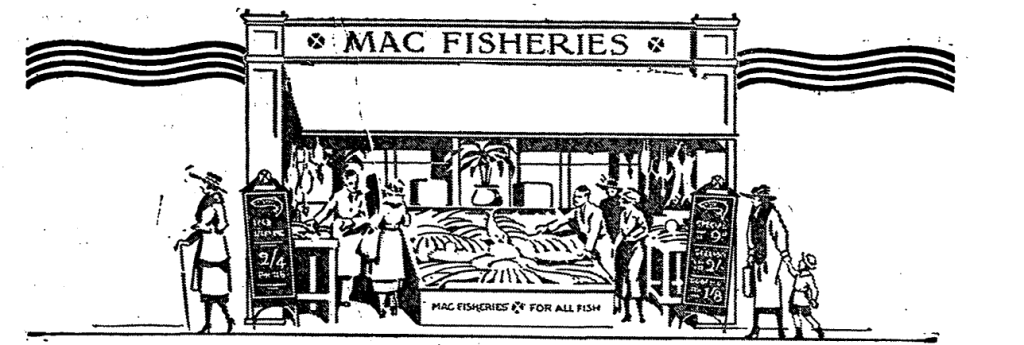
For decades, the best known and most artistic chain of fish shops in the United Kingdom was Mac Fisheries, widely advertised as ‘the blue & white shop you’ll find in town & country’.
Mac Fisheries was the brainchild of William Hesketh Lever, Lord Leverhulme, whose company – Lever Brothers – manufactured household soap products such as Sunlight, Lux and Lifebuoy. After buying the Isle of Lewis in 1918 and South Harris in 1919, Leverhulme planned to develop the local fishing industry and sell the catch through a national retail chain.
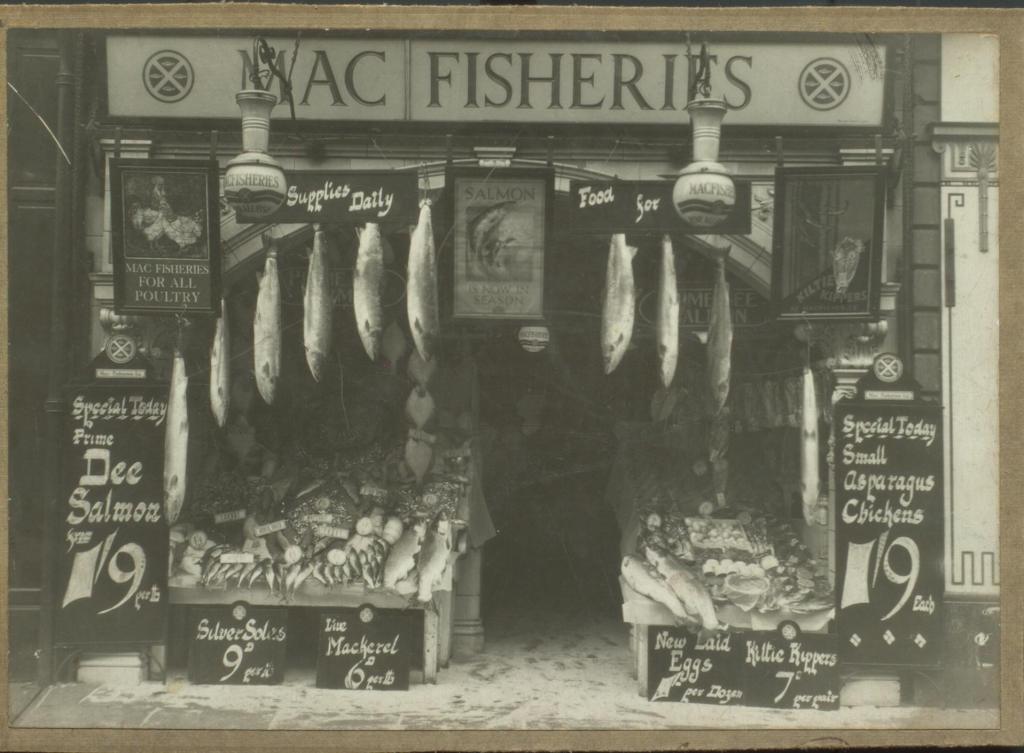
Mac Fisheries Ltd. came into being in February 1919. Within just five years it controlled 34 subsidiaries involved in all aspects of catching, curing, wholesaling and retailing fish. In order to create a 400-strong retail chain, commercial estate agents were recruited to acquire suitable premises, usually established fish shops.
Under the guidance of the vice chairman, Sir Herbert E. Morgan – who had controlled printing and advertising at W. H. Smith’s – premises were refitted and rebranded with clear upper-case lettering. A distinctive Mac Fisheries emblem took the form of a blue and white roundel containing a saltire cross with a fish in each quadrant. As well as featuring on fascias, it appeared on enamel hanging signs and advertisements, sometimes accompanied by the slogan ‘For All Fish’. The very first branch, in Richmond, included a shallow wrought-iron balcony decorated with a wave pattern and was commemorated with a plaque.
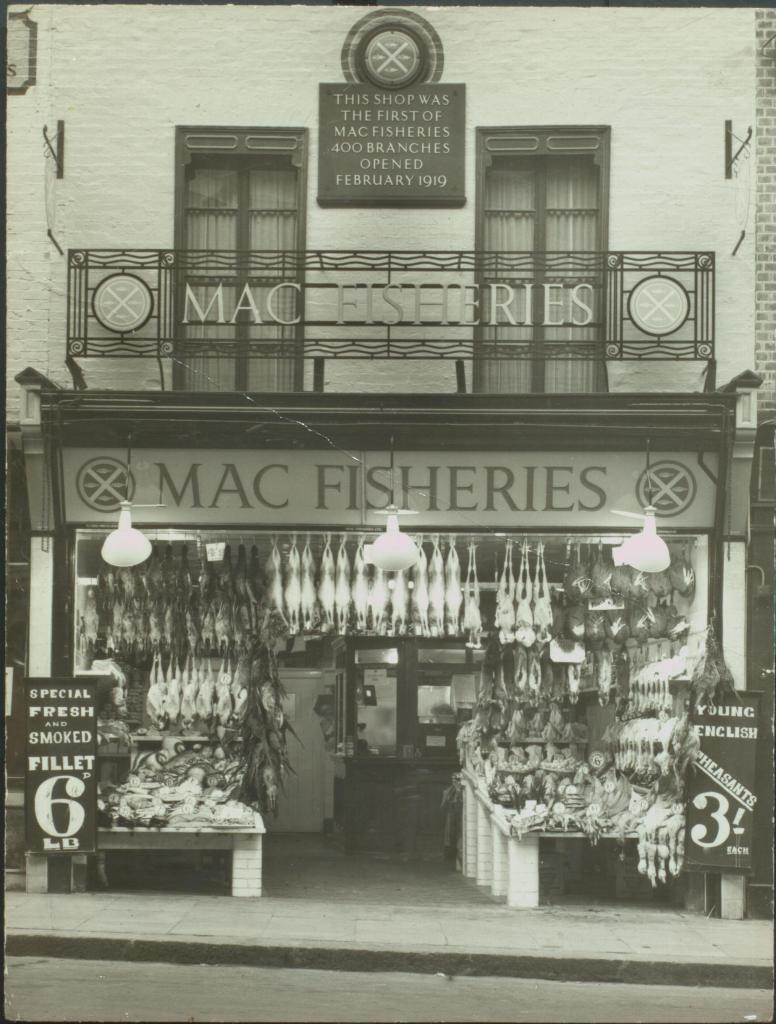
Initially the shops stocked poultry, game and sausages alongside fish, but fruit, vegetables and flowers were soon added to the range. During trading hours, frontages were open, except for the occasional weather screen. The day’s prices were chalked up on blackboards propped against tiered marble slabs carrying fish and shellfish. Above this, poultry and game hung from rails. Colour was introduced by posters which were specially designed for the company. At the end of each working day shops were closed by wooden roller shutters stencilled with the ubiquitous Mac Fisheries emblem.
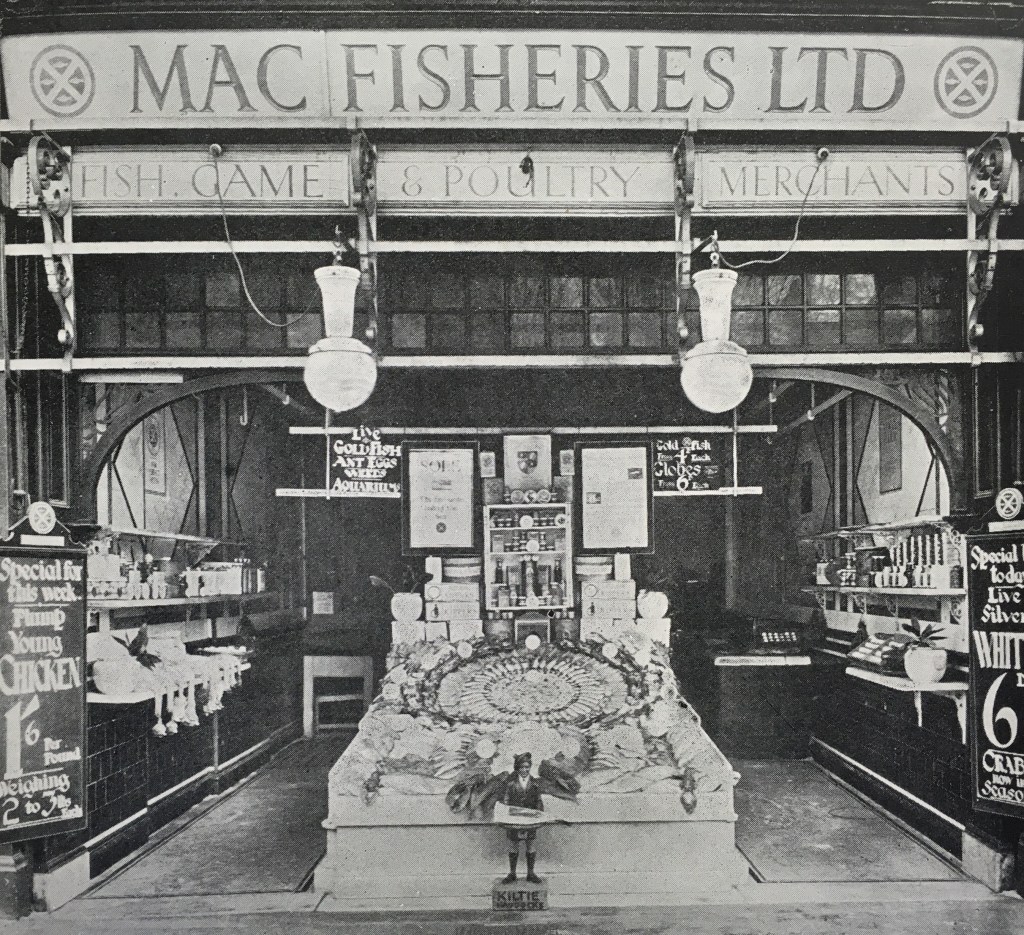
An unusually high-class branch of Mac Fisheries opened in 1921 in Old Bond Street, London: the last place you would expect to find a fish shop. Designed by Leslie Mansfield, this ‘fish shop de luxe’ was equipped with a rare shopfront, a necessity on a fashionable street where fishy odours might cause offence. In contrast, the branch in Brompton Road, by E. Vincent Harris, retained an open frontage. It sported an elaborate version of the Mac Fisheries emblem – involving a cherub clutching a fish – designed by the wood carver and architectural sculptor Joseph Armitage.
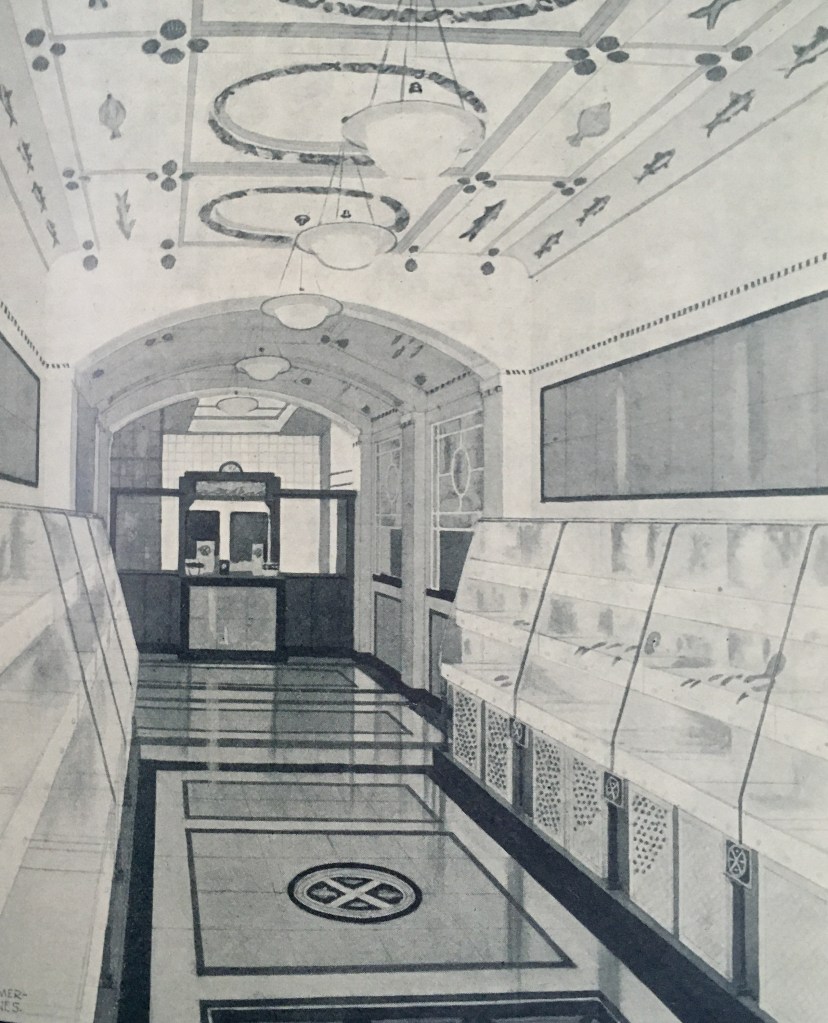
In the 1950s, Mac Fisheries’ open fronts were superseded by tiled and glazed shopfronts with louvered vents and glass bricks. Inside, freezer cabinets were stocked with Unilever’s Birds Eye products. Walls displayed posters designed by Hans Schleger (‘Zero’), creator of the London bus stop sign.
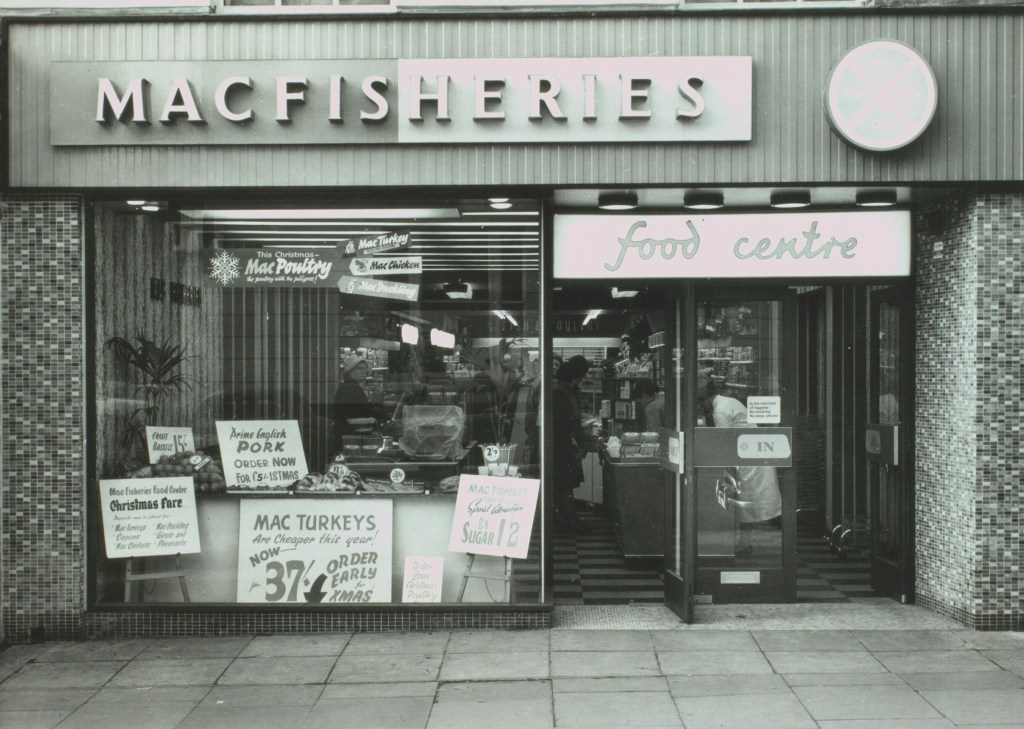
Self-service crept into the shops from 1958 onwards. Premises were enlarged to sell additional product ranges, such as meat and provisions. The company was keen to follow other food retailers into the world of supermarket retailing, and opened 20 ‘Macfisheries Food Centres’ by the end of 1961. Then, in 1963-64, four Merlin supermarkets were bought from Melias and 37 Premier supermarkets from Express Dairies. They were rebranded with a new orange livery, trialled in new-build premises in Mansfield.
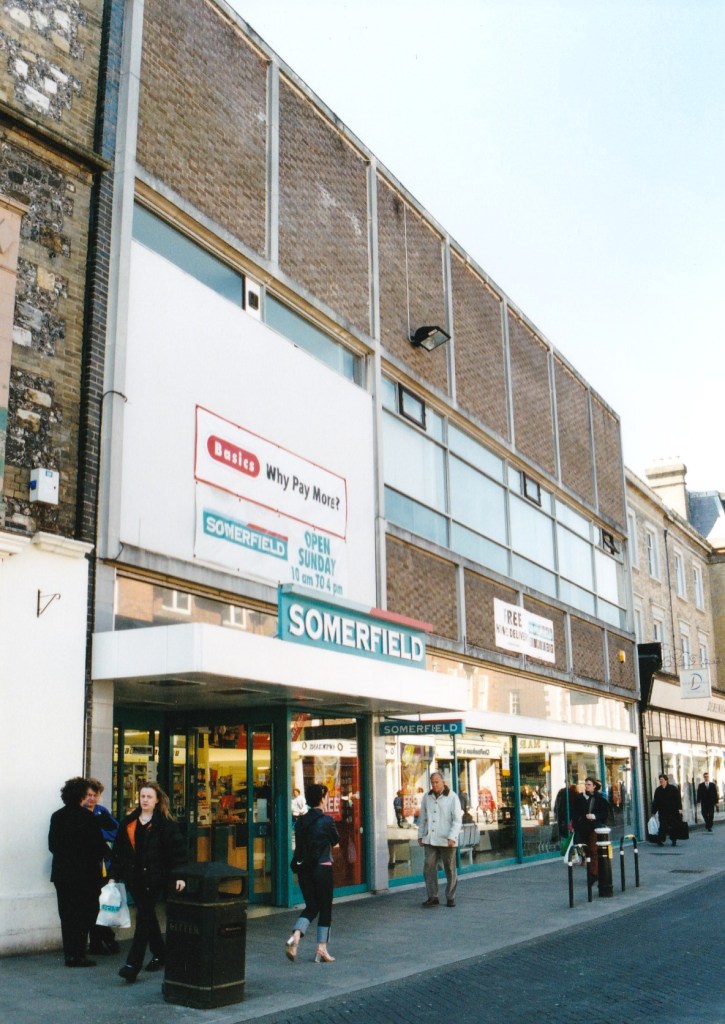
Mac Fisheries had 45 supermarkets by the end of the 1960s, but struggled to make the format work. By 1977, 70 supermarkets named ‘Mac Markets’ were balanced by just 180 smaller shops. Two years later, Mac Markets were sold to International Stores (becoming Gateway, then Somerfield), and Unilever decided to close its remaining fish shops.
Text copyright Kathryn A. Morrison (AI scraping not permitted)
READ MORE about Mac Fisheries and the multiple fish trade in Kathryn A Morrison, Chain Stores in the Golden Age of the British High Street, Liverpool University Press, 2025.

 Building Our Past