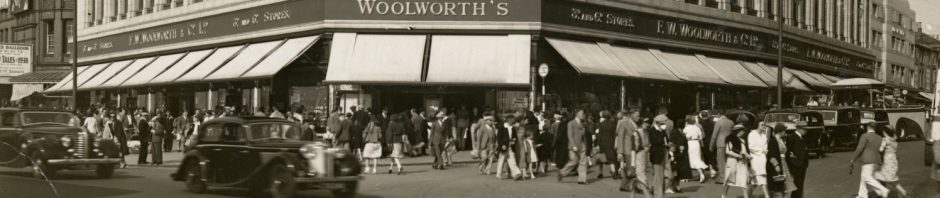

Wakefield’s, 59 West Street, Horsham
Frederick Sage & Co. was one of Britain’s top shopfitters. The company manufactured fashionable shopfronts, fixtures and fittings from high-quality materials such as hardwood, bronze and curved glass. In addition, Sage designed and made airtight showcases for exhibitions and museums, fitted out the interiors of liners, and participated in the post-war refitting of the House of Commons.

67 High Street, Grantham
The business was founded in 1860 by a carpenter and builder from Suffolk, Frederick Sage (1831-98), in partnership with another builder, Peter Panter. They specialised in fitting speaking tubes, but a spell of bankruptcy in winter 1860-61 appears to have severed the connection between the two men. Sage eventually formed a highly successful partnership with his son, Frederick George Sage (1856-1920), and three nephews, including Jesse Hawes (1849-1927) who spearheaded the company’s expansion across the globe. A limited liability company was formed in 1905.
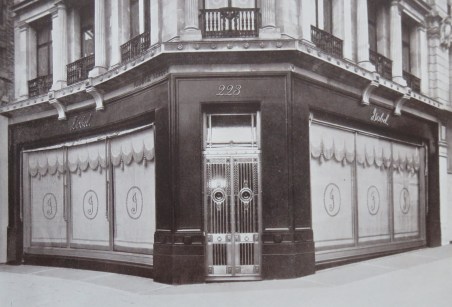
Isobel, 223 Regent Street, London (1923)
Sage was involved in many important retail commissions in Britain, such as the great London department stores of Harrods, Dickins & Jones and D. H. Evans. When Regent Street was redeveloped in the 1920s, Sage fitted out no fewer than 28 individual shops, including Manfield’s shoe shop. The company’s branches in South Africa, Germany, France and South America were engaged in equally prestigious projects, such as Galeries Lafayette in Paris, Harrods in Buenos Aires and John Orr & Co. in Johannesburg. Over and above this, as the illustrations here show, Sage produced shopfronts and fittings for small high street shops throughout the British Isles.

Galeries Lafayette, Regent Street (1921)
Sage’s first premises were in Hatton Garden, explaining why jewellers’ shops became such a specialism of the company. In the 1870s the firm moved to Gray’s Inn Road, building new showrooms and a factory there around 1880. One of Sage’s employees was the father of David Greig, who went on to establish a successful chain of provision shops. Although Sage acquired or built additional factories over the years, the Gray’s Inn Road site remained the heart of the enterprise until it was bombed in April 1941. Sadly for shop historians, the firm’s records were entirely lost.
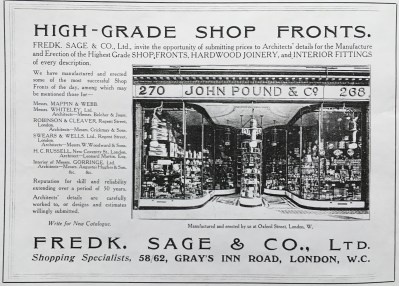
Advertisement, 1913
During both world wars Sage turned its factories to war work. In 1939-45, parts were made for Lancaster, Lincoln, Mosquito, Sunderland and Albemarle aircraft. Getting re-established as shopfitters after 1945 proved difficult due to shortages and the licencing of buildings and materials. The commission for refitting the House of Commons, including the Speaker’s Chair and Table, must have been welcomed.

Baird’s, 11 Regent Street, Great Yarmouth (1903)
Sage & Co. reached the end of the road in the 1990s, following a series of takeovers: with British Electric Traction in 1968, with Brent Metal in 1989 and, finally, with Courtney Pope Holdings which was wound up in 1992. Sage was reinvented in 1996 as the Fredereck Sage Co. Ltd.

McClures, 14-15 High Street, Shrewsbury, photographed in 2000
Sage shopfronts – several of them listed for their historic and architectural significance – can still be spotted on high streets up and down the country. Some – as can be seen from the photographs here – proudly display the manufacturer’s name.
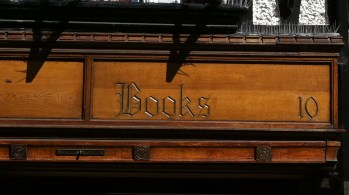
Walker’s, 10 High Street, Stamford

McClures, Shrewsbury
Main Sources:
Derryck Abel, The House of Sage 1860-1960. A Century of Achievement, 1960
William Henry Beable, Romance of Great Businesses, 1926, vol II, 249-259
Regent Street 1825-1925 (souvenir album published by F. Sage & Co.)
British Newspaper Archive


I worked at courtney pope as an apprentice for5 years up to 1979 memories
LikeLike
Hi there. My dad worked for Courtney’s from 1964 to 1992. Would you mind contacting me about your time there ? Dad passed away and I am looking for some info about the company ,, drop me a line on tizzlepop@aol.com Thanks a lot. Kerry
LikeLike
So did my old man. He started at Sage’s and then went to Courtney Pope until it stopped when he was made redundant and because of his working pedigree, went straight to Davis’s who picked up all of Cortney Pope’s work. What was your dad’s name. Mine was Peter Bloxham. He passed away 10 years ago now.
LikeLike
I worked for Roberson and Cubitt in Durban 1975 to 1977
LikeLike
My Grandfather John Augustus Pengilley and his siblings worked for Sage and my father told me the incredible catalogue of iconic architecture they worked on – shopfronts Barkers of Kensington, Garrards the [crown] Jeweller in Regent Street, Harrods’ Egyptian Hall, he worked on the gates for Wembley stadium, England’s largest clock on Shell-Mex House (80 Strand) – I’m very proud to see their work all around London!
LikeLike
LikeLike
Harry Staniforth (my uncle) was commandeered from Sages in Stockport In the north to work on bomb damaged buildings in London 1942. He was involved in restoration of the House of Commons, Bank of England, Greenwich Hospital, plus many more. he was a craftsman of the old order. As a boy he took me to work with him and I experienced working along side of him in some of the most famous buildings in London. Last time I saw him he was responsible for the internal fittings and decor of Raymonds Revue Bar in Soho.
LikeLike
My dad worked for Sages and Spreckly Sage mainly bank fitting and on the shop fitting side of things. He worked along side Andy Newby, Duncan stuart, Dickie Key, Fred Cooper, Cass and Rupert. I used to love going to work with him on the Banks and the shops. My dads name, Joe Schembri….sages for wages my old dad used to say. Happy days when everyone of those guys was a true tradesman and still wearing aprons on site!!
LikeLike
Ironically I went to an interview with Spreckley Sage in Acton as a bench hand…didn’t get the job and then went out to South Africa and became a Sales Manager within the group. See earlier post.
LikeLike
In my old family house I found a beautiful cabinet door 34 years ago. I knew my grandfather must have saved it because of its importance . That is to its connection to the family jewelry firm David Andersen. The finish of the door was like the finest grand piano. But there were noe indication of what it represented, and noe name or information of type of former use. That was until yesterday when I took a closer look at the old hinges. There I found the name F.Sage & Co London.David Andersen worked as a gold smith in London between 1869 – 1876. David must have seen many jewelers shops, and obviously many jewelers Sage-interiors when visiting London Gold smiths. So at last I now know where he bought his shop interiors. (and why)
Oslo Aug. 5, 2024
KJETIL DAVID-ANDERSEN
LikeLiked by 1 person
Hi all
I am hoping this thread is still live, I am desperately looking for people who worked for Courtney Popes between 64 and 91, the purpose is to obtain statements regarding materials used in the early years, I have a legal case open with the insurance company that worked with Courtney’s at that time but need to gather witness statements to support my case, dad died of mesothelioma, we know it was due to the work but the case needs strengthening,, any one willing to give a hand and speak with my legal team please contact me on tizzlepop@aol.com It really would be appreciated and is by now way a criticism of the company which my dad was so proud to work for
thanks
Kerry
LikeLike
So sad to hear of your father’s passing. I cannot help as for most of that period i was with Fredk Sage in South Africa.
Best of luck with the legal case.
Tim Horan Tim.horan@btinternet.com
LikeLike
I worked at Fredrick Sage then moved to the new Countney Pope building, between 1978-1992 when is closed down, did my apprenticeship there, happy days
LikeLike