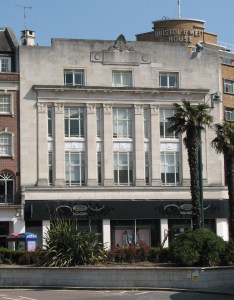
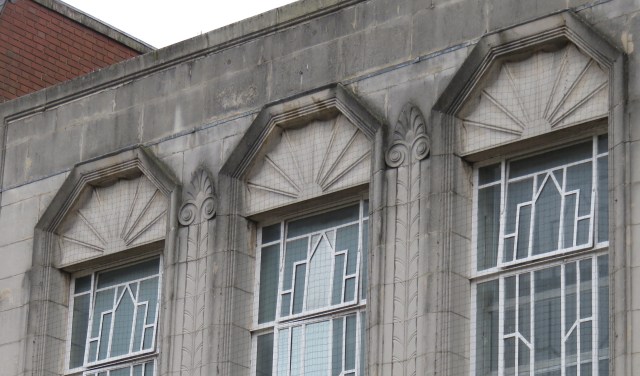
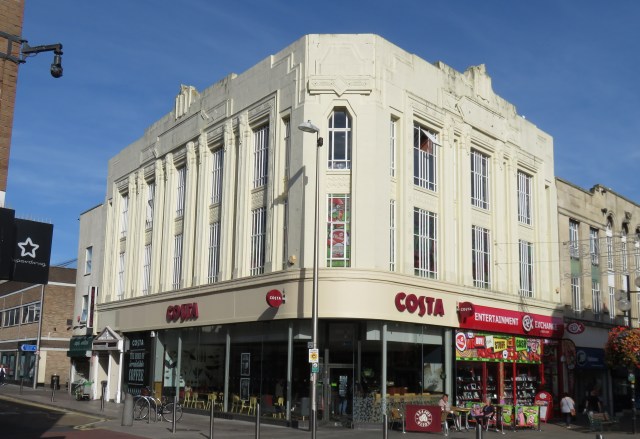
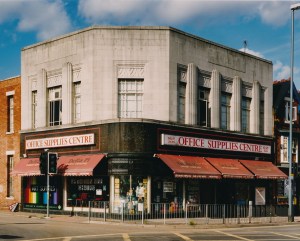
8 Classic Features To Help You Recognise an Old Woolworth’s Store

Historic England's avatarThe Historic England Blog

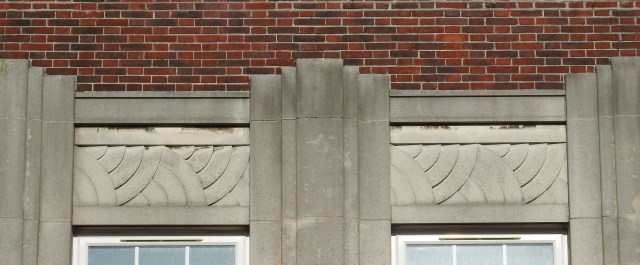
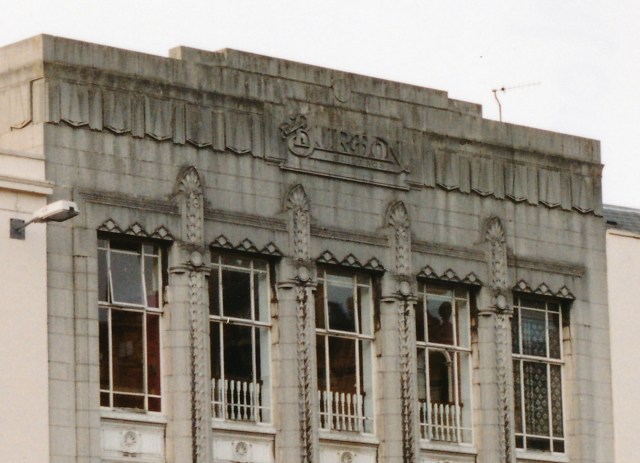
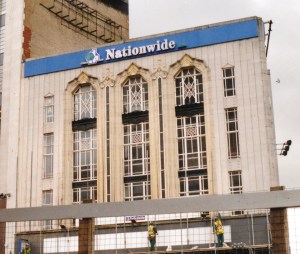
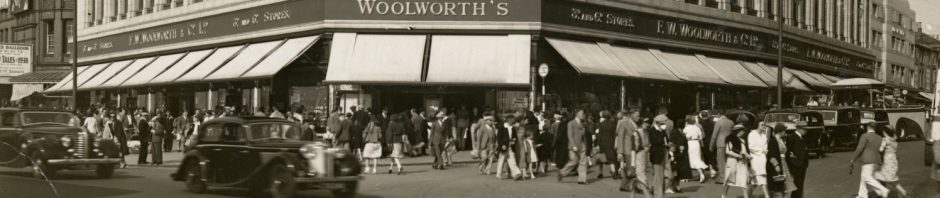
Researching Woolworth’s stores in Great Britain and Ireland allowed me to wallow in childhood nostalgia. I clearly remember the old counter-service Woolies – customers clamouring for the attention of the ‘girls’, or testing the gigantic red scales that always stood in the entrance.

View original post 836 more words

Posted in Woolworths | Leave a comment

8 Historic London Shopfronts

This gallery contains 10 photos.

The Historic England Blog London streets are lined with colourful shops, clamouring for our attention. Many are of considerable age, and have survived for our enjoyment only through careful maintenance by generations of shopkeepers. Kathryn Morrison, Head of Historic Places … Continue reading

More Galleries | Leave a comment

A Spotter’s Guide to W. H. Smith’s

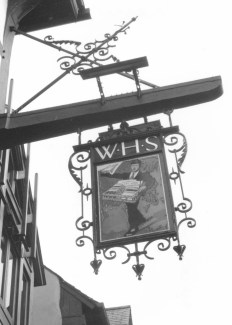
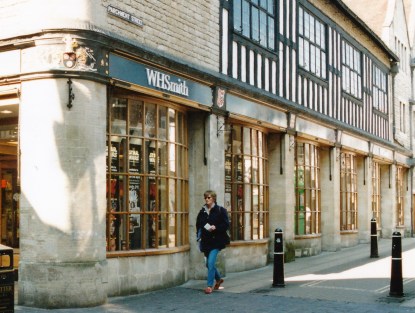
Worcester 2000 - Copy

Worcester

The Newsboy

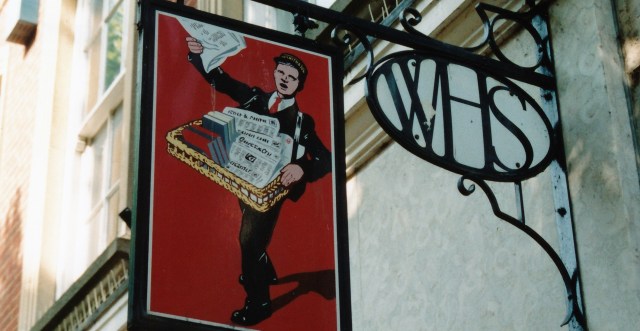
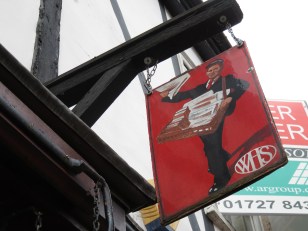
W. H. Smith’s distinctive enamelled hanging signs depicted a newsboy crying his wares against a bright red background. The newsboy was designed for Smith’s in 1905 by the artist Septimus E. Scott (1880-1966). Scott had trained in his native Sunderland and went on, in the 1920s, to design railway posters and illustrations for well-known brands such as Rowntree and Wincarnis.

Chester 3

Chester

Although many newsboy signs were taken down in the 1950s and 1960s, some still hang outside Smith’s shops, for example in St Albans, Stratford-upon-Avon, Worcester, Chester, Newtown (a restored shop in Powys accommodating the W. H. Smith museum), Cirencester and Durham. These signs are not absolutely identical. Not only do the brackets vary, but the style and composition – showing a newsboy brandishing a newspaper, with a tray of books and papers slung around his neck – evolved through time.

Stratford upon Avon 2001 (8) - Copy

Stratford-on-Avon, still with some lettering on the bracket

IMG_4580

St Albans, incorporating the egg monogram

Old photographs reveal that some newsboy signs had a boxy shape: these were actually ‘boy lanterns’, illuminated internally by electricity. Sometimes the lantern fixtures are still in place.

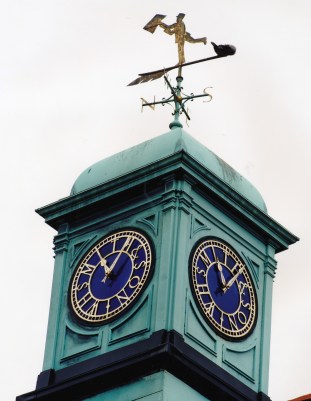
Salisbury AA008975

Salisbury

The newsboy wasn’t restricted to hanging signs and lanterns: he could appear in the most unlikely places. At Salisbury, in 1933, the refurbished shop was topped by a clock turret with a jaunty newsboy weather vane.

The Egg

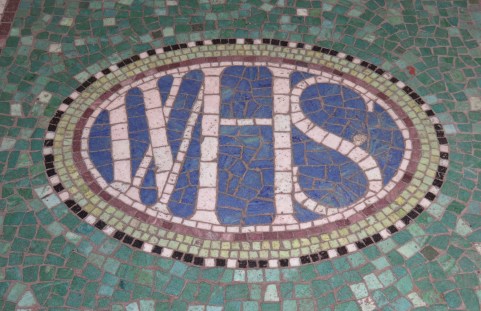
In 1905, R. P. Glossop designed a new logo for W. H. Smith’s, comprising the initials ‘WHS’ expanded to fill an oval frame.

Monmouth (4) - Copy

Monmouth

This ‘egg’ monogram served multiple functions. It can be spotted, for example, on mosaic floors in Monmouth, Fowey and Llandrindot Wells, on oak stall risers in Rickmansworth, on a brass name-plate in St Albans, and even on the wrought-iron bracket of the hanging sign in Worcester (see above). Archive photographs show the egg monogram adorning the lanterns that once illuminated Smith’s railway bookstalls, and even on floor mats inside the shops.

IMG_4544

Rickmansworth: this would have been coloured blue and gold

Bow Windows and Bull’s Eye Glass

W. H. Smith consciously opted for an olde-worlde image, not unlike Boots’ ‘black and white’ shops of the pre-1914 period. The company favoured shallow bow windows divided into small panes in Georgian fashion – sometimes on upper elevations as well as on shopfronts.

Winchester 2000 (1) - Copy

Winchester

These bow windows included so-called ‘bull’s eye’ or ‘bottle’ glass – not in every pane, but set at random. Bull’s eye glass makes a feature of the pontil or punty scar, which remains at the centre of a disc of spun crown glass when the rod is removed. Smith’s glass, however, would have been moulded rather than spun: it was not the real thing. Like many other aspects of W. H. Smith’s shopfronts, it was included to evoke the Tudor period.

Tenby (8) - Copy

Tenby

Bull’s eye glass also appeared in the small panes of the transom lights (or ‘weather screen’) that ran across the top of shopfronts, for example at the Letchworth branch which opened in 1907, when Smith’s bookbinding factory first moved to the town.

IMG_4525 - Copy

Rickmansworth

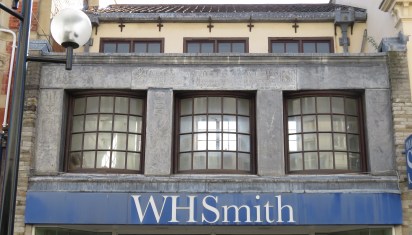
Smith’s shopfronts were usually recessed, with projecting display cases at either end, and were of natural, unpainted oak. The soffits were decorated with plaster motifs. A lot of the shops designed by Smith’s in-house architect Frank C. Bayliss (d.1938), made extensive use of Cotswold stone, laid as ‘coursed rubble’ – not rubble in the usual sense of the term, but blocks of stone roughly dressed in a vernacular manner. This can be seen on the upper elevation at Winchester, framing the façade at Weston-Super-Mare, and on the stall risers in St Albans and Leominster.

Ornamental Leadwork

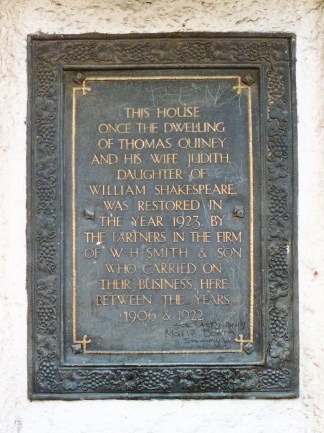
From 1906 until 1921 W. H. Smith occupied a corner property in Stratford-on-Avon which was associated with Shakespeare’s daughter, Judith (listed Grade II*). The firm decided to build larger premises nearby in 1921-23 (by Osborn, Pemberton & White with Frank Bayliss; listed Grade II), but also ‘restored’ the old shop.

Stratford upon Avon 2001 (4) - Copy

Stratford-on-Avon

This work was commemorated by an artistic lead plaque with a vine scroll border, set on the corner of the building. It was probably made by the Stratford-on-Avon Art Guild whose director, the Bath architect Frederick Ernest Osborne (1883-1935), went on to design aspects of Smith’s shops in other towns. For example, he was responsible for the decoration of Smith’s tea room in Worthing in 1928. The Stratford-on-Avon Art Guild is known to have fabricated a lead panel for Smith’s shop in Winchester, and possibly made all of the firm’s architectural leadwork.

Weston S Mare 2016 (11) - Copy

Weston-Super-Mare

Stratford upon Avon 2001 (10) - Copy

Stratford-on-Avon

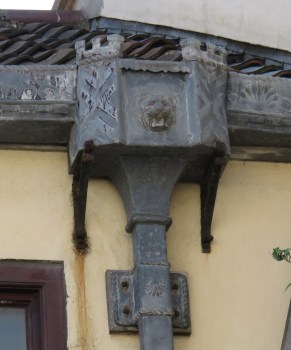
Leadwork featured prominently on Smith’s shops in the 1920s and 1930s. It can be seen principally in ornamental rainwater goods, with castellated hoppers and downpipes decorated with cable motif, vine scrolls and other patterns. On the side of the Winchester shop is a rainwater hopper depicting a ship and the date 1927.

Weston S Mare 2016 (14) - Copy

Weston-Super-Mare

Weston S Mare 2016 (5) - Copy.JPG

Weston-Super-Mare

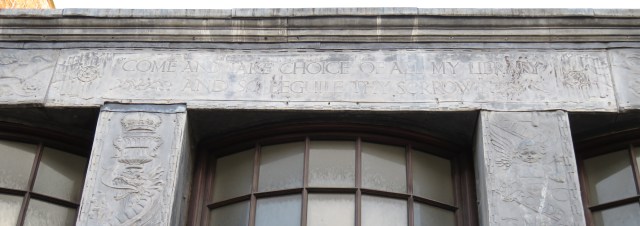
At Weston-Super-Mare, the entire first floor of the shop was faced in lead, embossed with shallow patterns. Above the typical Smith’s-style bow windows were stag hunts entwined with Tudor roses and pomegranates. Four large panels flanking the windows referred to Bath (a bear and the city arms), Somerset (a dragon with a chalice and crown), Taunton (a cherub and crown) and Bristol (a unicorn and the city arms). But, oddly, not to Weston itself.

Stratford upon Avon 2001 (6) - Copy

Stratford-on-Avon

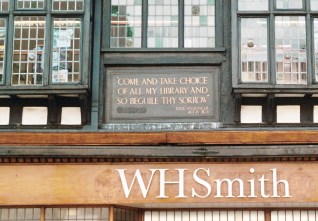
At both Weston-Super-Mare and Stratford-on-Avon the frontage of the shop included a lead panel displaying the text: ‘Come and take choice of all my library and so beguile thy sorrow’. This Shakespearian quote is from Titus Andronicus, Act 4, Scene 1. At one time the Cheltenham shopfront quoted Wordsworth: ‘Dreams. Books are each a World and Books we know are a substantial World both pure and good’. Above this a lead panel took its text from Edward Bulwar Lytton’s The Souls of Books: ‘The world so loud & they the movers of the world so still’.

Gill Lettering

W. H. Smith’s beautiful lettering was designed in 1903 by Eric Gill. This font was used for the first time on the fascia of Smith’s shop on the rue de Rivoli in Paris, where it was hand-painted by Gill himself. It continued to be used by the firm into the late 1950s. The modern equivalent is known as ‘Gill Fascia’.

IMG_4586 - Copy

St Albans

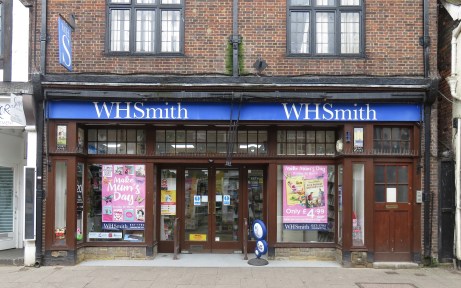
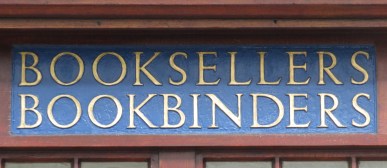
On fascias or signboards, the name of the firm, W. H. Smith & Son, was picked out in gold or white on a blue (often tiled) ground. This survives in St Albans, together with secondary signage reading ‘newspapers stationery’ and ‘booksellers bookbinders’. The current blue and white livery was introduced in 1997.

Tile Pictures

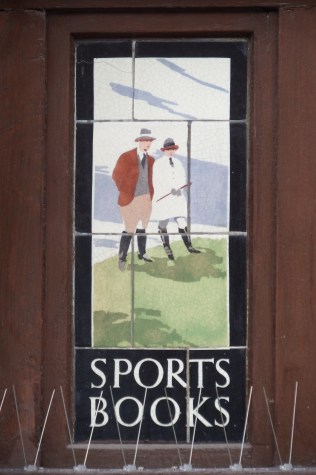
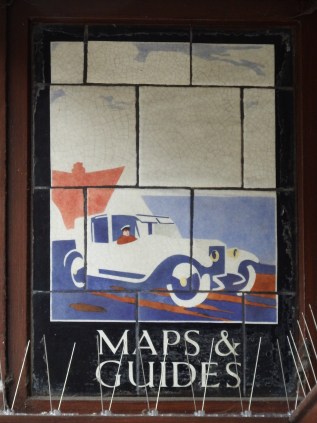
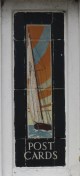
Pictorial tile panels in an attractive and colourful art deco style adorned the top corners of Smith’s distinctive recessed shopfronts in the 1920s and 1930s. Made by Carter & Co in Poole, these panels were effective advertisements for particular categories of goods such as postcards, books, guides and road maps.

003 - Copy

Rickmansworth

007 - Copy

Rickmansworth

Tenby (5) - Copy

Tenby

Tenby (11) - Copy

Tenby

In a recent study (published in the Journal of the Tiles and Architectural Ceramic Society in 2015), Ian M. Betts found these tile panels at 60 Smith’s branches. In general, they survive in small towns, for example Rickmansworth, Tenby, Great Malvern, Llandudno and Newtown. Others are now in museums, such as the Museum of London and the Jackfield Tile Museum, in W. H. Smith’s own collection, or in the hands of private collectors. Still more possibly remain in situ, covered up by paintwork or later shopfitting and awaiting rediscovery.

This post is in the series A Spotter’s Guide to the High Street.
Posted in CTN (Confectioners, Newsagents, Tobacconists), Spotter's Guides | 5 Comments

Jesse Boot and Boots Cash Chemists

nottingham-jan-2017-24-copy-copy

Detail of Boots’ shopfront, Pelham Street, Nottingham (1903).

Jesse Boot (1850-1931) followed in the footsteps of his Wesleyan parents, John (1815-1860) and Mary (1826-85), by becoming a medical botanist, or herbalist, providing remedies to the poor. John had opened the ‘British and American Botanical Establishment’ at 6 Goosegate in Nottingham in 1848. The family lived nearby, at 71 Woolpack Lane, in 1851, but by the time John died, aged 44 in 1860, they had moved to 6 Goosegate, presumably over the shop. Jesse Boot assumed control of the business in his mid twenties.

img_4169-copy

Bedford (1898): commemorating the company’s formation.

Alongside his own concoctions, Boot began to sell patent medicines at discounted prices for cash (rather than credit, as most chemists would have done at this time). As a result the business – called ‘Boot’s Patent Medicine Stores’ – took off. The premises, now at 16 Goosegate, were enlarged and rebuilt on an ambitious scale in 1881-3 to designs by the architect Richard Charles Sutton (1834-1915). The two-storey cast-iron shopfront, with its barleytwist colonnettes and plate glass windows, survives today. Coinciding with this rebuild, ‘Boot’s Patent Medicine Stores’ was renamed ‘Boot & Co Ltd.’

goosegate-aa99-08297-tp-1999

16-20 Goosegate, Nottingham (c. Historic England)

Boot’s mother, Mary, worked alongside him until her death in 1885. A year later, suffering from overwork (and probably also grief), he had a breakdown and sought recuperation in the Channel Islands. There he met Florence Annie Rowe (1863-1952), who worked in her father’s book shop in St Helier, Jersey. After their marriage, Florence helped Jesse to develop his business. She took an active interest in the design of the shops, which grew rapidly in number from the late 1880s and accrued new departments. In the largest branches these included books (from 1889), stationery (from 1895), toiletries (from 1896), artists’ materials, leather and fancy goods. Boots Booklovers Library, a subscription library usually positioned on the first floor, was established in 143 branches between 1898 and 1903.

The first Boots branch outside Nottingham had opened at 17 Snig Hill, Sheffield, in 1884, just before Boot’s sojourn in the Channel Islands. This was followed – in 1887, after his recovery and marriage – by a branch in Lincoln. For a short time, in the early 1890s, Jesse and Florence Boot lived in Sheffield.

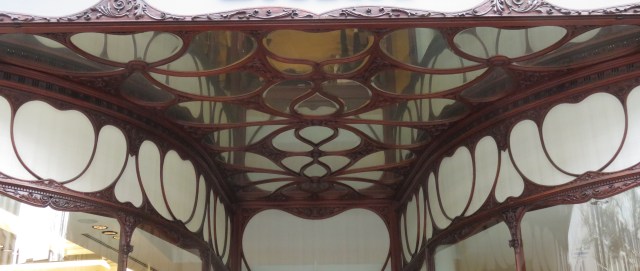
In 1888 Boot announced that he had spent months ‘hatching a surprise’ on Goosegate. This surprise was described as ‘a gorgeous structure of Mahogany Panels, Gilt Beading and Plate Glass Mirrors, which might pardonably be mistaken for a corner section of a Pullman Palace Car’ (Nottingham Evening Post, 14 December 1888, 2). It was, in fact, ‘an American elevator’, operated by hydraulic power, which served the basement (Artists Materials) and the first floor (Dispensing Department, Ladies’ Department, and Ladies’ Waiting Room – in other words, the lavatory).

A private company with around 18 investors was formed to finance expansion in 1888; this was the ‘Boots Pure Drug Co. Ltd.’ The shops, now trading as ‘Boot’s Cash Chemists’, were managed by qualified chemists. In 1890 there were four shops in Nottingham, three in Sheffield and two in Lincoln; the company employed 100 people, including 13 qualified chemists. Two years later the chain had increased to 24 outlets, dispersed throughout nine different towns.

There were 60 Boots shops in 1896, 181 in 1900, 251 in 1901 and 560 by 1914: a tremendous rate of expansion which required a restructuring of the company. In batches, the retail establishments held by the Boots Pure Drug Co. Ltd. were transferred to associate companies. First of all, in 1892, a limited liability company called ‘Boots Ltd.’ was formed to take over branches in the Midlands and Eastern counties. This was chaired by the grocer Mr James Duckworth (1839-1915), mayor of Rochdale – a self-made man who had a great deal in common with the Managing Director, Jesse Boot. In February 1900 ‘Boots Ltd.’ changed its name to ‘Boots Cash Chemists (Eastern) Ltd.’ Other regional companies were: ‘Boots Cash Chemists (Western)’ formed in 1897, ‘Boots Cash Chemists (Lancashire)’ in 1899 and ‘Boots Cash Chemists (Southern)’ in 1901. The latter was founded after the acquisition of Day’s Drug Stores, which provided Boots with 65 ready-made branches in the south-east. ‘Boots Cash Chemists (Northern)’ came into being in 1911, after the acquisition of J. H. Inman of Newcastle.

scribbling-diary-1905-bb016870-c-eh-copy

Boots’ Scribbling Diary, 1905, detail (c. The Boots Archive)

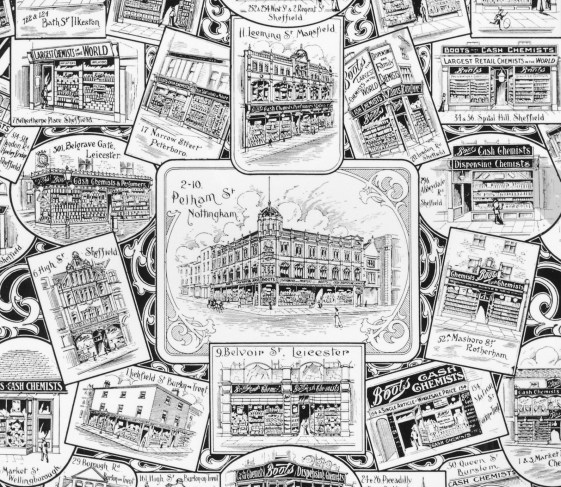
The shops held by these companies were supplied by the Boots Pure Drug Co. Ltd. Many were purpose built to designs by the Nottingham architect Albert N. Bromley, or by Boots’ in-house architect and his team. In 1892 it was announced that the ‘central depot’ was moving from Goosegate to 2-10 Pelham Street ‘where premises have been specially built from the designs of the managing director’ (Nottingham Evening Post, 19 August 1892, 4). Boot reportedly loved building, a passion evidently shared by his wife. Due to street improvements, the Pelham Street depot was rebuilt, in the style of a large emporium, in 1903.

pelhamst-1890s-c-boots-co-plc

2-10 Pelham Street, Nottingham, in the 1890s (c. The Boots Archive)

Boots’ manufacturing process had expanded beyond the premises on Goosegate. In 1889 Boot rented three rooms in Elliot’s lace factory on Island Street, Nottingham; by 1892 he had taken over the entire mill. At that time the firm employed nearly 300 people: 150 in the branches and 150 at the warehouse and laboratory (managed by E. S. Warning) on Island Street. Boot went on to lease every building lying between the Nottingham Canal and the Midland Railway Station. Here were the printing works, shopfitting department, general office and pharmaceutical laboratories. In 1908 an old Gas Works to the east was purchased and the site further extended.

bedford-oct09-21-copy

Bedford ( 1898)

During the Great War, 4,000 Boots employees joined the forces, which made it difficult to fulfil demanding Government contracts. These included chemicals previously imported from Germany, which now had to be made on home soil. In addition, Boots developed and manufactured box respirators, which protected soldiers from the effects of gas. They also produced saccharine, and tablets for sterilising water. Despite wartime conditions, new shops continued to be built.

Jesse Boot was knighted in 1909, became a baronet in 1919, and was raised to the peerage as Lord Trent of Nottingham in 1929. His philanthropy greatly benefitted his native town of Nottingham, where he was given the Freedom of the City in 1920. He financed the new University College, opened by King George V in 1928, and Highfields Park. In addition, he contributed generously to the Harlow Wood Orthopaedic Hospital (‘the Cripples Hospital’) of 1928-29. It was built, at no charge, by the ‘Sir Jesse Boot Property & Investment Co.’, which had been formed in 1920. Boot also erected housing for war veterans and workmen, in Nottingham and in Jersey.

From the age of 50 Boot was crippled by rheumatoid arthritis and his motor car had to be specially built to accommodate his invalid chair. In 1920 he sold his company to the United Drug Co. of America and in 1922 decided to retire to Cannes, subsequently settling in Jersey. Boot remained Chairman of the company for some time, but eventually handed responsibility to his son John Campbell Boot (1889-1956). He died in Jersey in 1931.

geograph-680917-by-Alan-Murray-Rust creative commons

Jesse Boot’s bust (1934) at Highfield Park. Image c. Alan Murray-Rust, Creative Commons.

Postscript
When the United Drug Co of America bought Boots, it comprised 630 shops, extensive production facilities and 10,000 employees. By the time the Americans sold to British investors in 1933, two years after Jesse Boot’s death, the chain operated over 900 shops.

A new site in Beeston had been acquired in 1927 to augment the cramped factories in the city centre. A Soap Factory opened there in 1929; Sir Owen Williams’ Wets Factory (D10) opened in 1933, and his Drys Factory (D6) in 1936. D10 and D6 are both Grade I listed. A new headquarters building by Skidmore, Owings & Merrill was erected in 1966-68.

The rival national chain Timothy Whites & Taylors was acquired by Boots in 1968. In 1971 the Boots Pure Drug Co. changed its name to ‘The Boots Company Ltd’. ‘Boots Opticians’ was formed in 1987 and became an important subsidiary chain. ‘The Boots Company PLC’ merged with Alliance UniChem in 2006 to become ‘Alliance Boots’. It is now a subsidiary of Walgreen Boots Alliance, and has 2,500 shops in the UK and Ireland.

Main Sources

Stanley Chapman, Jesse Boot of Boots the Chemists. A Study in Business History, Hodder & Stoughton, 1974

Kathryn A. Morrison, English Shops & Shopping, Yale University Press, 2003

Acknowledgements

My thanks to Sophie Clapp of The Boots Archive for giving me permission to publish images from their collection. For Alan Murray-Rust’s image see Geograph.

Posted in Boots the Chemist, Chemists' Shops | 3 Comments

A Spotter’s Guide to Boots the Chemist

canterbury-ff000460-pw-2000-copy

Canterbury (c. Historic England Archive)

The Boots Scroll

The Boots scroll – the distinctive signature logo – is familiar to everyone. Boots’ name is written in flowing cursive script, with a pennant flowing from the bar of the ‘t’ and an understroke emerging from the ‘s’. This logo is thought to have been devised in the late 19th century by a signwriter in Boots’ Shopfitting Department named Jack Hunt (Boots News 10 April 1974, 15). Many variants have been produced, including one in Gothic script for the  medieval-style shops favoured by the company before the Great War.

southend-bl-photo-copy

Southend in 1915 (Reproduced by permission of Historic England Archive)

Several retailers plagiarised the Boots scroll, including Cash & Co., who sold boots. Their signboards looked very like ‘Boots Cash Chemists’ at first glance. The scroll was standardised in 1924, and shortly afterwards registered as a trade mark. It appeared all over Boots’ shopfronts, notably on the fascias. As is still does today, in its shiny blue badge.

041

Ludlow, 2017 (R. Baxter)

midhurst-bb007163-ab-copy

Midhurst, 2000 (c. Historic England Archive)

img_4146-copy

Liverpool, 2017

The Boots Monogram

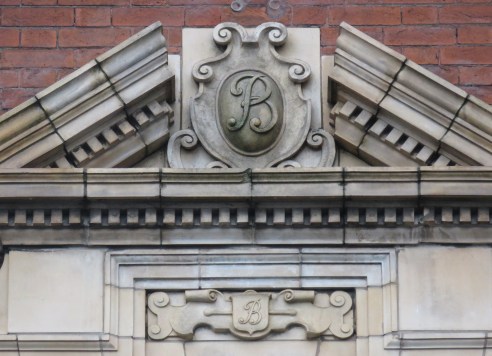
Boots’ cursive monogram can often be found on the upper façades of the company’s buildings.
img_4127-copy

London Road, Liverpool, 1896

nottingham-jan-2017-20-copy

2-10 Pelham Street, Nottingham, 1903

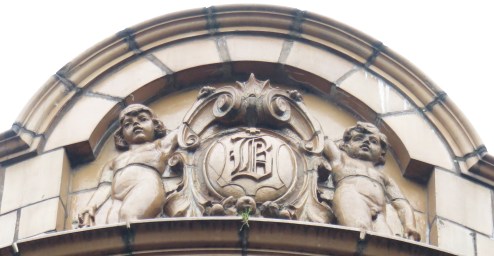
The monogram was often contained within a cartouche. As with the scroll (see above), several variants were used, including blocky Gothic-style lettering. This could be flanked by two back-to-back ‘Cs’ (for ‘Cash Chemists’). The monogram is sometimes – as in Tiverton – the last visible evidence that a building originated as Boots.

tiverton-2016-1-copy-copy

Tiverton, 1916

Brown Terracotta Fronts

From the late 1890s until around 1907 many purpose-built branches of Boots were faced in caramel-coloured glazed terracotta (often called faience) or plain reddish-brown terracotta. These buildings often had shaped gables or corner turrets. The detailing was inspired by French Renaissance and English Jacobean architecture. ‘Dolphins’ – hybrid sea creatures common in classical and Renaissance art – were a favourite motif.

003

Bedford, 1898

Boots’ so-called ‘central depot’ (its ‘flagship store’ in modern parlance) at 2-10 Pelham Street in Nottingham, of 1903, is the supreme example of this group of buildings though not, as sometimes claimed, the first. The architect was Albert Nelson Bromley.

nottingham-jan-2017-19-copy

2-10 Pelham Street, Nottingham, 1903

Imposing branches of this type – all designed by Bromley – were built on corner sites in several other towns, such as Birmingham, Sheffield (1906; 252-4 West Street) and Southend, where the facing material was identified as Doulton’s Carrara Ware.

southend-bl-photo

Southend, photographed by Bedford Lemere in 1915 (Reproduced by permission of Historic England Archive)

The style could be adapted to smaller branches of Boots, for example in Burton-on-Trent (1897), Bedford (1898), Buxton (1906), Sheffield (1905, 762 Attercliffe Road, listed Grade II), Cambridge (1906, Market Place), Dover (1908), Grantham (1899), Lewisham (1908), Lytham St Anne’s (1906), Mansfield (1904), Melton Mowbray (1898) and Nuneaton (1907).

buxton-2-2001-1-copy

Buxton, 1906

Timber-Framed Fronts

Boots had altered a couple of genuine timber-framed buildings, notably in Chester and St Albans, before beginning to erect new mock-timber-framed frontages.

kings-lynn-10-copy

Kings Lynn, built c.1903-8

Michael Vyne Treleaven, Boots’ in-house architect, prepared a design for a new black and white half-timbered front at 43-44 High Street, Kings Lynn, in 1903. The building standing on this site today does not conform exactly with Treleaven’s original design, yet it was certainly occupied by Boots by 1908 (London Daily News, 12 December 1908, 3). Perhaps it was an early experimental venture in this style.
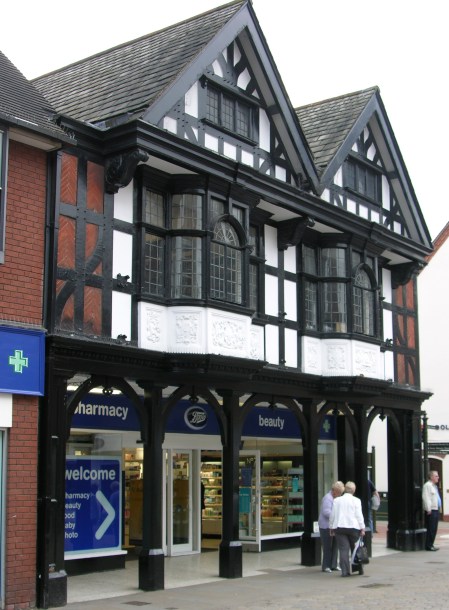
easter2011lichfield-9-copy

Lichfield, built 1908. Trent Bridge had a similar arcade.

Later examples of black and white fronts include Trent Bridge (1906-7; later Boots Social Club, now ‘The Embankment’), Wellingborough (1907), York (1907), Shrewsbury (1907), Winchester (1905), Kingston-upon-Thames (1909), Lichfield (1908), Bury St Edmunds (1911), Peterborough (1911-12) and Gloucester (1914). Derby (1911-12) offers a variation with a plastered front in the style of the 17th century. Indeed, no two of Boots’ historical fronts were the same – even the timber bargeboards and brackets differed from site to site. In most cases – at least up to 1912 – Treleaven can be established as the architect.

winchester-2000-1

Winchester, built 1905.

Several of these buildings had oriel windows with Venetian-style glazing, probably inspired by the well-known Sparrowe’s House (the ‘Ancient House’) in Ipswich, while others had mullion and transom windows with leaded lights and stained glass panels. The infill panels were often covered in plaster decoration. At Lichfield this included an owl wearing a mortar board, a beehive, and a jester playing a bagpipe.
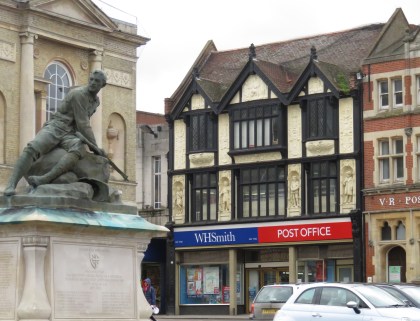
img_4081-copy

Former Boots, Bury St Edmunds, built 1911

Boots stopped producing historical fronts at the outbreak of the Great War, but the company architect Percy J. Bartlett designed a couple of timber-framed façades c.1930, in Hereford and Farnham. This was something of a short-lived fashion amongst multiple retailers at this time. Woolworth, for example, built a similar store in Kingston-upon-Thames.

Statues of Local Worthies

Most of the statues of local worthies that adorned many of Boots’ historical façades were probably made by Gilbert Seale & Son, an architectural sculptor, modeller and plasterer based in Camberwell in south London. Seale can be firmly identified as the sculptor of the statues at Peterborough (Peterborough Advertiser, 11 May 1912, 2) and at Bury St Edmunds (Bury Free Press, 25 November 1911, 3). He probably decorated the frontages of many Boots branches before the Great War, the plasterwork as well as the figures.
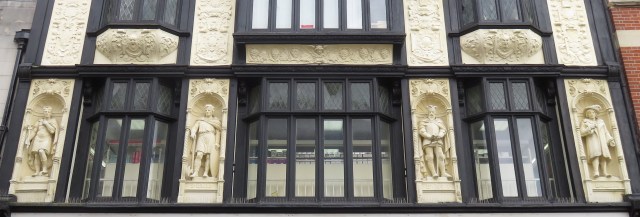
img_4029-copy2

Bury St Edmunds, built 1911

007-copy

Bury St Edmunds, built 1911

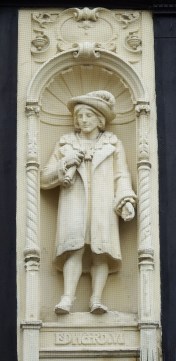
The individuals represented on Boots’ façades, generally identified by short inscriptions, were usually of local or regional significance. The two figures in the photograph of Winchester, above, were Bishops Walkelin and Wykeham. Those at Bury St Edmunds – from left to right as one faces the façade – were Agricola, St Edmund, Edward I and Edward VI. An additional relief panel in the central gable depicted ‘Canute Rebuking his Flatterers’ – this title is carved into a timber.

Boots’ Newcastle shop was adorned with Thomas Bewick, Harry Hotspur, Sir John Marley and Roger Thornton, while Derby featured Florence Nightingale, John Lombe, William Hutton and Jedediah Strutt. The figures at Peterborough were: Athelwold (‘Athwald’), Peada (King of Mercia), Henry VIII, Prince Rupert and the Earl of Essex. The local newspaper was baffled by the inclusion of the last pair, who alluded to the Civil War but had no obvious link with the city. At Kingston-upon-Thames Queen Elizabeth was accompanied by five kings, including Athelstan and Edward the Elder. Here the antiquary and mayor (in 1898, 1901 and 1908), Dr William Finney, is said to have advised on the identities of the statues, suggesting that Boots sometimes chose the identities of the figures through a process of local consultation.
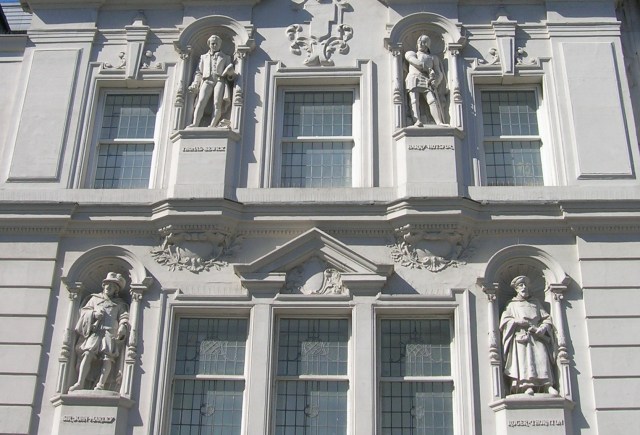
newcastle-2-copy

Newcastle, 1912 (repaired after fire 1913)

Boots’ Scottish flagship was the branch on Princes Street in Edinburgh, a baronial-style stone-faced building. As in Newcastle, timber framing would hardly have been suitable in this northern city. Nevertheless the frontage included statues depicting persons of national importance: Sir Walter Scott, John Knox, Robert the Bruce, William Wallace, George Wishart, Robert Burns and, in the centre, Bonnie Prince Charlie. It is not known what happened to these figures when the building was demolished in 1965 – maybe one day they will come to light.

Main Sources

Stanley Chapman, Jesse Boot of Boots the Chemists. A Study in Business History, Hodder & Stoughton, 1974

Kathryn A. Morrison, English Shops & Shopping, Yale University Press, 2003
Posted in Boots the Chemist, Chemists' Shops, Spotter's Guides | 1 Comment

The Story of Montague Burton – the Tailor of Taste

Introduction

NPG x19440; Sir Montague Maurice Burton by Bassano

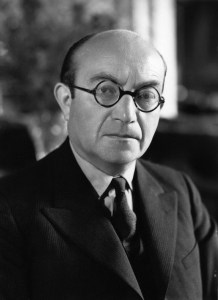
Montague Burton photographed by Bassano on 15 June 1938. c.  National Portrait Gallery (cropped)

Montague Burton was not the first to establish a successful chain of tailor’s shops throughout Britain: Joseph Hepworth and his son Norris had opened their first shops in 1884. Nevertheless, between the 1920s and the 1960s, Burton was the country’s predominant high street tailor. The company manufactured made-to-measure suits at its factories in Leeds and Worsley, dealing directly with customers through its impressive shops. In the 1920s and 1930s these ‘modern temples of commerce’ were built on a large scale in town and city centres, often with upper-floor billiard halls that attracted potential customers. When fashions changed and the demand for suits plummeted, Burton diversified into general outfitting. It is now one of several retail brands in Philip Green’s Arcadia Group, with around 400 UK outlets.

1900 to 1918

The founder of Burton, Meshe David Osinsky (1885-1952), emigrated in 1900 from the province of Kovno (within the Pale confining Russia’s Jewish population; modern Lithuania) to England where he initially took the name Morris, or Maurice, Burton. Although he claimed to have borrowed £100 from a relative to set himself up in business in 1900, Burton evidently started out as a pedlar. By 1904, however, he was running a small outfitter’s shop at 20 Holywell Street, Chesterfield. This was followed by additional shops in Chesterfield and Mansfield, selling ready-made clothing to working men.

Burton began to offer made-to-measure (‘wholesale bespoke’) suits in 1906, but contracted out their manufacture until he opened his own workshop two years later. This was reportedly located in part of ‘Progress Mills’ (known only on letterheads) before moving to Elmwood Mills in Leeds.

Following his marriage to Sophia Amelia (‘Cissie’) Marks in 1909, Burton took British citizenship and moved to Sheffield where he opened a ‘Burton & Burton’ store at 101-103 The Moor. The second ‘Burton’ was probably Burton’s brother Bernard, who remained a lifelong business associate. By 1914 Burton & Burton had 14 shops, mainly occupying leased premises on high streets throughout northern England and the Midlands (including Manchester, Leicester and Stockport).
Burton was excused military service during the Great War and in 1916 won a lucrative contract to manufacture uniforms. One year later, Burton & Burton was transformed into a limited liability company called Montague Burton, The Tailor of Taste Ltd. The man himself now assumed the name Montague Maurice Burton. By 1919 he had 36 shops, of which many (including Coventry, Dudley, Swansea and Wandsworth) had opened in the course of the war. Eight branches were in Ireland.

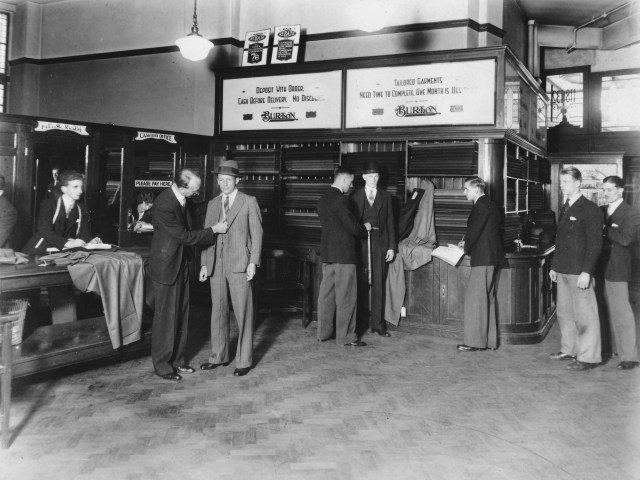
Burton’s shops enjoyed a symbiotic relationship with his factories. Customers would visit a shop, peruse catalogues, inspect fabrics, have their measurements taken, place their order and pay a deposit. Their suit was then manufactured (made to measure, to the customer’s specifications) in one of Burton’s factories. The main production facility from 1914 was Concord Street Mills, Leeds. With the pressure of war work, however, Byron Street Mills was taken on in 1917 as an auxiliary clothing factory. Other facilities were located on Woodhouse Lane, Melbourne Street and Millroyd Street.

1918 to 1939

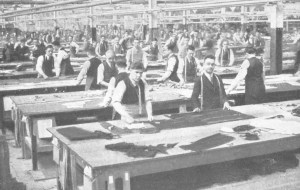
Growth did not stop with the Armistice. The demand for ‘demob’ suits enabled Burton to take over the vast Hudson Road Mills in Leeds from the wholesale clothiers Albrecht & Albrecht. These were said to be the largest works of their kind in the world, and were greatly expanded by Burton.

hudson-rd-mills-cutting-rm

Cutting Room, Hudson Road Mills (from Ideals in Industry, 1936)

hudson-rd-mills-canteen

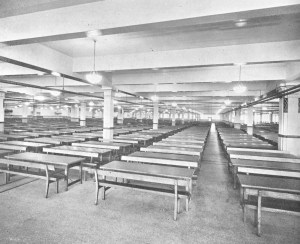
Canteen, Hudson Road Mills (from Ideals in Industry, 1936)

The first canteen at Hudson Road Mills, built in 1922, could accommodate 1,000 at a sitting. Its successor, which was completed in 1928, could seat 4,000 workers, but was itself superseded by a new canteen for 8,000 (by architect N. Martin), which was opened by Mary, the Princess Royal, in October 1934. By this time there were 10,000 employees at Hudson Road Mills. As well as its state-of-the art catering facilities the factory had a medical clinic and rest rooms. Sports field and recreation grounds were provided in 1935.

hudson-rd-factory-2000-copy

Hudson Road Mills, Leeds, 2000

Suits were despatched from this great factory to the branches by a fleet of 24 motor vans. The chain of shops expanded rapidly. There were 36 in 1919 and 200 in 1923. When the company went public, with capital of £4 million in 1929, it had 364 sites (197 freeholds) and 293 shops. By 1932 there were 380 shops, and by 1939, 595. From the early 1920s these premises were purpose-built by the company, on an enormous scale. Click to read more about these buildings, or to consult a spotter’s guide to Burton’s shops.
london-descreened

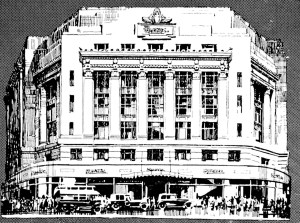
Burton’s flagship store on the corner of Tottenham Court Road and New Oxford Street, London (1930; from Ideals of Industry, 1936)

In 1937 Burton’s architect, Nathaniel Martin, collaborated with the architects Wallis Gilbert & Partners on a subsidiary clothing works on the Great Lancashire Road at Worsley, near Manchester (The Builder, 10 March 1939, 478). Conceived as a Garden Factory and built in a modern style, this was dubbed ‘Burtonville Clothing Works’. It opened in October 1938 – the year Burton decided to open ready-to-wear departments in all branches – but soon had to be supplemented by Halliwell Road Mills in Bolton, which was acquired in 1939.

Within months the country was once more at war – and Burton once again switched its resources to military clothing.

1945 to 2017

Burton bought a lot of property cheaply during the Second World War, and so by 1945 the company owned 130 key high street sites which it was not using. Many of these properties never became shops. Throughout the 1940s it was difficult for Burton to fulfil orders due to shortages of cloth and other materials. Expansion of the retail chain was arrested – indeed, replacing war damaged shops was a priority until 1950 – but in 1947 the bomb-damaged Peter Robinson store at Oxford Circus in London, was acquired. This was developed into a women’s fashion chain with branches in Brighton, Gloucester, Cheltenham and elsewhere.

Sir Montague Burton, who had been knighted in 1931, died in 1952, when there were 616 Burton branches. In 1953 the firm merged with Jackson the Tailor. Lionel and Sidney Jacobson (sons of the founder of Jacksons) took over the management of the company and refurbished the shops, starting with the Newcastle branch. The Hudson Road factory had a staff of just 5,000 in the late 1950s: half of the number employed there in 1939.

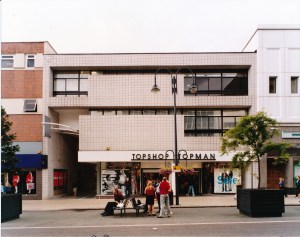
Burton began to diversify by stocking lines associated more with outfitters rather than with tailors: ties in 1969 and shirts in 1974. During the 1970s and early 1980s most of Burton’s factories, including Hudson Road Mills, ceased production. The Burton Group (as the company was called from 1969) began to concentrate on women’s wear: the manager of the Peter Robinsons chain, Ralph Halpern, launched Top Shop in 1964. Top Man started up in 1978 and freestanding Top Shop outlets opened from 1974. Later acquisitions were Evans Outsize (1970), Dorothy Perkins (1979), Debenhams (1985) and John Collier (1986). Principles was launched in 1984, followed by Principles for Men in 1985.

southport-1999-copy

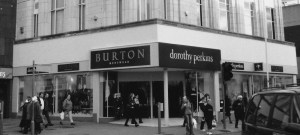
Shared fascias: Southport in 1999

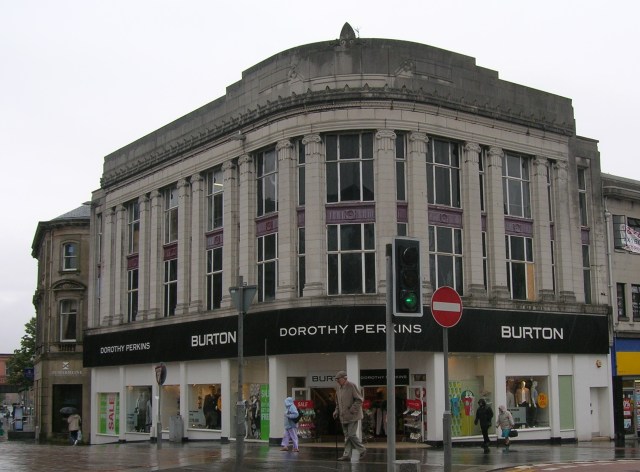
In a 1990s review of its property portfolio (‘Townprint’) the Burton Group rationalised its use of space, often co-locating shops within a single building. Thenceforth Burton often had to share its premises with other house brands, such as Dorothy Perkins. In 1998 Debenhams was demerged and the Burton Group was renamed Arcadia Group. Through the purchase of Sears in 1999, Arcadia acquired Richard Shops, Miss Selfridge and Wallis. Since 2002 Arcadia has been owned by Philip Green’s family.

abergavenny-17-copy

Modern fascia: Abergavenny

Many Arcadia brands have come and gone over the years. Jackson the Tailor, for example, was wound down in 1978. Burton, though no longer a traditional tailor and much transformed from its heyday, has remained trading throughout. Often there is still a snooker hall on the first-floor, over the shop.

Principal Sources: Ideals in Industry, 1936 (3rd edn); Eric M. Sigsworth, Montague Burton – the Tailor of Taste, 1990; K. Morrison, English Shops & Shopping, 2003. Thanks to @LaidByMonty via Twitter for supplying a few elusive dates. If anyone can plug any gaps, I would love to hear from you.

Postscript. On 30 November 2020 Arcadia entered administration. The Burton brand, but not the shops, was bought by the online retailer Boohoo.com – together with Dorothy Perkins and Wallis – in February 2021.

Posted in Burton, Fashion and Clothing | 12 Comments

Burton’s ‘Modern Temples of Commerce’

hull-2016-11-copy

Hull (1936)

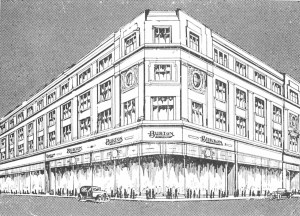
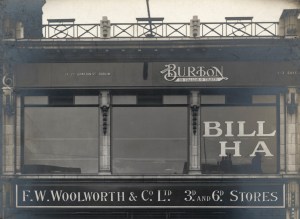
Montague Burton began to build new shops – ‘modern temples of commerce’ – around 1923, when he had amassed around 200 branches. The next year the company opened in a wing of Woolworth’s new superstore in Liverpool where Burton’s architect, Harry Wilson, worked alongside Woolworth’s William Priddle.

liverpool-descreened

Liverpool (Church Street, 1924; from Ideals in Industry, 1936)

Early drawings of Woolworth’s Liverpool and London superstores, dated 1922-24, show that Woolworth intended to allocate space to billiard halls, but these never materialised. Instead, the idea of combining billiards and retailing was adopted by Burton.

fww01_01_0040_001.tif

Colchester, c.1930 (c. Historic England Archive

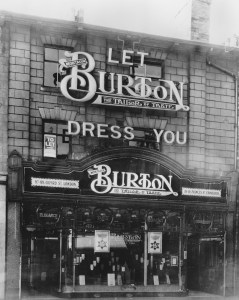
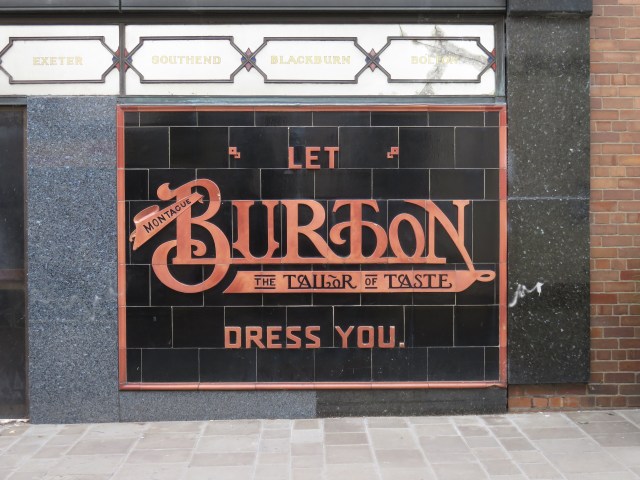
At this time Burton’s shops occupied a motley portfolio of leased buildings. They often had a striking appearance, with gigantic lettering plastered over their frontages – even screening upper-floor windows – with the invitation: ‘Let Montague Burton the Tailor of Taste Dress You’. The shopfronts followed a template. Each had a arched fascia of green glass, edged with gold and filled with white lettering. Below this ornate transom lights, still in the Edwardian fashion, displayed the words ‘Elegance’, ‘Taste’, ‘Economy’ and ‘Courtesy’. The entrance lobbies had mosaic floors.

hull-hessle-rd

Hessle Road, Hull, 1920s (c. Arcadia Group PLC)

More modern shopfront designs were adopted in the mid-1920s. At Liverpool (1924, see above), Hammersmith, Bradford (1925) and other branches of this period the transom lights were rectangular, punctuated by garlands and containing the usual words: ‘Courtesy’, ‘Taste’, etc. By the end of the decade, however, this had been superseded by the Burton ‘chain of merit’ (see below).

nottingham-jan-2017-8-copy

Nottingham (Beastmarket, 1924)

The Nottingham branch (Beastmarket, 1924) is typical of the earliest purpose-built Burton stores, having strong neo-Classical features and paired pilasters. From 1927 until 1929, when Burton went public, the shops were purchased and held by Burton’s property company, Key Estates Ltd. The estate agents Healey & Baker were employed to find suitable sites in prominent locations, ideally occupying corners. Unsurprisingly, many pubs were acquired. Sites were inspected by Burton’s Deputy Manager, Archibald W. Wansbrough (1880-1961), or by Montague Burton himself. Often the vendor was kept in the dark about Burton’s interest – in case this inflated the price.

belfast-conference-88-copy

Belfast, rebuilt after a fire in 1928.

Harry Wilson had become the company architect by the early 1920s, and was responsible for developing Burton’s house style. Montague Burton, however, maintained a close personal interest. The company’s in-house Architects Department was set up around 1932 under Wilson. He was followed as chief architect around 1937 by Nathaniel Martin, who was still in post in the early 1950s. The architects worked hand-in-hand with Burton’s Shopfitting and Building Departments, who coordinated the work of selected contractors. Throughout the late 1920s and 1930s they were kept phenomenally busy: by 1939 many of Burton’s 595 stores were purpose-built.

douglas-isle-of-man-2014-8-copy

Douglas, Isle of Man (1929; Burmantofts white faience)

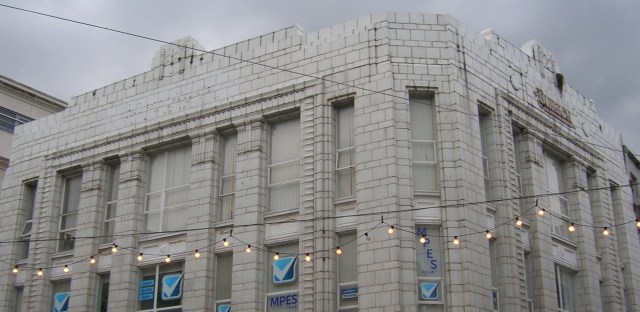
Burton’s buildings are instantly recognisable. However, they were not identical. It is sometimes said that Burton adopted four different designs: in fact the company’s buildings were much more varied than that. Façades, for example, could be clad in a variety of materials, including Portland or ‘Empire’ stone, emerald pearl granite, white faience (glazed terracotta) or red brick. Sometimes locally quarried sandstone was used, for example in Carlisle and Dundee.

paisley-2-copy

Paisley (1929-30; listed Grade B)

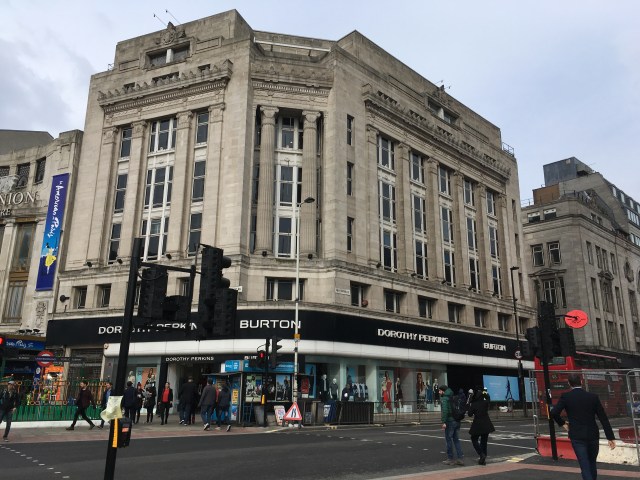
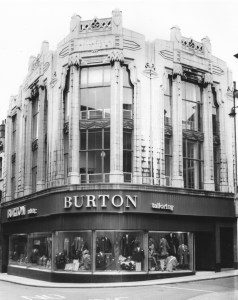
Architecturally, façades were conceived as giant elevations, of the type made popular by Selfridges on Oxford Street in London in the years before the Great War. An example is the six-storey flagship store on the corner of Tottenham Court Road and New Oxford Street in London (1930), which was advertised as ‘the largest tailoring establishment in the world’.

Burton Tott Ct Rd 2017

Corner of Oxford Street and Tottenham Court Road (1930).

Set between the upper-floor pilasters of these stores were metal-framed windows with margin lights, and moulded metal spandrel panels which masked floor levels. The rendering was often classical – sometimes with strong Grecian overtones – but from the late 1920s this relatively ‘correct’ architectural approach was sidelined.

bournemouth-copy

Bournemouth

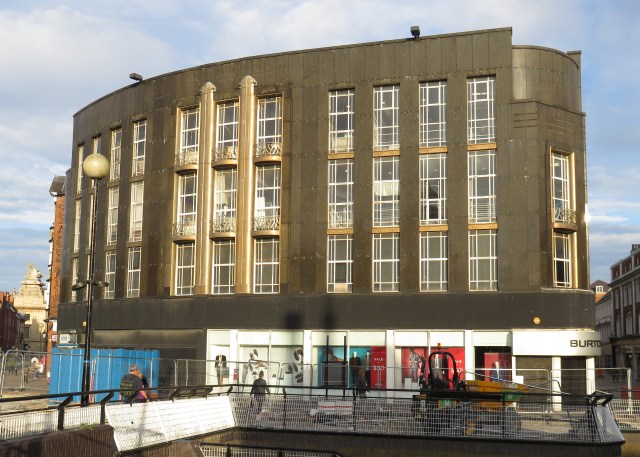
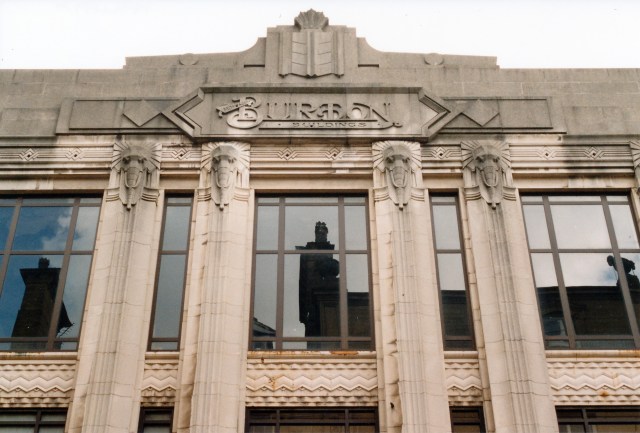
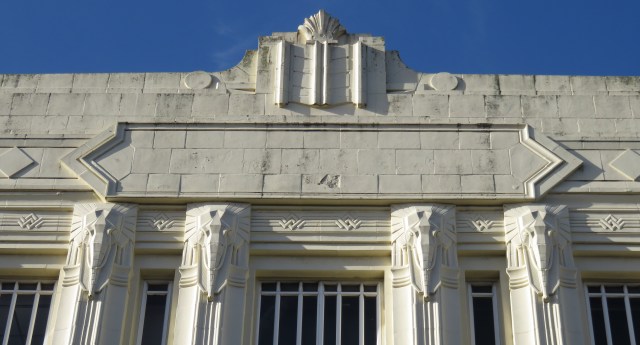
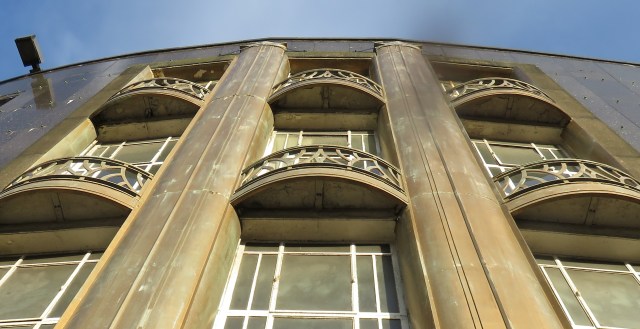
Burton became one of the most enthusiastic exponents of the art deco style on British high streets: the armature of the buildings remained similar, but pilasters were replaced by moulded or ornamented fins (for example at Bury St Edmunds in 1933), while capitals were superseded by geometric blocks, or even stylised elephant heads (for example at Weston-super-Mare in 1932). The repertoire of motifs was extensive.

bury-st-edmunds-me-18-copy

Bury St Edmunds (1933)

weston-sm-3-copy

Weston-Super-Mare (1932)

birmingham-dale-st-aa009682

Birmingham, Dale Road (1937)

hitchin-rb-jan-2017-2-copy

Hitchin (1938) (photo: R. Baxter)

In the late 1930s a number of buildings, especially in historic town centres such as Woking, York, Truro and Hitchin (1938), were designed with more conservative neo-Georgian fronts. These were usually faced in red brick, with pale ashlar dressings and Ionic pilasters. Regardless of style, parapets added height to Burton’s buildings, but many of these were removed or rebuilt in later years because they became structurally unstable. Even if parapets survive, ‘Burton’ lettering has often ‘gone for a Burton’.

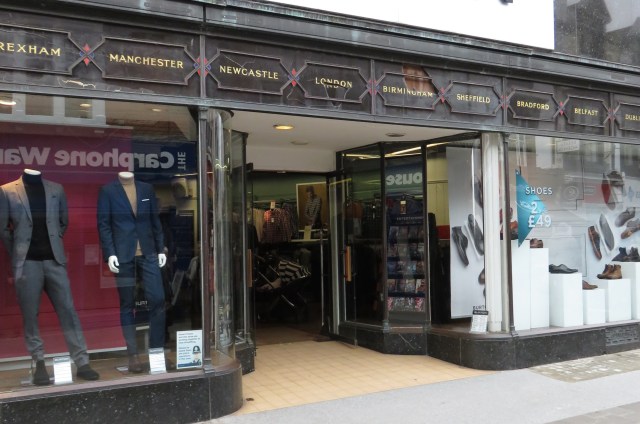
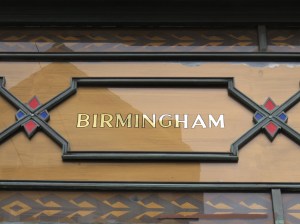
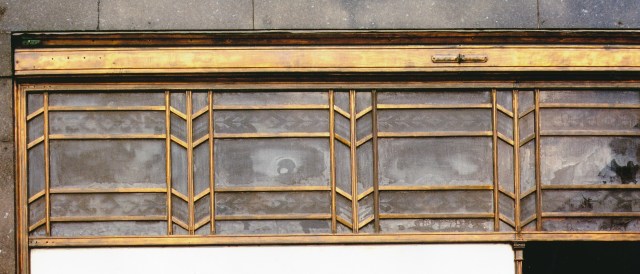
Two types of shopfront were used by Burton through the 1930s. They had two principal features in common. First, emerald granite frames with date stones laid by members of the Burton family. Second, transom lights displaying the company ‘chain of merit’: naming towns which hosted important branches. One design involved elongated hexagons and the other chevrons: motifs which were repeated on the entrance doors. Examples of both designs have survived, together with some of Burton’s lettered mosaic floors and entrance lobbies. Burton’s principal shopfitters were John Curtis Shopfitters of Leeds and the Cheltenham Shopfitting Co.

abergavenny-20-copy

Abergavenny (1937)

Despite the imposing size of Burton’s buildings, only a small area was needed for each shop. An entrance screen of timber and glass gave a club-like sense of privacy. Inside was an uncluttered, masculine space. The floor was of oak block and the walls were lined by wooden mantle cases for hanging garments and fixtures for displaying rolls of cloth. Part of Burton’s buildings often contained lock-up shops. These were on short leases so that Burton could repossess the space if needed, for example when ready-to-wear departments opened in the mid-to-late 1930s.

don-bradman-yorkshire-cricket-team

Don Bradman and fellow cricketers in Burton’s, c.1933. (Ideals in Industry, 1936)

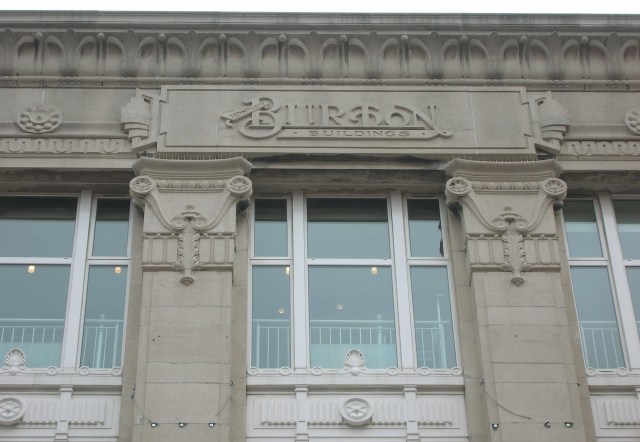
Montague Burton liked the first floors of his buildings to be used as temperance billiard halls. The space was designed with this in mind. Six-inch concrete floors were covered in wood block, and independent access was provided to one side of Burton’s shop. Some upper floors, for example in Nottingham, Hull and Stafford, were rented out as offices (often with ‘Burton Buildings’ or ‘Burton Chambers’ over the doorway and in the parapet). Others housed flats for Burton employees.

By 1937 Burton had six categories of building (A to F), the main variable being the number of storeys and the uses to which they were put.

cambridge-1999-copy

Cambridge (1950)

Lionel Jacobson, Montague Burton’s successor, instituted a programme of refurbishment in 1953, and by 1956 half of the 635 shops had been modernised. It was at this time that high fascias of slatted timber or mosaic tiles were installed, and the inter-war transom lights with their ‘chain of merit’ were concealed or removed. The lettering on the new fascias simply read ‘Burton tailoring’. Fortunately, this was all rather cosmetic, and did not involve wholesale replacement of the pre-war shopfronts.

leeds-aa022435-2001-by-tp

Leeds, Briggate (c. Historic England Archive)

By and large Burton built far fewer new stores after the war. New stores of the 1950s were much less ostentatious than those designed in the 1930s.

Around 1960, when Burton was doing a roaring trade in Italian men’s suits, some new stores were built in a blocky modern style. Asymmetrical windows were deeply recessed, appearing dark in façades clad in white oblong tiles. Two stores were built on Briggate in Leeds in this style, one including an arcade.

Into the 1970s, shopfronts had pale grey granite stallrisers and pilasters and red Perspex letters illuminated in red neon. Many fascias were sprayed with a textured coating in the 1980s.

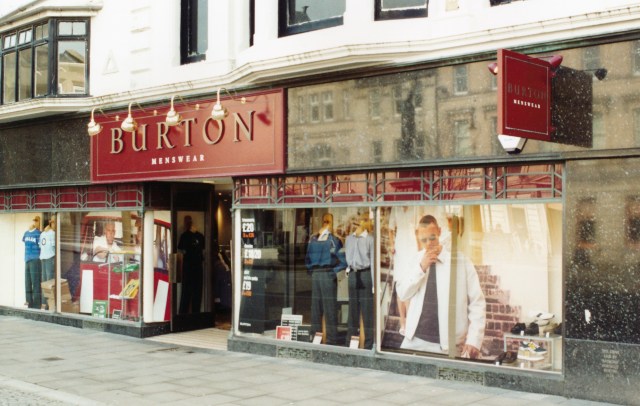
Burton’s Architects Department (renamed the Design & Construction Department in 1971) closed in 1975 and it was an external design company that modernised the shops shortly thereafter. Many sites were disposed of by Montague Burton Property Investments Ltd (which had been set up in 1972). There is little to say about Burton’s shops since the 1970s. The maroon-coloured fascia and gold lettering so familiar at the turn of the millennium has more recently given way to very plain squared letters (BURTON), either black on a white ground or vice versa.

elgin-r-baxter-1937-1-copy

Elgin in 2002 (photo: R. Baxter)

Posted in Burton, Fashion and Clothing | 18 Comments

A Spotter’s Guide to Montague Burton – the Tailor of Taste, Part 2

weston-copy-2

Weston-Super-Mare (1932)

Art Deco Motifs

tunbridge-wells-aa011851-2000-copy-copy

Tunbridge Wells (c. Historic England Archive)

Burton’s architect, Harry Wilson, had fully embraced art deco by 1930 and seems to have had great fun dressing façades in variants of this popular style. This involved the application of stylised geometric motifs, sometimes in profusion.

By the mid-to-late 1930s the most common of Burton’s art deco motifs was a band of overlapping concentric  quadrants. This Burton ‘signature’ may be spotted, for example, in Abergavenny (1937), Falmouth (1937), Gosport (1938), Letchworth (1938) and Hertford (1939). It can even be found executed in faience, for example in Jarrow, Macclesfield (1939) and Hull (Hessle Road, 1939).

letchworth-rb-2017-6-copy

Letchworth (1938) (photo: R. Baxter)

Sometimes several Burton branches adopted the same (or a very similar) design. One stylistic group of the early 1930s included Cheltenham, Ilford, Leamington Spa (1931) and Southend (1929-33).

leamington-spa-1999-1-copy-copy

Leamington Spa (1931)

southend-1999-copy

Southend

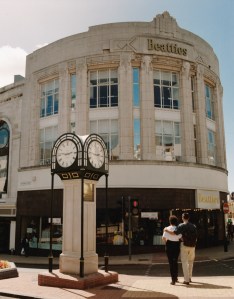
One of the most extraordinary of Burton’s art deco facades, unparalleled elsewhere, was in central Birmingham. This was distinctly Moorish in style, and can be regarded as Burton’s equivalent of Woolworth’s Sunderland branch.

birmingham-2001-800dpi-copy

Birmingham in 2001, shortly before demolition

york-coney-st-sept-1959-copy

Coney Street, York (1931), in 1959 (before parapet removed) (c. Arcadia Group PLC)

Granite Façades

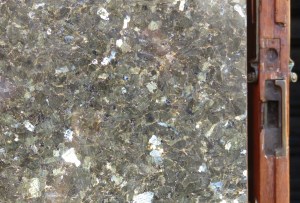
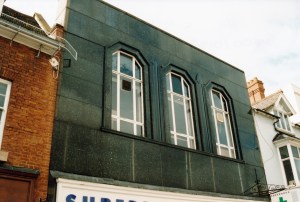
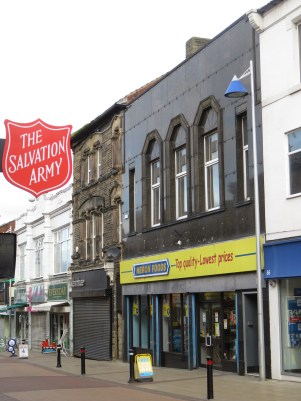
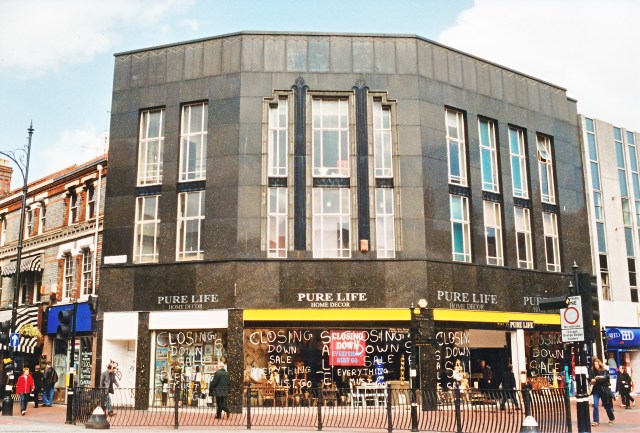
Smooth, reflective, polished emerald pearl granite faced around 15 Burton stores of the 1930s, including Bournemouth, Hull (1936), Mexborough (1937), Poole, Reading, Southampton, Stratford-on-Avon and Wednesbury. The suppliers at Hull, and probably for all the others, were Fenning & Co. of Hammersmith.

hitchin-jan-2017-32-copy

Emerald Pearl Granite (Hitchin, 1938)

stratford-on-avon-2001-1

Stratford-on-Avon in 2001

Mexborough March 2017 (14)

Mexborough

Many of these dark façades had three principal windows with polygonal heads, often enclosing sunbursts. This extended the aesthetic of the ‘chain of merit’ and the ‘coffin’ doors. Interestingly, the same design was replicated in Empire Stone, brick and other materials, for example in Newark (Stodman Street, 1934), Bury St Edmunds, Durham, Lincoln (1931), and elsewhere.

hull-2016-15-copy

Hull (1936)

The black façade of Hull, the most stunning of the granite stores, was set off by gold metalwork. It resembled the smaller Reading frontage.

reading-2000

Reading (1936)

The fashion for polished granite façades was probably triggered by the National Radiator Building (Ideal House; Raymond Hood & Gordon Jeeves, 1928) in central London. Marks & Spencer also built a few stores with dark granite facades, notably in Leeds, and at the Pantheon on London’s Oxford Street.

Elephant Heads

halifax-2001-3

Halifax (1932)

While a vast variety of geometric motifs, mostly abstract, appeared in the Burton lexicon, the most popular and intriguing are the elephant heads which crown pilasters at, for example, Barking (1931), Belfast (Ann Street), Cardiff (Queen Street), Greenwich (1932), Halifax (1932), Oldham, Streatham (1932), Wolverhampton and Weston-Super-Mare (1932). Perhaps ALL of Burton’s elephants date from a brief period in 1931-32?

weston-s-mare-3-copy

Weston-Super-Mare (1932)

Taking the place of capitals, these can be compared with the use of lion’s heads on Woolworth’s Walsall store, of a similar date. The exact significance of Burton’s elephant heads, however, has never been fully explained.

wolverhampton-beatties-burtons-copy

Wolverhampton in the 1990s

Posted in Burton, Fashion and Clothing, Spotter's Guides | 5 Comments

A Spotter’s Guide to Montague Burton – the Tailor of Taste, Part 1

Abergavenny (5) - Copy.JPG

Abergavenny (1937)

‘The Tailor of Taste’

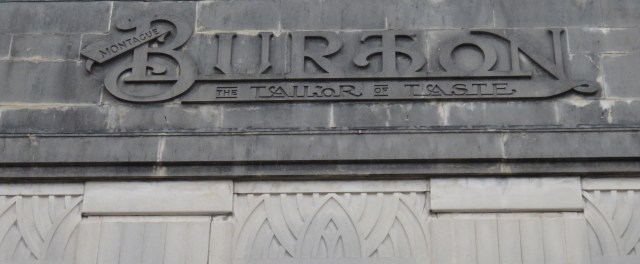
When Montague Burton became a limited company in 1917, it was registered as ‘Montague Burton the Tailor of Taste Ltd’. The slogan, as part of Burton’s name, formed part of firm’s logo, appearing on fascias, parapets, floors, and even on ventilation grilles.

abergavenny-25-copy

Abergavenny (1937)

penrith-2016-4-copy

Penrith (1937)

Date Stones

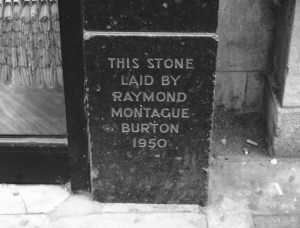
Burton shopfronts had surrounds of polished emerald pearl granite, with simple plinths that were treated as foundation stores. They were engraved with the name of the member of the Burton family who ‘laid’ them, and the date. Most of them were laid by Montague Burton’s children: Barbara (born 1909), Stanley (born 1914), Raymond and Arnold (twins, born 1917). These stones continued to be laid until the end of Montagu Burton’s life, in 1952.

douglas-isle-of-man-2014-4-copy

Douglas, Isle of Man (1929)

carmarthen-1-copy

Carmarthen (1935)

Ventilation Grilles

These can be spotted beneath Burton’s display windows. Instead of simple vents, these inlets were protected by specially commissioned bronze grills bearing the Burton logo and slogan. Two designs can be found: one rectangular and the other oval.

abergavenny-21-copy

Abergavenny (1937)

sheerness-june-2016-10-copy

Sheerness (1931)

The ‘Chain of Merit’

In the 1930s Burton devised two different designs for the transom lights that ran along the top of the display windows. Both included the ‘chain of merit’, including the names of towns and cities with important Burton stores.

abergavenny-24-copy

Abergavenny (1937)

sheerness-june-2016-8

Sheerness (1931)

The most common of these designs involved a chain of elongated hexagons. This feature was often covered up in later years, but it remains visible at Sheerness (1931), York (High Ousegate, 1933), Abergavenny (1937), Nottingham (Goosegate) and elsewhere. Sometimes only the glazing bars remain.

sheerness-june-2016-20-copy

Sheerness (1931)

sheerness-june-2016-6-copy

Sheerness (1931)

york-high-ousegate-aa022323-2001-copy

York, High Ousegate (1933)

The alternative design of transom lights involved nested chevrons, with the names of towns etched or imprinted on the glass between bands of lozenges.

newark-market-place-aa99_07333-1999-copy

Newark Market Place (1935)

birmingham-dale-st-1999-dark-23-contrast-30-2-copy

Birmingham, Dale Road (1937). Photographed in 1999; now Tesco Express.

The chevron design was very similar to one of Woolworth’s designs in the late 1930s. In fact, some drawings in the Woolworths Collection in the Historic England Archive show that Woolworth once toyed with the notion of a ‘chain of merit’, with polygonal frames, for the Liverpool branch. The two firms were always watching one another for inspiration.

‘Coffin’ Doors

Burton’s entrance doors usually had elongated hexagonal glazed panels to match the ‘chain of merit’, and were nick-named ‘coffin’ doors. These can be spotted at York (High Ousegate; 1933), Huntingdon (1951) and elsewhere. More commonly, solid oak ‘coffin’ doors survive in side entrances, usually leading to a billiard hall. Several shops with chevron-patterned transom lights, such as Newark (Market Place, 1935), had a different door type, with matching chevron decoration.

hitchin-jan-2017-20

Hitchin (1938)

Tiles and Mosaics

hull-2016-2-copy

Hull (1936)

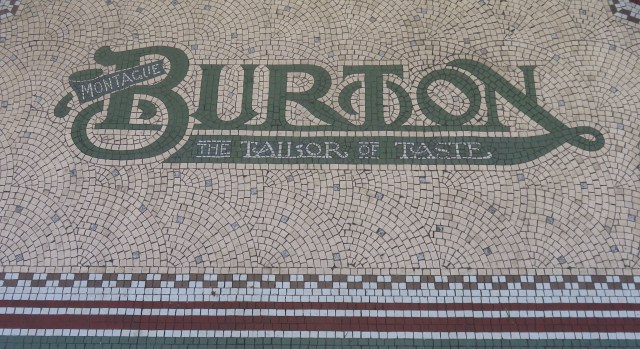
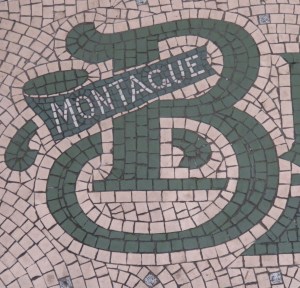
The entrance lobbies of many Burton shops had mosaic floors in the early-to-mid 20th century, and Burton was no exception. These sometimes included the popular Burton slogan: ‘Let Burton Dress You’. This also appears in a black and red glazed terracotta panel on the side elevation of the branch in Abergavenny (1937). Burton’s terracotta was usually supplied by the Middleton Fireclay Co. of Leeds.

abergavenny-5

Abergavenny (1937)

penrith-2016-35-copy

Penrith (1937)

Posted in Burton, Fashion and Clothing, Spotter's Guides | 2 Comments

The Legacy of J. Hepworth & Son

penrith-2016-8-copy

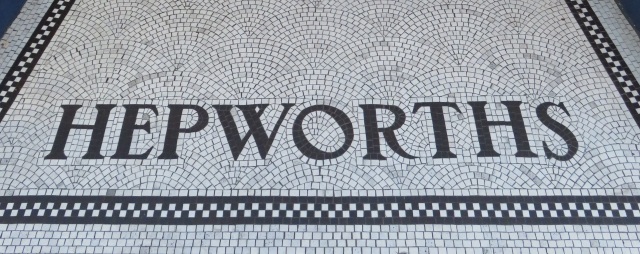
Hepworth’s lobby floor, Penrith

For a full century, between 1884 and 1985, Hepworth’s was a thriving national chain of men’s clothing shops, with a strong line in ready-made and made-to-measure suits. Rivals in the same field included Montague Burton, The Fifty Shilling Tailor (later renamed John Collier), Alexandre and Jackson’s.

Hepworth’s shops were converted to the Next format in 1982-85. The premises had never been quite as striking visually as Burton’s – the company did not construct so many complete buildings and did not engage in such all-encompassing shopfitting – yet traces of Hepworth’s can still be spotted on the high street.

penrith-2016-45

Hepworth’s, Penrith

Hepworth’s was founded by Joseph Hepworth (1834-1911), the son of a ‘cloth dresser’ from Lindley near Huddersfield. Joseph followed in his father’s footsteps while he was still a schoolboy, becoming a part-time woollen cloth dresser at a local mill. Because he had to start work at an early age, Joseph always felt that his education was neglected. He compensated for this, however, with business nous.

Joseph married a local girl, Sarah Rhodes, in 1855. Six years later he was living in his mother-in-law’s house and working as a ‘teazel setter and woollen draper’, probably at George Walker’s Wellington Mill in Huddersfield. Teasels were used to brush the surface of the woven cloth, to raise the nap. In 1864 Joseph and his brother-in-law, James Rhodes, entered business together as ‘Juvenile Clothing Manufacturers’ in Scarborough Buildings, Bishopgate Street, Leeds. Although this partnership was dissolved in 1867, Joseph continued to specialise in the manufacture and wholesaling of juvenile clothing, employing 2 men and 20 women in 1871.

blandford-forum-2000-copy

Hepworth’s, Blandford Forum

In 1878 Norris Rhodes Hepworth (1857-1914) became a partner in his father’s business, which was known thenceforth as Joseph Hepworth & Son. By 1881 the firm gave employment to 272 hands: they used outworkers as well as employing machinists in the factory at 25 Wellington Street, Leeds.

Shortly after this, on Norris Hepworth’s initiative, the firm adopted a new strategy. It cut out the middleman. Instead of continuing to act as a producer and wholesaler that supplied the trade, Hepworth’s began to retail direct to customers, not just in Britain but also in the Colonies. The decision was taken to open shops in ‘all important towns’ as rapidly as possible, rather than to build up a chain gradually. Amongst the first retail branches, which opened in 1884, were South Shields, Middlesbrough, Birmingham, Derby and Aberdeen. A year later there were 53 shops, promoted as ‘The World’s Clothiers’ or ‘the Great XL’ (seemingly a pun on ‘excel’). When the Wellington Street showrooms were extended in 1885, the basement was lit in the most modern fashion, by electricity.

In 1891, with 81 shops, Hepworth’s became a limited liability company with capital of £360,000 (Leeds Times, 14 November 1891, 4). This followed the opening of a large new factory, the Providence Works on Claypit Lane (Leeds Times, 17 January 1891, 8), designed by the London architect H. A. Cheers. Unfortunately, it had to be rebuilt after a fire just four years later, in 1895. By the eve of the Great War, Joseph Hepworth & Son was probably the largest clothing manufacturer and retailer in the country, a position usurped by Montague Burton in the early 1920s.

hepworth-arcade-hull-2016-1-copy

Hepworth’s Arcade, Hull

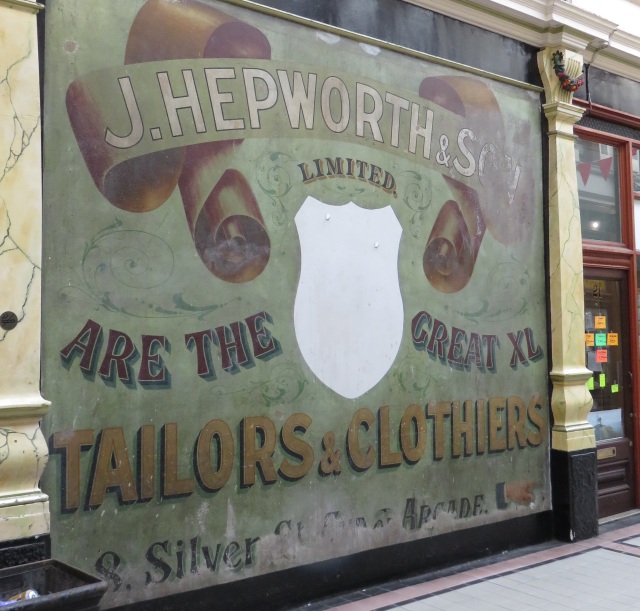
Fragments of several Hepworth’s shopfronts have survived, as does their painted sign in Hepworth’s Arcade on Silver Street in Hull. This L-shaped shopping development was designed by the architects Gelder & Kitchin specifically for Hepworth’s, who relocated there in 1894. In the mid-20th century Hepworth’s shops were characterised by deep entrance lobbies (maximising window display area), low stall risers of pearl granite (bringing the clothing to the same level as window shoppers) and deep fascias (signboards) with large lettering reading, simply, ‘HEPWORTHS’.

hepworth-arcade-hull-2016-3

Hepworth’s Arcade, Hull

Hepworth’s changed its image in 1961, becoming closely associated with Hardy Amies, the Queen’s dressmaker. It opened shops named ‘The Hardy Amies Tailoring Shop’ within several Debenham Group department stores, such as Woollands of Knightsbridge, Pauldens of Sheffield and Plummer Roddis of Southampton. A new production centre opened at Ashington. Expansion remained strong throughout the 1960s, with 13 new shops opened and another 19 planned in 1966 alone.

IMG_20170815_0001 - Copy

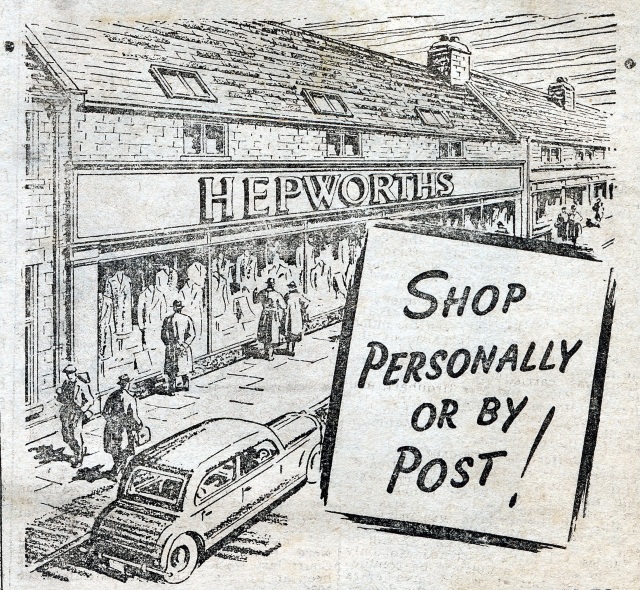
Hepworth’s, Stornoway, Isle of Lewis: 1954 advertisement

stornoway-hepworth-2016-1

Hepworth’s, Stornoway, Isle of Lewis

Hepworth’s set off in a different direction in the 1980s. This began when the designer and retailer Terence Conran, then associated principally with Habitat, was brought in as Chairman. Hepworth’s sales were lacklustre in 1981, when the company bought the womenswear chain Kendall & Sons of Leicester, with 79 shops, and used this as a springboard for a new chain of women’s shops called Next. George Davies was brought in to nurture this development. The first Next opened in 1982, followed by Next for Men in 1984, and the chain was augmented by the acquisition of Lord John shops in 1985.

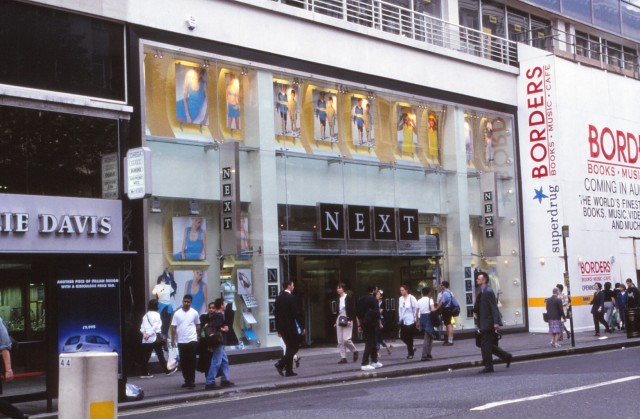
Next proved so phenomenally successful that Hepworth’s name was eradicated from the high street by the end of 1985, absorbed by the new brand.

Next Oxford St c.2000.jpg

Next, Oxford Street, London, 1998

Continue reading
Posted in Fashion and Clothing | 209 Comments