A Spotter’s Guide to Historic Tobacconists’ Shops

012

Formerly French & Sons, stationer and tobacconist, Leys Avenue, Letchworth, 2015

Window Shelves

Traditional tobacconists sold combinations of snuff, tobacco, cigars, cigarettes and pipes, often alongside confectionery, stationery, newspapers, or even a barber’s shop. They signalled their presence on the high street in different ways. For example, bottles, jars and canisters once lined shallow shelves inside their windows, rather as carboys filled with coloured liquid signposted chemists’ shops.

fribourg-windows-crop

Fribourg & Treyer, Haymarket, London, 1960. (Reproduced with permission from the Historic England Archive)

‘Red Indians’ and Highlanders

Much more conspicuous than rows of tobacco jars were the carved wooden figures that stood on pavements outside tobacconists’ doorways, usually representing American Indians with skirts made of tobacco leaves or Scottish Highlanders in kilts. The Highlanders may have been a nod to the Scottish invention of a mill that ground tobacco into snuff. The association of these figures with tobacconists began in England and Holland in the 17th century and later spread to America, where they are called ‘Cigar Store Indians’. Despite being highly collectible, some figures still fulfil their original purpose.
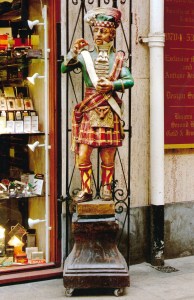
cambridge-arcade-southport-aa002854-22-feb-2000-copy

Cambridge Arcade, Southport, 2000 (c. Historic England Archive)

21 July Indian (3) - Copy

76 Low Petergate, York

Vending Machines

Often there was little in their design to distinguish tobacconists’ shopfronts from those of other traders. Nevertheless, long after the telling scent of tobacco has dissipated, some visual clues remain. For example, stainless steel cigarette dispensing machines might survive on frontages. These usually date from the middle of the 20th century and were stocked with specific brands such as Player’s.

whitstable-high-st-3-copy

Oxford Street, Whitstable, 2016

Signage

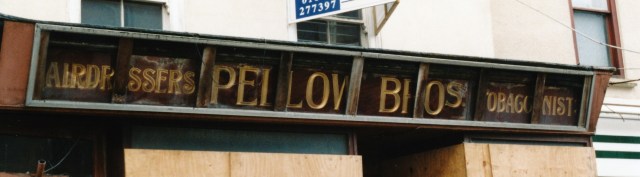
Some fine tobacconists’ signs are still on show, with the favourite motif undoubtedly being the pipe. Signboards – perhaps predictably – were often tobacco coloured, or reddish-brown, with gilded lettering. This was normally V-cut and covered with enamelled glass. Alternatively, lettering could be painted onto the back of the glass.

cheltenham-dickins-2-2000-copy

Cobblers Corner, High Street, Cheltenham, 2000
bodmin-36-fore-st-2000-copy

Fore Street, Bodmin, 2000

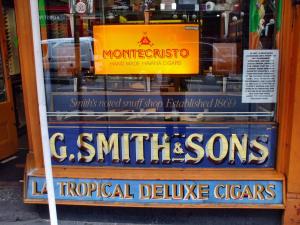
Until recent years fine glass signage with gilt lettering survived at G. F. Smith & Sons (est. 1869), 74 Charing Cross Road, London. Regrettably, after closure in 2011 all character was stripped from the shopfront – a great loss to London’s streetscape. Signage of similar vintage is, thankfully, still treasured in other towns and cities.
g-_smith__sons2-by-michael-pfeiffer-wikicommons

Charing Cross Road, London (Wikimedia Commons: Michael Pfeiffer)

sahgb-cheltenham-1-copy

Cotswold News, Clarence Street, Cheltenham, 2015

hull

Hull, 2016

Sometimes a large painted advertisement signalled the tobacconist’s shop from afar. Often prominently sited on the gable end of a building, these promoted popular brands such as Wills’s Gold Flake. As well as these ‘ghost signs’, enamel cigarette advertisements occasionally survive in situ on shopfronts – though many have been removed and sold to collectors. The profusion of brand signs in this sector is accounted for by manufacturers giving retail tobacconists ‘grants’ for window dressing.

whitstable-argyle-st-5-copy

Argyle Street, Whitstable, 2016

063

High Street, Leominster, 2016

rugby-lennons-2001-copy

Market Place, Rugby, 2001

Banbury 2000 - Copy

Banbury, 2000

One of the Best: Fribourg & Treyer

Several venerable tobacco shops remain in London. Best of all, from the spotter’s viewpoint, is Fribourg & Treyer at 34 Haymarket (before street numbering ‘at the sign of the rasp and crown’, a rasp being an implement used for snuff). A Peter Fribourg was documented at this address in 1751, and the firm of Fribourg & Treyer (renamed Evans & Evans during the Great War because ‘Fribourg & Treyer’ sounded foreign) remained here until 1982.

Fribourg Blog Option 1.JPG

former Fribourg & Treyer (now Fancy That of London), Haymarket, London, 2016

At some point in the late 18th century, Peter Fribourg or Gotleib Augustus Treyer, who took over the business in 1780, installed the present shopfront. It is a thing of beauty, with round bow windows to either side of the shop entrance. One of the small window panes, to the right, is painted in gilt letters (which are now degraded) with an advertisement reading: ‘Fribourg & Treyer Tobacconists to His Majesty and Purveyors of Foreign Snuffs to the Royal Family’. The King in question was George IV, who is known to have been a regular customer. Snuff was the mainstay of the business for its first century, with cigars and cigarettes becoming just as popular in the 1850s. By 1900 these were outselling snuff.

img_3451

former Fribourg & Treyer, Haymarket, London, 2016

Tobacconists’ Chains

Over the years several retail chains have specialised in tobacco. One of the first was Salmon & Gluckstein, which had 140 branches by 1902 when it was taken over by the Imperial Tobacco Company. In 1937 Salmon & Gluckstein acquired Bewlay & Co. (est. 1780), and in 1955 rebranded the shops as House of Bewlay. These adopted distinctive Gothic lettering and medieval-style shopfronts of unpainted timber. Because of their quality, it is likely that several House of Bewlay shopfronts have survived and might be identified by avid shop spotters. That in Chester, for example, became Thorntons.
fww01_01_0692_001.tif

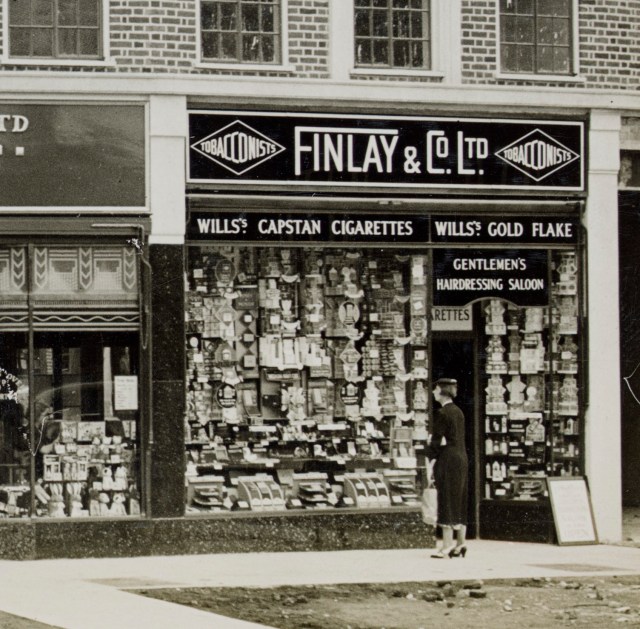
Finlay & Co Ltd, Eastcote, 1937 (Reproduced with permission from the Historic England Archive)

For much of the 20th century one of the most ubiquitous national chains was Finlay & Co, later trading as Finlays. Like many other tobacconists, the shops sometimes included hairdressing salons and eventually sold confectionery and newspapers alongside tobacco. Finlay’s closed in 1989. Others included Dunhill, which began in 1907 when Alfred Dunhill diversified from ‘Motorities’ (accessories for motorists), and John Hollingsworth, a small Midlands chain which used to display a pipe on its fascias.

birmingham-2001

Birmingham, 2002

This is the second in a series, ‘A Spotter’s Guide to the High Street’, published here at http://www.buildingourpast

Posted in Spotter's Guides | 4 Comments

Dairy Chain: The Story of the Meadow Dairy Company

meadow-dairy-15-fossgate-dec-2016-1-copy

15 Fossgate, York

Previous posts have discussed the provisions shops of Lipton’s, David Greig, Home & Colonial Stores and the Maypole Dairy Co. All these businesses, though long gone, had distinctive shopfronts which can still – occasionally – be recognised on modern high streets.

amble-img_6439

Queen Street, Amble, Northumberland

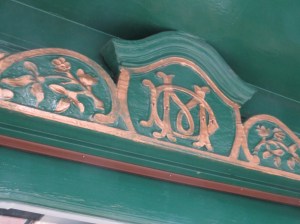
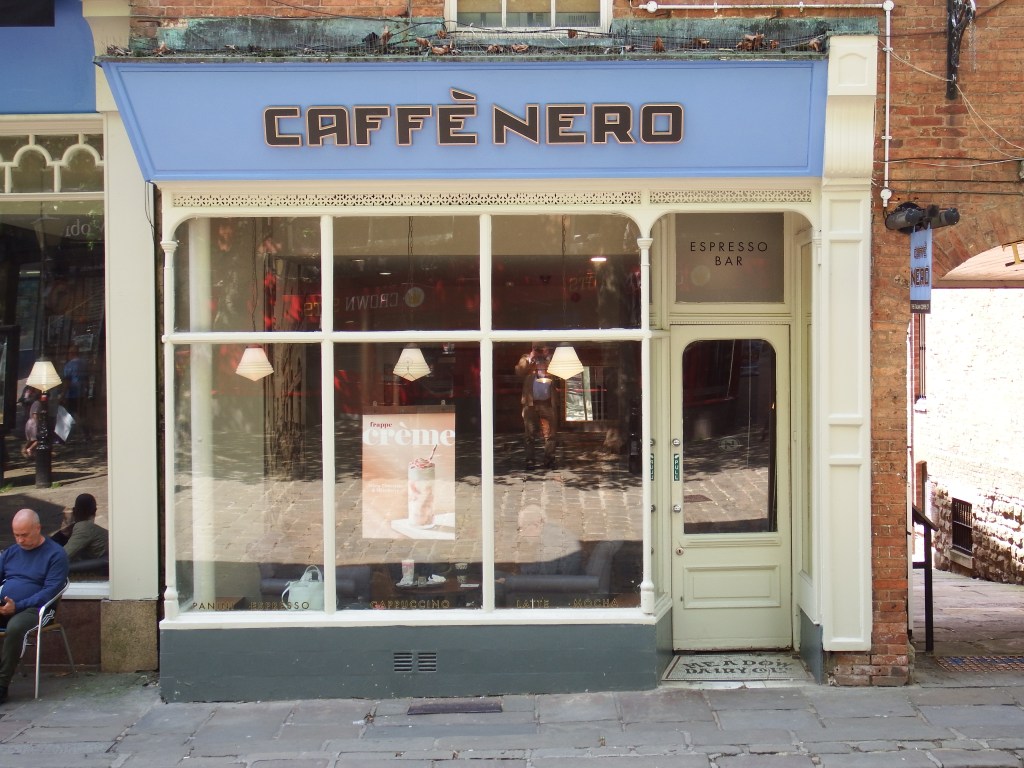
The Meadow Dairy Co., another significant chain from the Edwardian era, has left fewer physical traces. Its best shops resembled those of Maypole Dairy Co. The firm’s monogram was ‘MD’, rather than the ‘MDC’ used by Maypole. This generally appeared above the doorway, with the full name displayed on the mosaic pavement of the entrance lobby as well as on the fascia. Meadow seems not to have enforced uniformity across the chain, and probably spent less on shopfitting than Maypole and other rivals. Some branches had very thin, fluted consoles, like those of Home & Colonial Stores.

meadow-dairy-15-fossgate-dec-2016-2

15 Fossgate, York

The Meadow Dairy Co. was founded in Newcastle in 1901 by George Beale (1864-1953). Beale hailed from a relatively prosperous farming family in Monks Kirby, Warwickshire, and served his apprenticeship with the West Bromwich grocer, W. H. Edmunds, before joining the Maypole Dairy Co. He seems to have held a senior position with Maypole from c.1884 to c.1898. [NB: George Beale prosecuted by the Butter Association in 1900 for selling margarine as butter, and without a printed wrapper, was clearly a different individual.]

amble-3-copy

Queen Street, Amble

In 1897 Beale married Elizabeth Potts of Newcastle, and in the 1901 Census he was listed in that city as a ‘Butter Merchant’. With assistance from members of the Potts family, Beale set up the  Meadow Dairy Co., opening the first outlet at 8 Nun Street, Newcastle.

Expansion was swift, sponsored by the margarine manufacturer Van den Bergh. In 1909, with 29 branches, Meadow took over the Keeloma Dairy Co. of Sheffield (55 shops) and by 1914 there were around 200 Meadow Dairy shops throughout the north of England and Scotland. Coverage in the south was secured by gradual merger with Pearkes Dairies Ltd., which continued to trade as Pearks’ Stores. The acquisition of Broughs Ltd. of Newcastle in 1918 brought the total number of shops controlled by Beale to 473. Two other companies were acquired in the early 1920s: Sherry’s Dairy Co. of Manchester (12 shops) and Neale’s Tea Stores of Birmingham (55 shops). Meadow grew from 743 outlets in 1923 to 850 in 1927.

From 1927 Meadow shared its buying, warehousing and transportation with Lipton’s, and in 1929 these associated companies merged with Home & Colonial Stores. Meadow thus became a small component of the enormous Allied Suppliers group. It continued to expand, for example by acquiring the 119 shops of John S. Driver of Bradford in 1953, but never replicated the enormous growth enjoyed in the 1920s.

meadow-dairy-15-fossgate-dec-2016-3-copy

15 Fossgate, York

Allied Suppliers, with its large portfolio of small provisions shops, was slow to embrace self-service and supermarket trading. In the Annual Report of 1966 — the year the company withdrew from the GEM Supercentre experiment — it even suggested that the supermarket trend had peaked. How wrong can you be! In the same year, Maypole, Meadow and Pearkes were merged to create a single company, Allied Stores Ltd., trading under the Maypole name. The ‘Meadow Dairy Co.’ swiftly vanished from British shopping streets.

Low Pavement, Chesterfield (c. R. Baxter)
Posted in Grocers, Provision Dealers and Dairies | 10 Comments

A Spotter’s Guide to Historic Butchers’ Shops

st-ives-cambs-slide

Stall riser, H. Anderson Jnr, St Ives, Cambs, 2000

Continue reading

Posted in Butchers' Shops, Spotter's Guides | 2 Comments

Cheap Meat for the Masses: Multiple Butchers in Britain

aa011562-5-sept-2000-copy-copy

Tiles by Carters of Poole, Dewhurst, Freshwater, Isle of Wight (c. Historic England Archive AA011562)

The importation of meat from North America to Britain started in the 1860s and accelerated in the 1870s as refrigeration improved. One of the leading shippers was Timothy C. Eastman (1821-93) who owned a huge abattoir, or ‘killing yard’, in New York. From around 1875 he exported large quantities of ‘dead’ (that is, frozen) American beef to England. He was joined in his business by his son, Joseph.

The Eastmans’ Scottish agents, from 1877, were the butchers John Bell & Sons of Glasgow, a firm established in 1827. Bell & Sons had earlier imported live cattle across the Atlantic but now adopted the very latest refrigeration technology for ships. Spearheading the sale of imported dead meat within Britain, the brothers Henry and James Bell set up a chain of butcher’s shops in 1879. Ten years later they controlled 330 shops which traded as The American Fresh Meat Co. or Hill & Dale Ltd. Unlike traditional butchers’ shops, these multiples did not have their own slaughter houses; there was no need, since everything was brought in from wholesalers.

The Bells’ target clientele was the working class, which benefited from the availability of cheap foreign meat. In June 1889 they set up Eastmans Ltd., with Lord Greville as Chairman. This new venture incorporated Timothy and Joseph Eastmans’ company, and appropriated their name. In 1900, however, with interest in other markets – primarily Argentina and Australia for beef and New Zealand for lamb – growing (and America becoming correspondingly less competitive), Eastmans Ltd. liquidated the American company. It relied, thenceforth, on English wholesalers.

img_2862

Eastmans, Abergavenny

In 1903 Eastmans Ltd. had 205 retail shops and cold stores capable of holding 310,000 carcasses of mutton; by 1912 the number of shops had risen to 1,400. The five years preceding the Great War, however, were lean years for the imported meat trade, due to rising prices and slack demand. For Eastmans Ltd., the war proved disastrous. Between 1914 and 1917, 495 shops closed. Most of the employees joined the forces, supplies were disrupted, and turnover was greatly reduced. In August 1920, while Eastmans was recovering from this setback, the Vestey Brothers, owners of the Union Cold Storage Co., stepped in and bought the company.

The Union Cold Storage Co. had been founded in 1897 and established the Blue Star Line in 1911. By 1923 it had 51 cold stores and freezing works abroad and at home, and a large fleet of refrigerated vessels. Beef was imported from Argentina and lamb from New Zealand; Australia was another important market. In 1923 the firm acquired the British & Argentine Meat Co. Ltd. (which had been formed in March 1914 through an amalgamation of two other chains of butchers’ shops: James Nelson & Sons Ltd. [with 1,000 shops] and George Drabble’s River Plate Meat Co. [with 440 shops]). The Vesteys now controlled 2,400 ‘retail shops, depots and market stalls in this country’, as well as factories and wholesalers.

Other chains acquired by the Vesteys in 1923 included W. & R. Fletcher Ltd., the Argenta Meat Co. Ltd., and J. H. Dewhurst. A few years later they absorbed the Empire Meat Co. The Vesteys thus became the largest meat retailer in the world, with an empire governed from an office in Smithfield Market, London. Of the numerous large meat multiples that existed before the war, just the London Central Meat Co. remained independent. In addition, the butchery departments of co-operative societies all over the country did a roaring trade. The London Co-operative Society alone, in 1934, had 159 shops plus an abattoir and a ‘meat products’ factory. It had begun to import chilled, as well as frozen, meat from around the world. Like some other multiple butchers, the London Co-operative Society sold English meat alongside imports.

uppingham2009

London Central Meat Co. Ltd. in Uppingham, Rutland

leominster-3-high-st-2017-copy

London Central Meat Co. Ltd, 3 High Street, Leominster (R. Baxter, 2017)

Ultimately, it was the Dewhurst brand (and its equivalent Alex Munro in Scotland) that came to dominate British shopping streets into the 21st century. Dewhurst’s had been founded in Southport, Lancashire, by John Henry Dewhurst whose grandfather, John Dewhurst, was a ‘master butcher’ employing a man and two boys (Census 1871).

img_3304

Dewhurst, Greenwich

In the 1920s multiples like Dewhurt pioneered hygienic plate-glass frontages for butchers’ shops. Previously butchers had preferred wide sash windows that could be raised to reveal a display of meat on a marble slab. A typical example of an inter-war Dewhurst shop survives in Greenwich. The stallrisers were of pearl granite rather than wood, which might absorb water and blood.

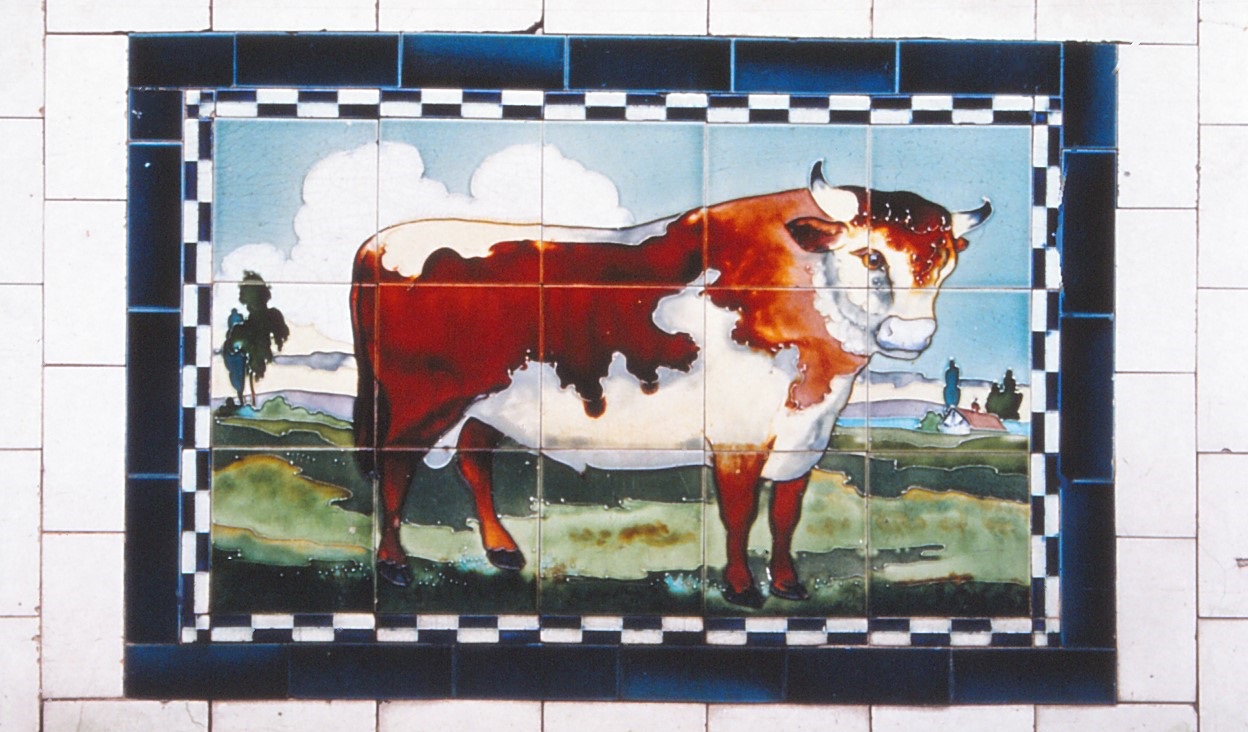
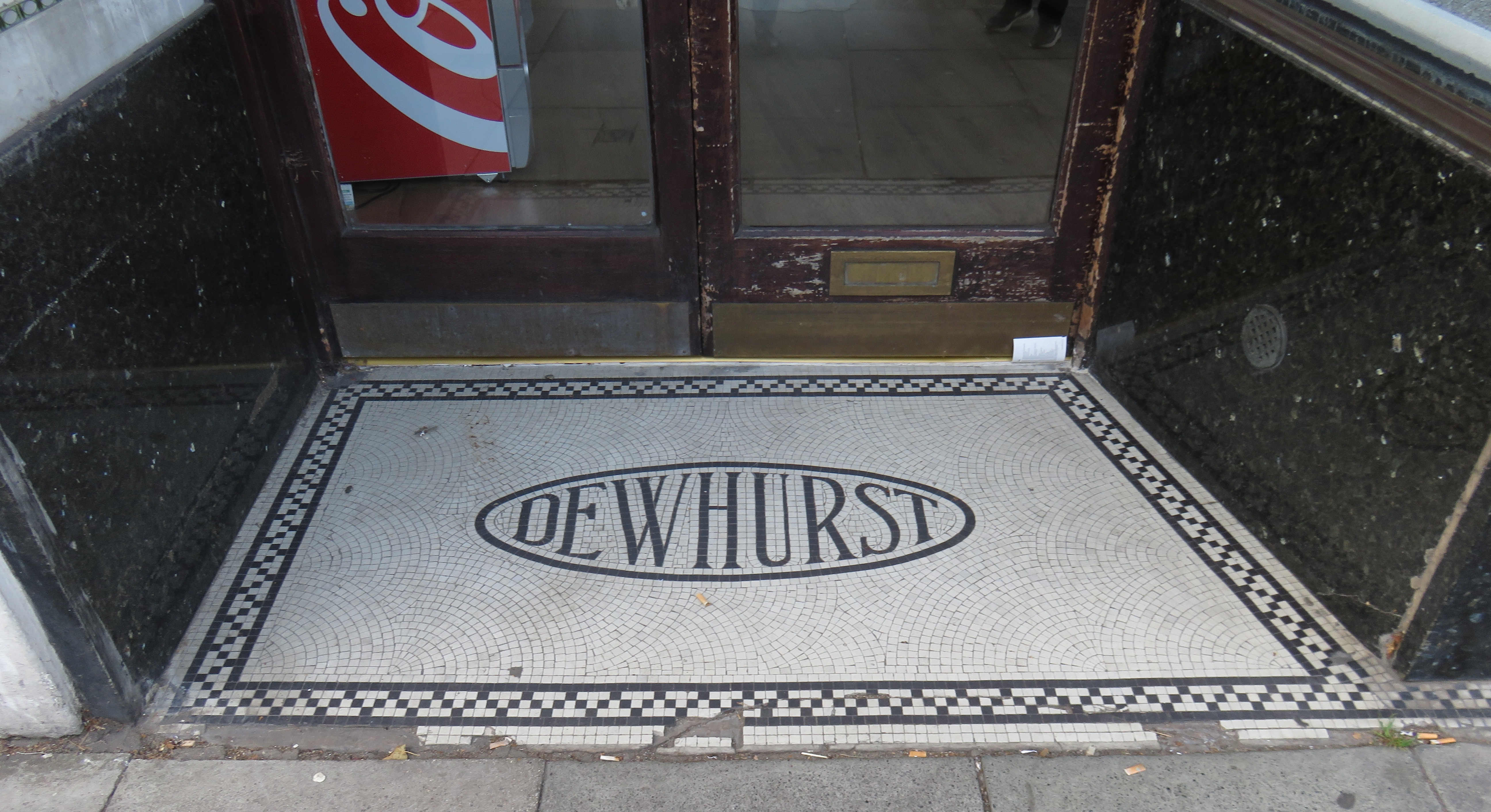
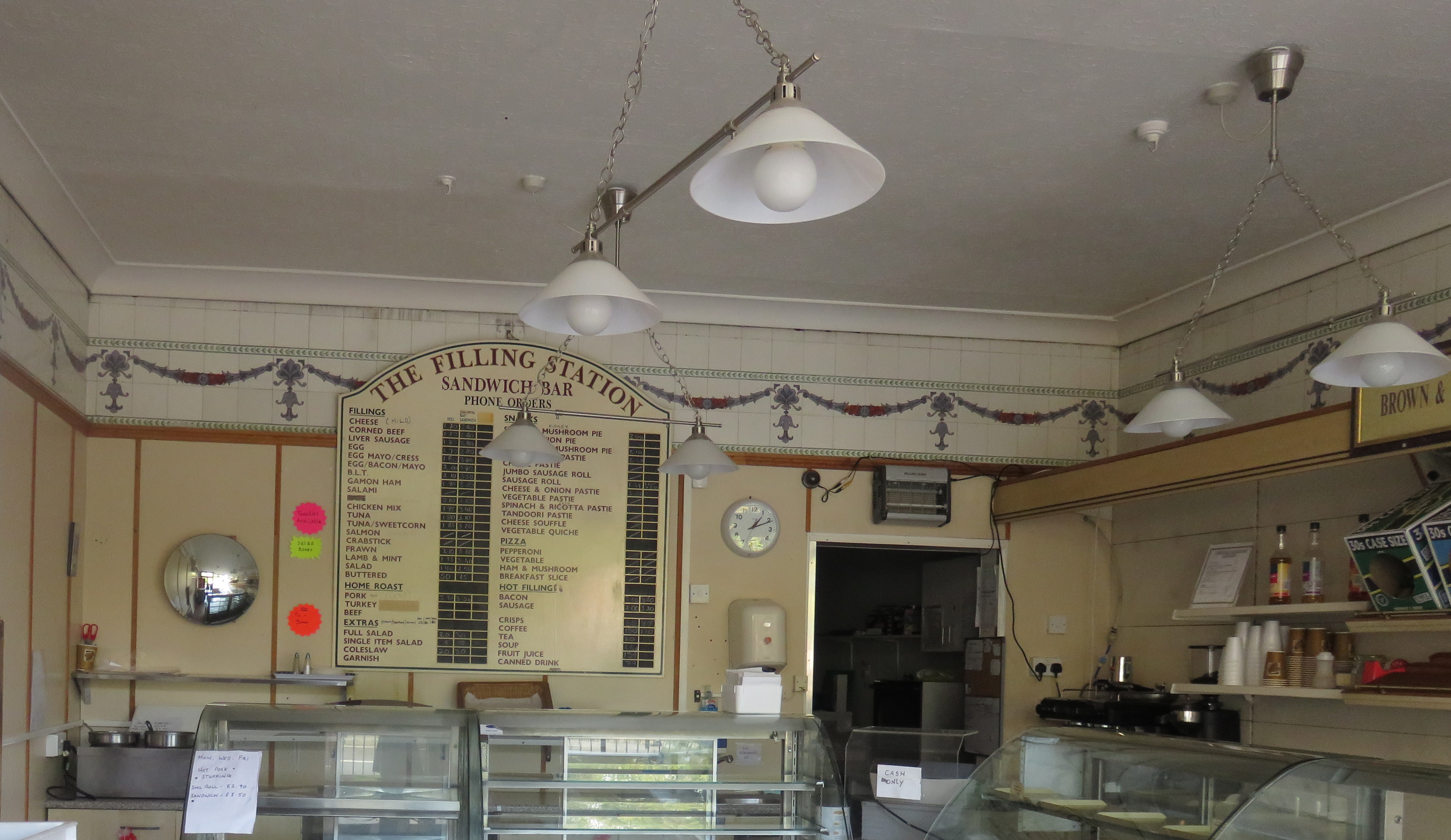
Dewhurst made  extensive use of decorative tiling. Many branches were brightened by panels depicting farmyard animals, manufactured by Carters of Poole. Around 1950, however, Dewhurst adopted chrome and plate-glass shopfronts, and established a uniform interior décor of white tiles with a black border.

macclesfield-1999

Dewhurst, Macclesfield, photographed 1999

IMG_3305.JPG

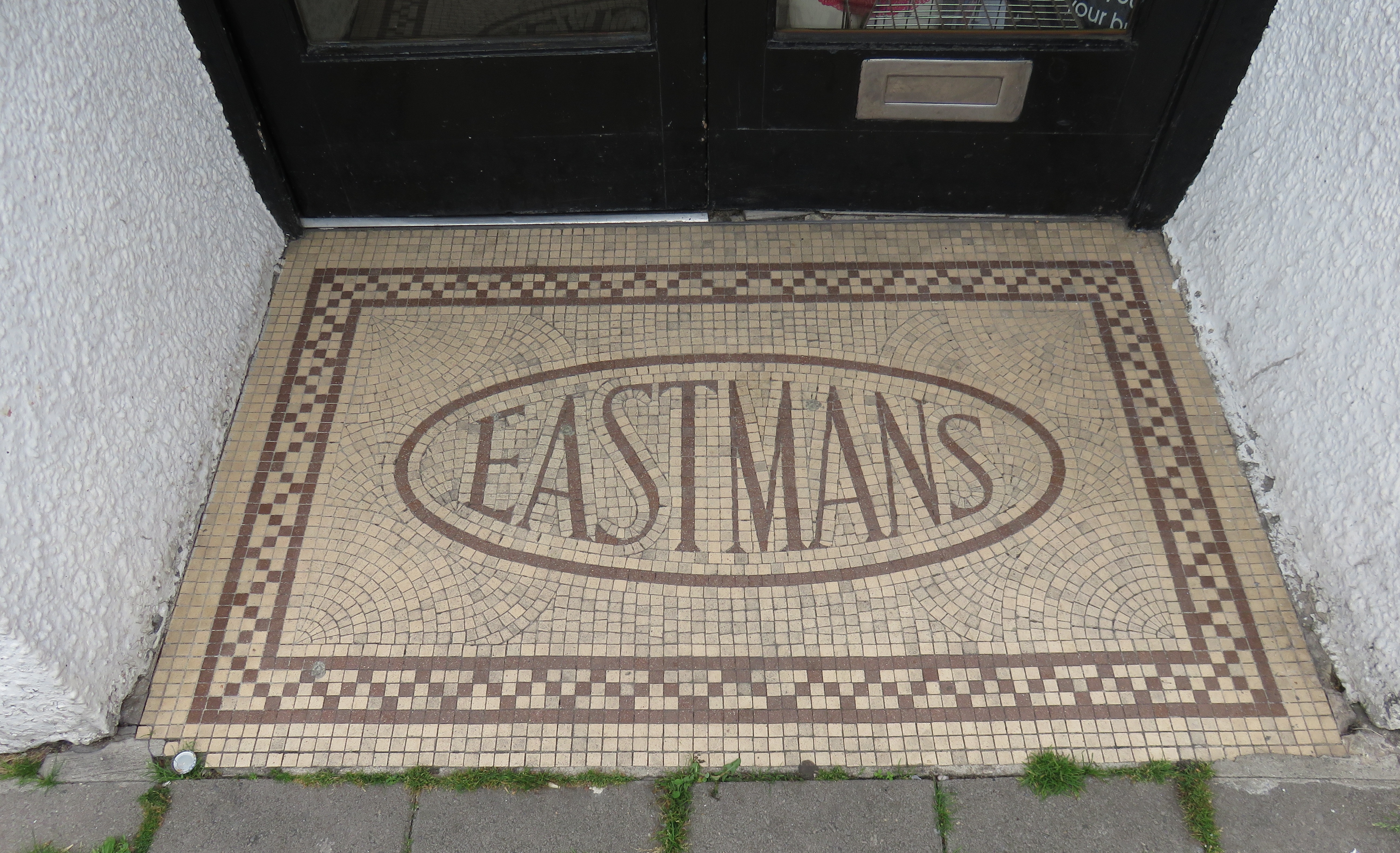
Dewhurst, Greenwich (compare with Eastmans’ floor, above)

img_3308-copy2

Dewhurst, Greenwich: interior showing decorative tiling

newport-iow-2000

Dewhurst the Master Butcher, Newport, Isle of Wight, in 2000

In 1977 there were 1,400 Dewhurst shops in the UK, and in 1980 they were rebranded as ‘Dewhurst The Master Butcher’. There were just 360 branches, however, by March 1995, when the company went into receivership along with its holding company, Union International. A management buy-out with Asda Property Holdings rescued around 210 shops: Asda bought the freeholds and leased the shops back to Dewhurst Butchers. These were gradually updated in the early 2000s

In 2005 Dewhurst was bought by West Country butcher Lloyd Maunder. A year later Dewhurst closed 60 shops and called in the administrators to help sell the remaining 35. Like so many other meat multiples, it vanished from the British shopping scene, bowing to the superior might of the supermarkets.

newport-iow-2-2000

Dewhurst The Master Butcher, Newport, Isle of Wight, 2000

Continue reading

Posted in Butchers' Shops | 15 Comments

The National Fur Company

Carmarthen (6) - Copy - Copy.JPG

Detail of National Fur Company shopfront, Carmarthen

The National Fur Company was established by Arron (or Arnold) Barder (1859-1914) in Sloane Street, London. In the early 20th century it moved to 193 Brompton Road, eventually expanding to fill 191-195, a site now occupied by Blom Bank.

Carmarthen (2).JPG

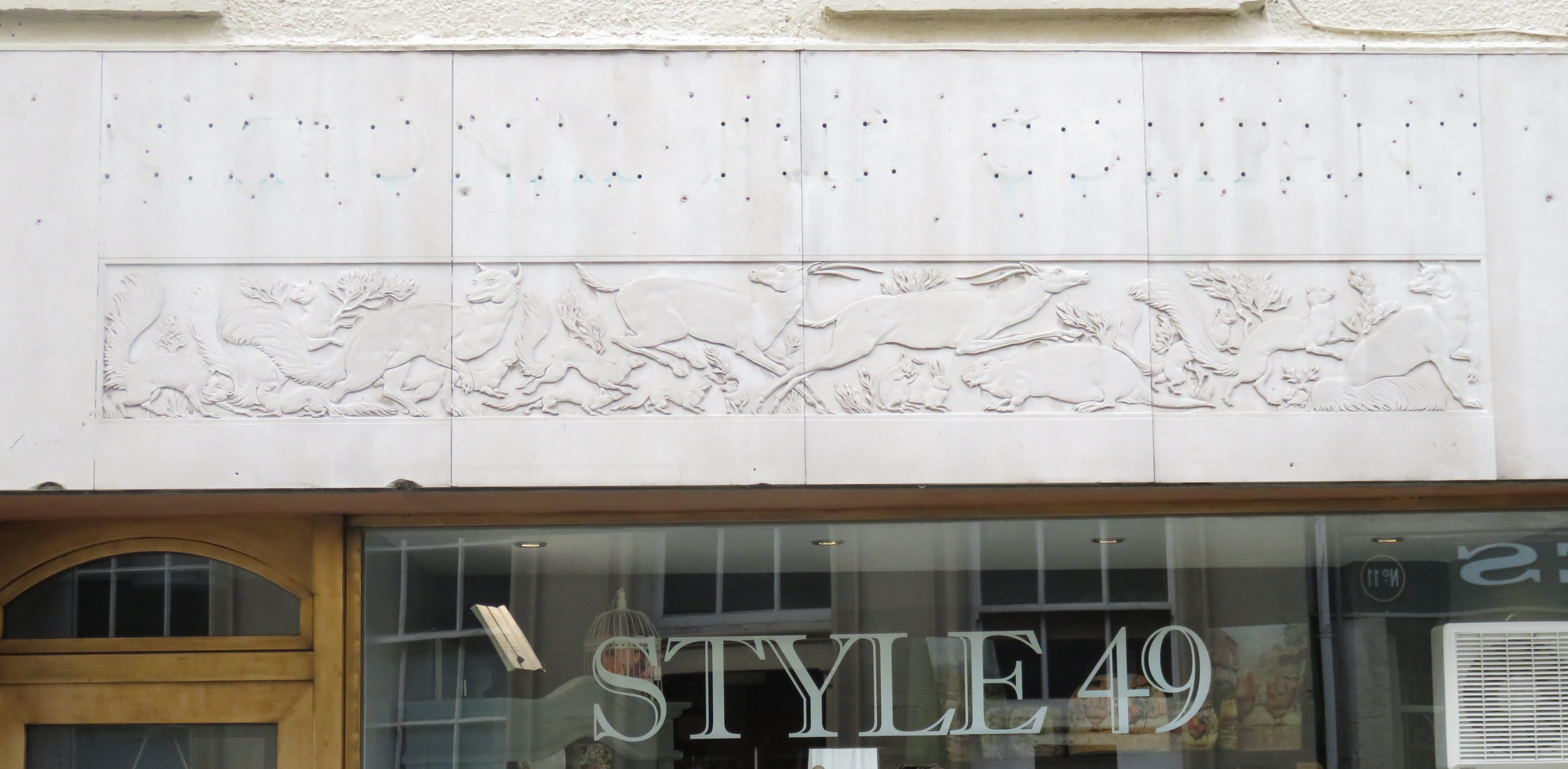
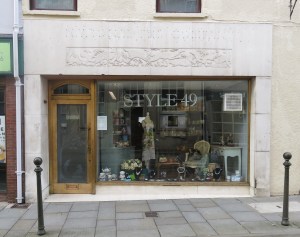
National Fur Company, now Style 49, Carmarthen

Barder’s father – a Jewish immigrant from Krakow – and brothers were also in the fur trade. The National Fur Company claimed, in its advertisements of the late 1920s, to have been established in 1878 ‘by the Grandfather of the present Managing Director’. It also claimed to have been the first company to sell ‘Good Furs at Reasonable Prices’. By the late 1920s it was offering ‘deferred terms’: 12 monthly payments with 5% interest, effectively hire purchase.

carmarthen-1

National Fur Company, now Style 49, Carmarthen

By 1932 the National Fur Company had opened branches in Leicester (15 Market Street), Cardiff (20 High Street), Swansea (35 Castle Street), Newport (68 High Street) and Carmarthen (49 King Street). The oldest of these appears to have been Cardiff, which was based at 23 High Street before the Great War. Birmingham had been added by 1950, and an additional branch opened in Exeter before 1970. The premises at 193-195 Brompton Road, previously leased, were bought in 1960 with the intention of rebuilding the company headquarters, bringing manufacturing, retailing and administration under one roof. Despite this, in 1978 the National Fur Company relocated to 241 Brompton Road.

img_20161001_0002-fur-2

National Fur Company, Leicester, in 1999

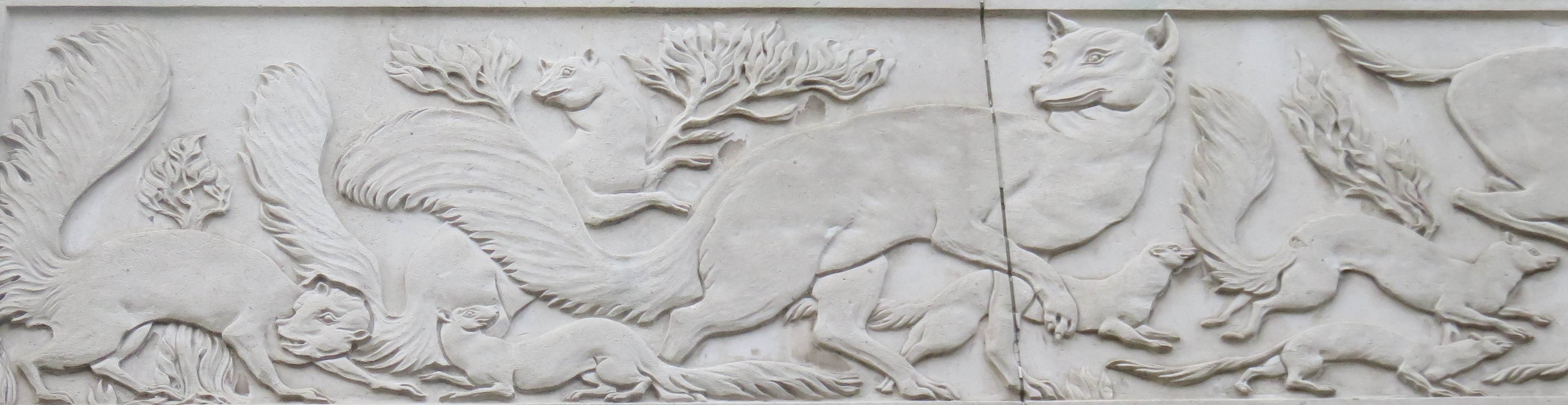
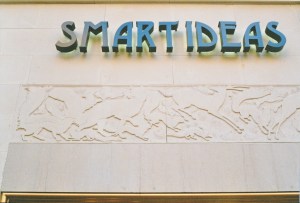
The National Fur Company shopfronts in Leicester, Cardiff and Carmarthen survive. All three were carefully designed in the same tasteful house style. Each has a similar pale ashlar surround (perhaps reconstituted Portland or ‘Empire’ stone) topped by a moulded relief frieze of running animals, including skunk, fox, mink, stoat, squirrel, rabbit, beaver and antelope.

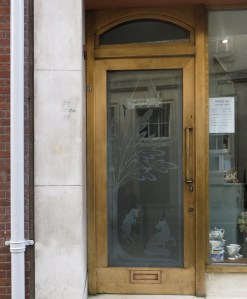
Within the stone frame of each shopfront, the display window was positioned to one side of an arch-headed doorway. The door at Carmarthen survives with its original glass panel, etched with a tree and two animals: a prancing goat and a seated fox, perhaps a reference to one of Aesop’s fables. None of the shops retains its original lettering, which was affixed directly to the stonework rather than to a separate fascia board. Nevertheless, a ghost of the lettering may still be discerned.

img_20161001_0002-fur-3

National Fur Company, Leicester, photographed in 1999

carmarthen-3-copy

National Fur Company, Carmarthen

The fate of the National Fur Company is unclear. It is unlikely to have survived the tremendous backlash against wearing fur which gained momentum in the early 1980s and led, ultimately, to the closure of most British furriers, as well as fur departments in large department stores.

Posted in Fashion and Clothing | 21 Comments

The Legacy of Home & Colonial Stores: Part 2

These examples of Home & Colonial stores were spotted after  The Legacy of Home & Colonial Stores was first posted. If additional shops come to light, they will be posted here. Contributions happily accepted!

Eastbourne

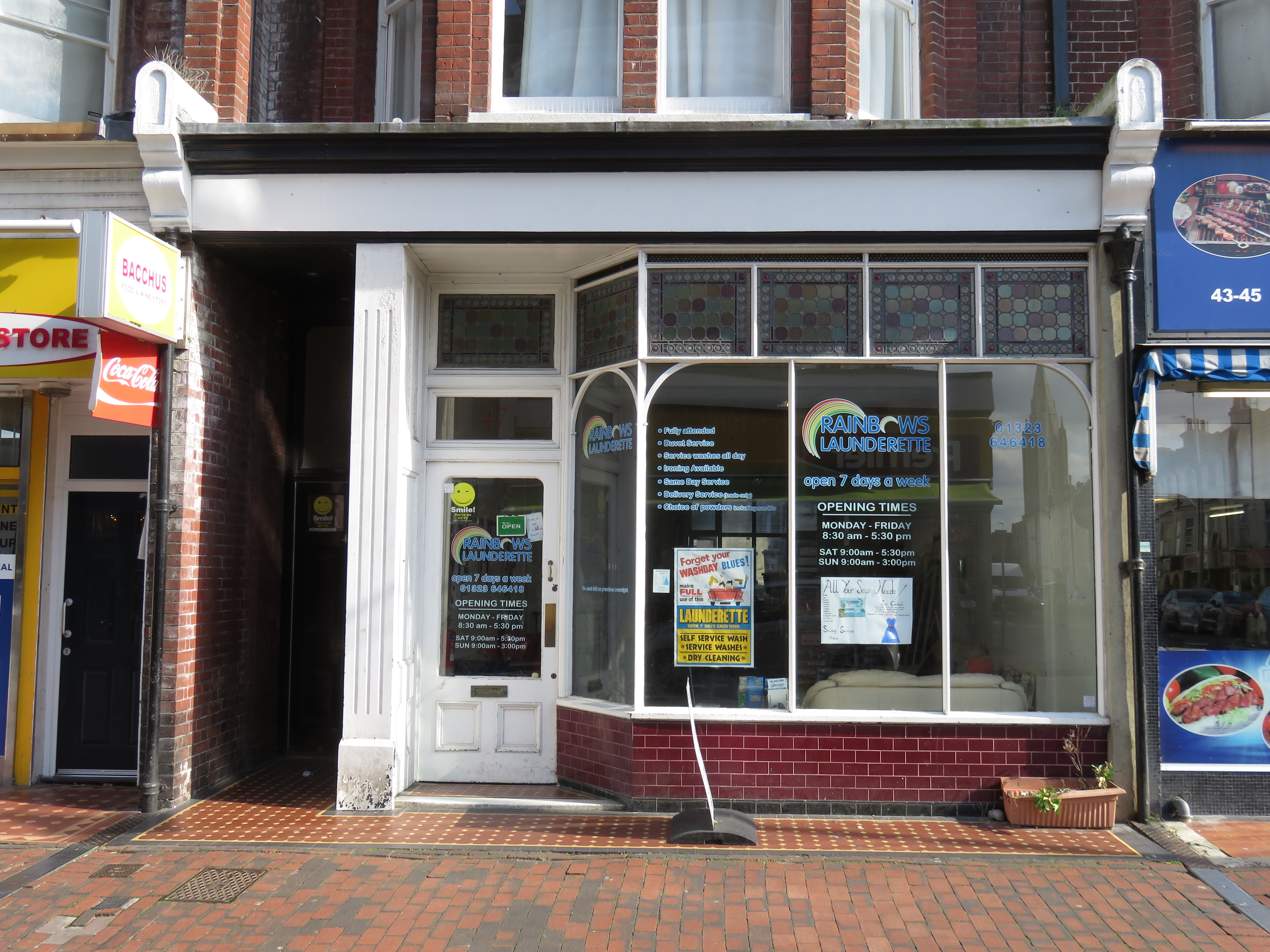
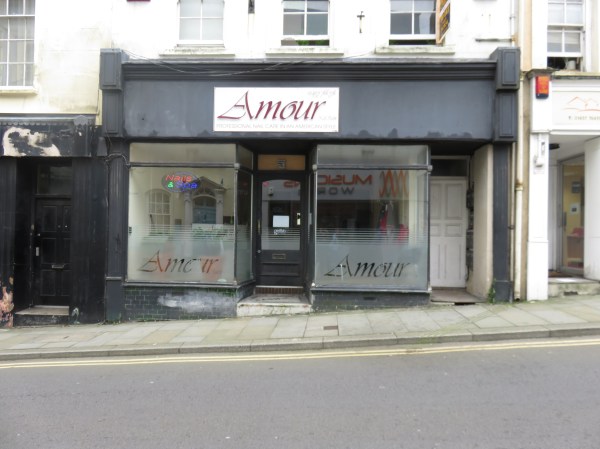
I have no documentary evidence for this one – spotted at 47 Seaside Road, Eastbourne, on a quick drive-past – but the design of the windows is a bit of a give-away! Now a launderette.
IMG_6391

Eastbourne

Hove

74800333-E7A9-408E-9B65-534296E52360

74 Westgate Road, Hove (c. Kathryn Ferry, 2020)

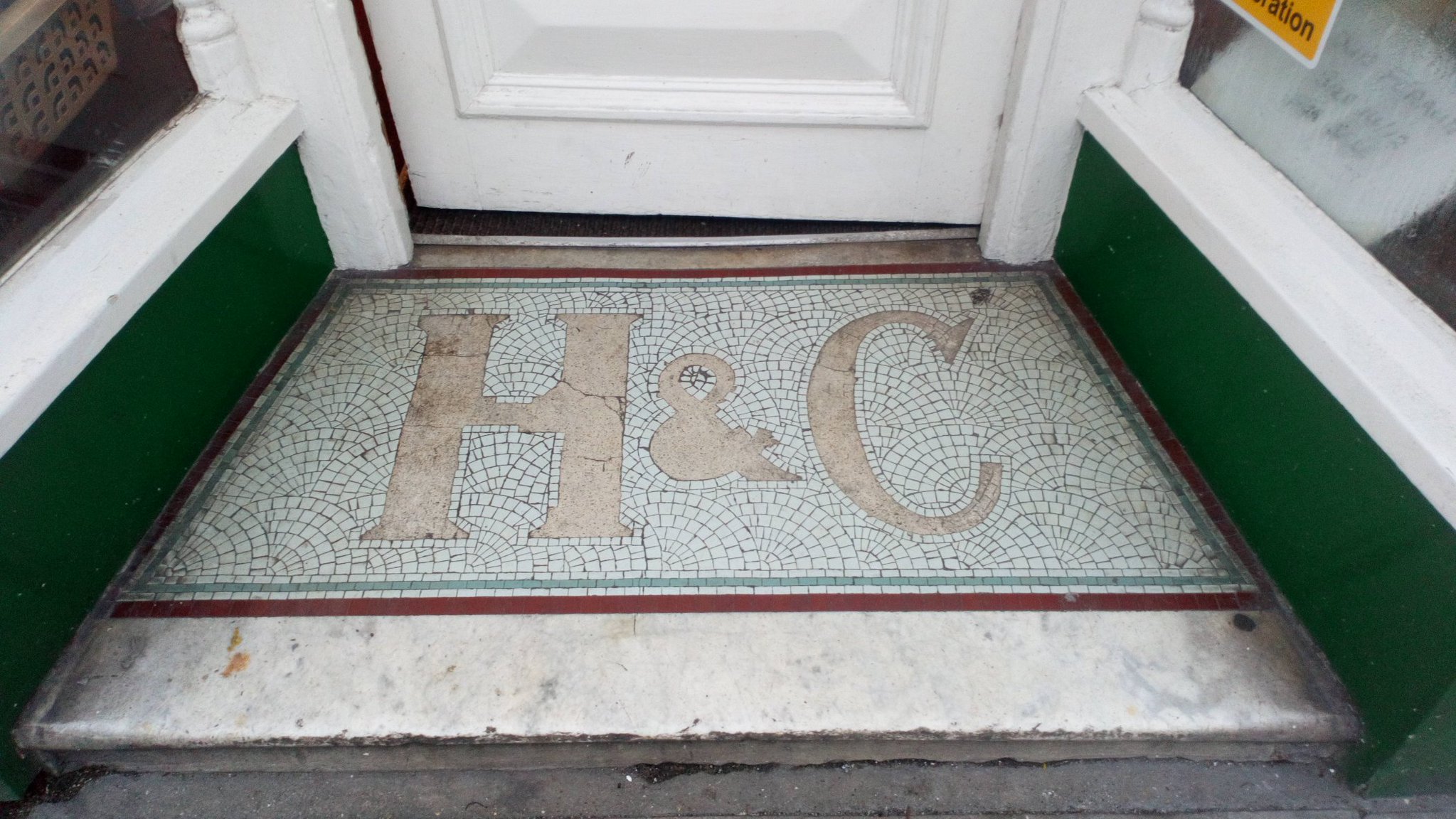
The lobby floor of the former Home & Colonial Stores at 74 Western Road, Hove. Except for this ‘H&C’ mosaic, the shop conformed to others in the parade rather than the company house style. Discovered by Kathryn Ferry.


Monmouth

img_2742

Former Home & Colonial Stores, 14 Monnow Street, Monmouth

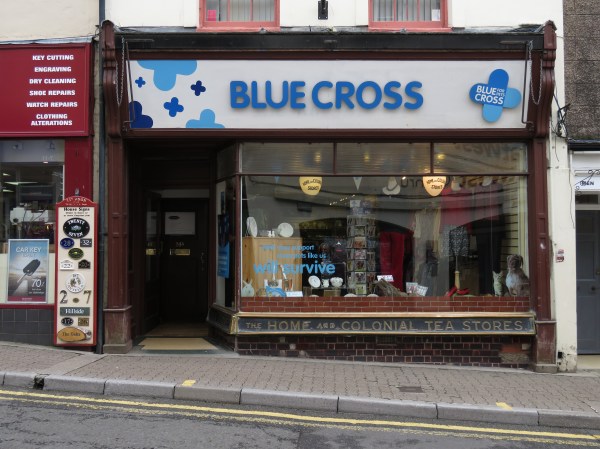
The Blue Cross charity shop at 14 Monnow Street, Monmouth, retains a well-preserved Home & Colonial Stores shopfront. It occupies a plain two-bay 19th-century building. According to the Post Office Directory of 1914, the premises were then occupied by Mrs Fanny Yeates, a boot and shoe maker. Although Home & Colonial had numerous outlets in Wales by 1914, it had not yet opened in Monmouth. It seems likely, therefore, that the essential features of the present shopfront date from the 1920s, or even the 1930s.

003

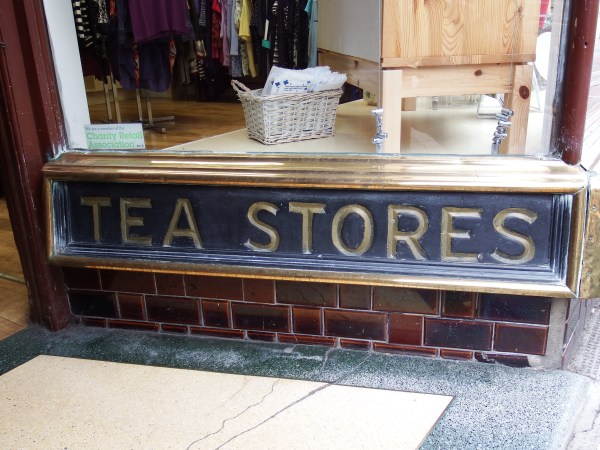
Monmouth: detail of brass and timber stall plate

Highly characteristic of the Home & Colonial house style are the ox-blood tiles – with chamfered edges, laid in the fashion of Flemish bond – and the brass stall plate displaying the name ‘THE HOME & COLONIAL TEA STORES’. The very slender pilasters and consoles to either side of the shopfront are also typical of Home & Colonial shopfitting. One very common – even diagnostic – feature of the brand, however, is missing. Instead of the usual multi-coloured bottle-glass transom lights, here we have opaque panes with a more modern design of horizontal banding. No doubt the original glass was replaced, either by Home & Colonial itself, or by a later occupant of the shop. The terrazzo floor of the lobby may also represent later modernisation.

007

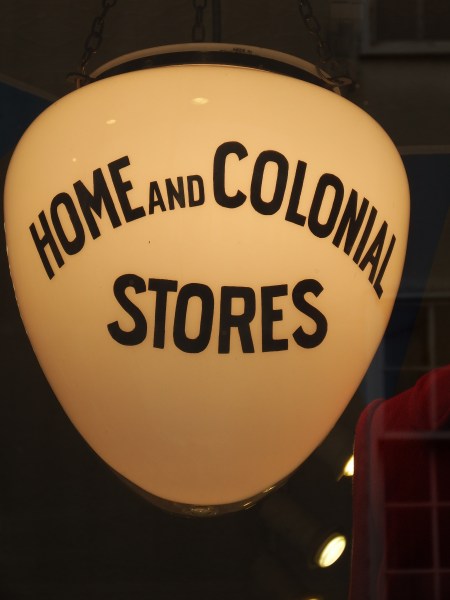
Monmouth: light fitting from exterior

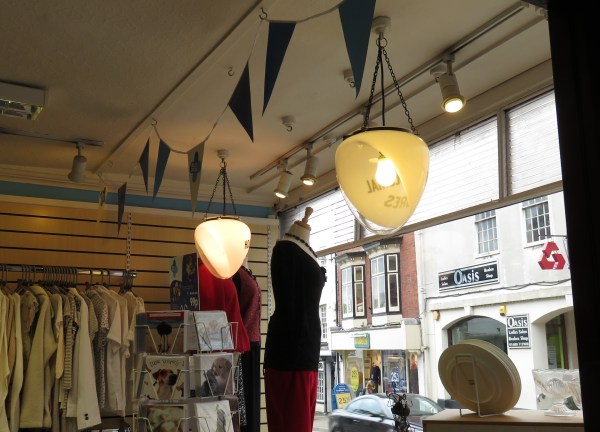
While the interior of this shop has been modernised, it retains two Home & Colonial light fittings in the window.

img_2749-copy

Monmouth: light fittings from lobby

Continue reading

Posted in Grocers, Provision Dealers and Dairies, Home & Colonial Stores | 3 Comments

Cash & Co. and Turner Shoes

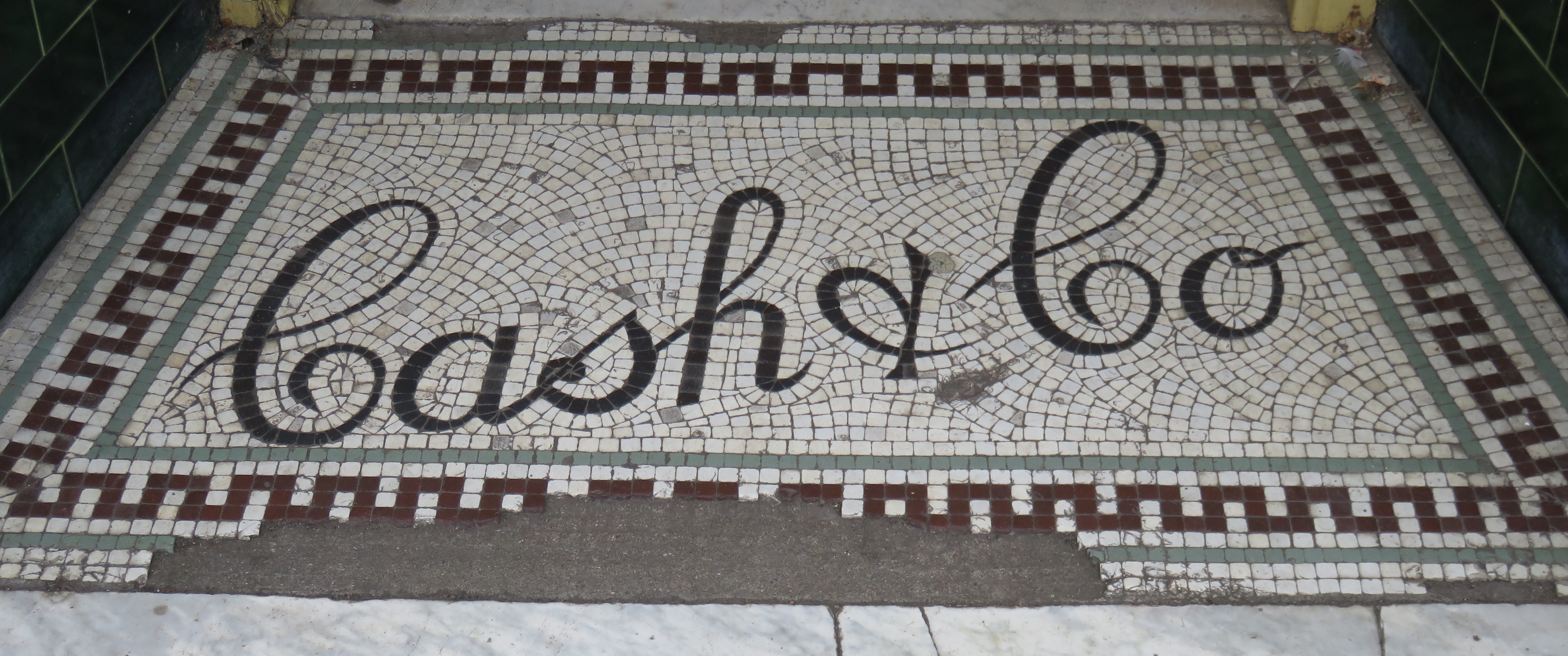
monmouth-3-copy

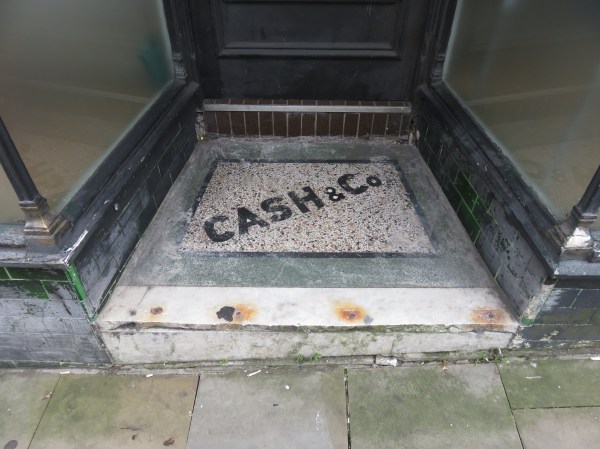
Main entrance, Agincourt House, Monmouth

In its early years, the key to successful multiple retailing was selling goods for cash, not credit. Bearing this in mind it is not surprising to find, in the 1870s and 1880s, that several different companies opened chains of boot and shoe shops under the simple name ‘Cash & Co.’ – just as Jesse Boot branded his shops ‘Boots Cash Chemists’.

It is difficult to disentangle the various Cash & Co. chains. One of the first was established by Manfield & Sons of Northampton, who traded as ‘Cash & Co., The Well-Known Boot & Shoe Makers’. Rebranding as ‘Manfield & Sons’ in 1883, they claimed:

This alteration has been rendered necessary by the frequent Piracy of the name “Cash & Co.,” whereby unscrupulous persons, trading under this and similar titles, have sought to mislead the Public and benefit themselves by the sale of inferior articles (Birmingham Daily Post, 1 December 1883, 7)

In 1886 a company called ‘Cash & Co., Leeds Boot & Shoe Store’ bought the Royal Boot Store, located opposite the market clock on Church Street in Whitby. Its advertisements stated that ‘The firm is in a position to supply the public at strictly Wholesale Prices, because they supply direct from the Leeds Factory to your feet’ (Whitby Gazette, 10 July 1886, 1). So far, the identity of this Leeds factory has proved elusive.

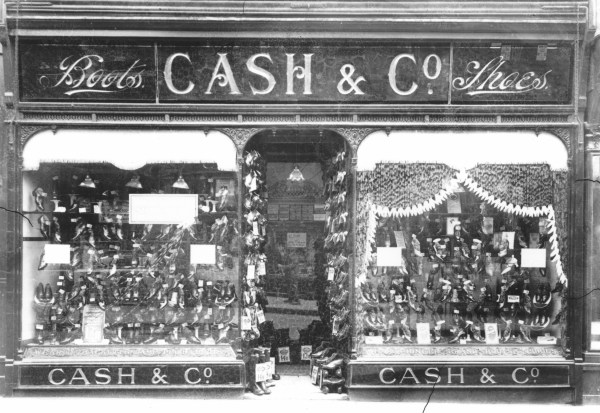
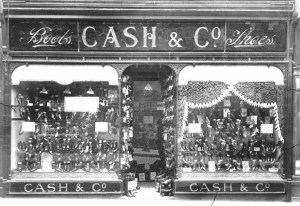
Manfield’s greatest problem, however, was a chain called Cash & Co. set up around 1882 by William and Edward Turner, who had footwear factories in Leicester and Northampton. One of their branches was photographed in Shrewsbury by the Italian businessman Joseph Lewis della Porta in 1888.

Cash & Co - Copy

Cash & Co, Wisbech, c.1920

W. & E. Turner Ltd. stopped making boots and shoes around 1904. After this it maintained two retail chains, the larger trading as Cash & Co. and the smaller chain as W. & E. Turner Ltd.

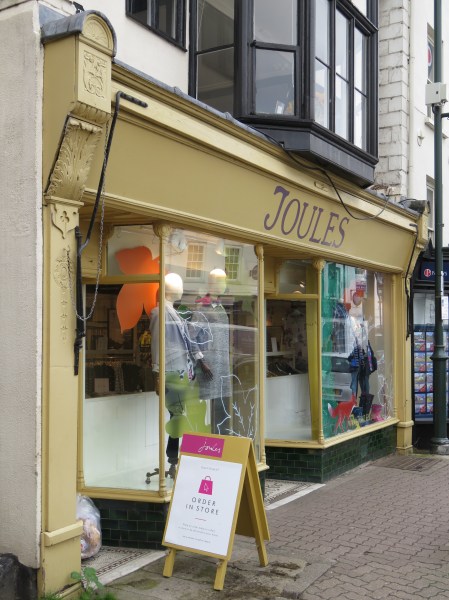
monmouth-10

Former Cash & Co., Monmouth

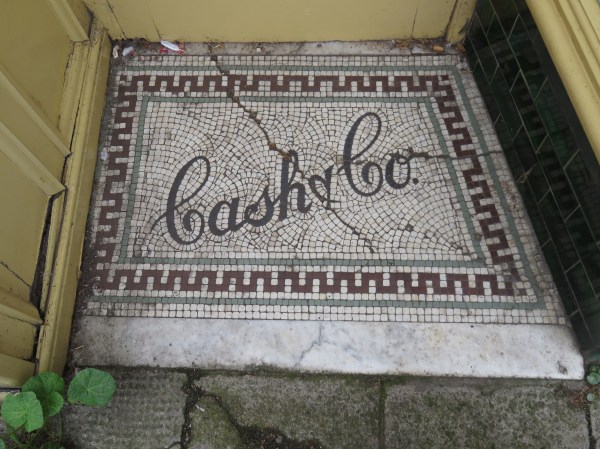
monmouth-5

Side entrance, Agincourt House, Monmouth

By 1914 Cash & Co. had 136 branches. The most obvious traces of these shops to survive are the tiled floors of entrance lobbies. Examples can be seen in Monmouth and, slightly later in date, in Haverfordwest. In each case the stall risers beneath the windows were clad in green tiles. A W. & E. Turner Ltd mosaic survives in the High Street in Lowestoft. Both Cash & Co. and Turner’s sold footwear under the brands Dr Hackett, Hyacinth, Snowdrop, Boulevard and – most prominent on shopfronts – Pioneer.

haverfordwest-2

21 High Street, Haverfordwest

In 1980 Turner Shoes – with 140 shops – was bought by Hepworths for £9 million. The Turner name quickly vanished from the high street, and some of the shops may have been used to launch Next in 1982.

haverfordwest-1

21 High Street, Haverfordwest

Posted in Shoe Shops | 1 Comment

Joseph Frisby Ltd

IMG_2362 - Copy.JPG

Detail of Frisby’s shop in Cullompton, Devon

Frisby’s was one of the earliest chains of boot and shoe shops to develop in England. The founder, Joseph Frisby (1848-1902), was the son of an agricultural worker from Frisby on the Wreake in Leicestershire. In 1871 he married Harriett Rowley, whose brother Robert was a hosiery manufacturer in nearby Syston.

Joseph entered business in Leicester, setting up as a general dealer at 59 Belgrave Gate. Although described in the Census of 1871 as ‘tobacconist’, by 1872 – when a pair of boots was stolen from an iron rod outside his shop – Joseph was selling footwear. After a spot of financial trouble in 1873 he seems to have concentrated on selling boots and shoes, to the exclusion of all else.

Frisby soon branched out. He ran market stalls in several distant towns on different days of the week. Every Saturday, for example, he manned a stall in the Cattle Market in Chesterfield, and on Wednesdays he traded from Powis Market Hall, Oswestry. For the remainder of the week, the stock for the Oswestry stall was stored in boxes and kept in the Market Hall. Aberystwyth and Wakefield markets were also attended regularly by Frisby in the late 1870s. One widow who stole a pair of shoes from the Wakefield stall received the harsh sentence of 10 years penal servitude.

Frisby opened branch shops as well as market stalls, for example on King Street, Huddersfield. He had to employ assistants to help run these outlets and, for preference, his managers were married men. By 1880 Joseph’s brother William Frisby (1851-1924) had moved with his family to Dorchester, where he managed one of the largest branches, at 14 South Street. This traded as ‘Frisby’s Great Leicester Boot warehouse’ and was augmented by new premises across the road at 7 South Street in 1899. Another important branch, trading under the same name, was at 35-37 Market Street, Lichfield. The shops offered a boot and shoe repair service.

img_2727-copy

Stone plaque on Frisby’s shop, Tewkesbury

Joseph Frisby ended his days in a large house, ‘Stoneleigh’, on Knighton Park Road in Leicester. His son Joseph Rowley Frisby (1879-1929) continued to run the business. His daughter Elizabeth is rather better known, as a suffragette who burned down Blaby railway station.

img_2296-j-frisby

Frisby’s shop, Weston-super-Mare

Frisby’s escaped the clutches of Charles Clore in the 1950s and 1960s. It remained a privately-owned family firm until 1982, when it had 156 outlets. In that year it was bought for £6 million by Ward White, which owned Tuf shoes and a chain named Wyles.

img_2364

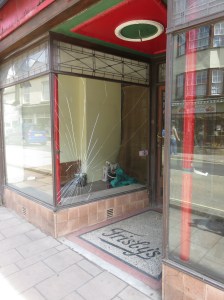
Frisby’s, Cullompton

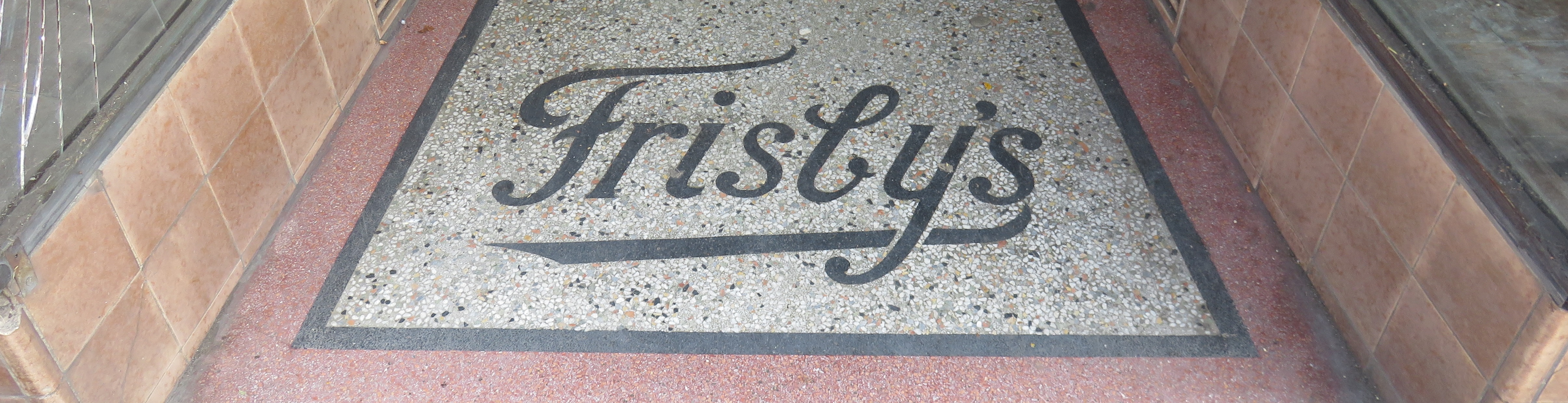
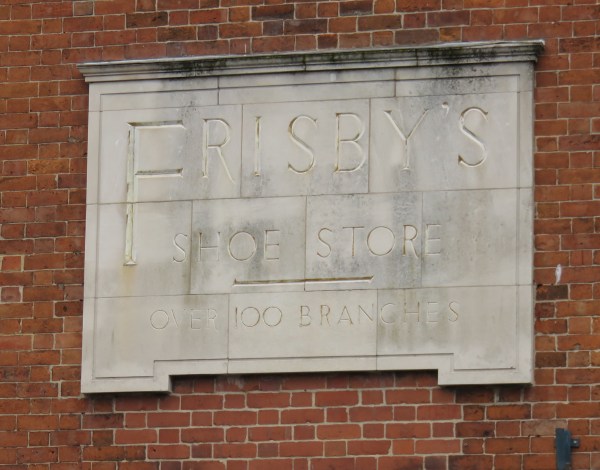
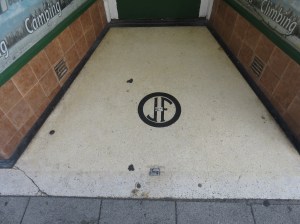
As with so many chain stores from the past, the biggest clue to identifying Frisby’s shops is the lettering that survives on the terrazzo floors of entrance lobbies. These lobbies were usually trapezoidal in plan. Similarities between the shopfronts in Weston-super Mare and Cullompton – with square mottled brown tiles that recall mid-century fire surrounds – indicate a house style, although the simplified lettering at Weston suggests a slightly later date.

This blog will be updated as additional examples of Frisby’s shops come to light. Please let me know of examples you come across.

Posted in Shoe Shops | 63 Comments

The Legacy of David Greig: Part 2

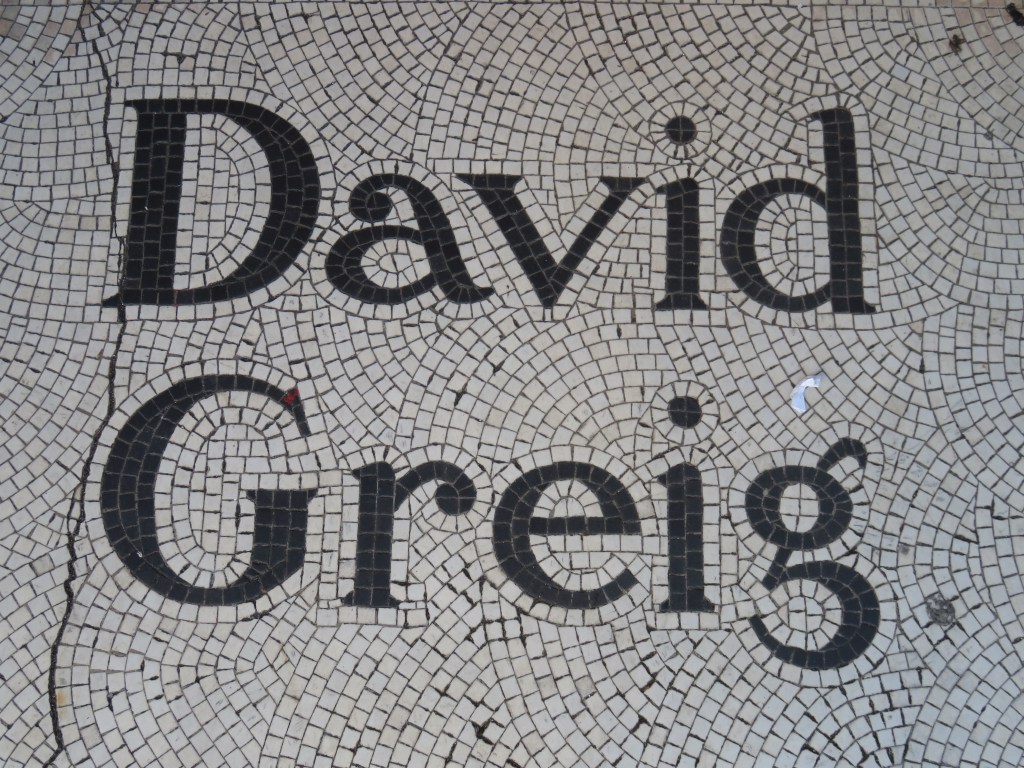
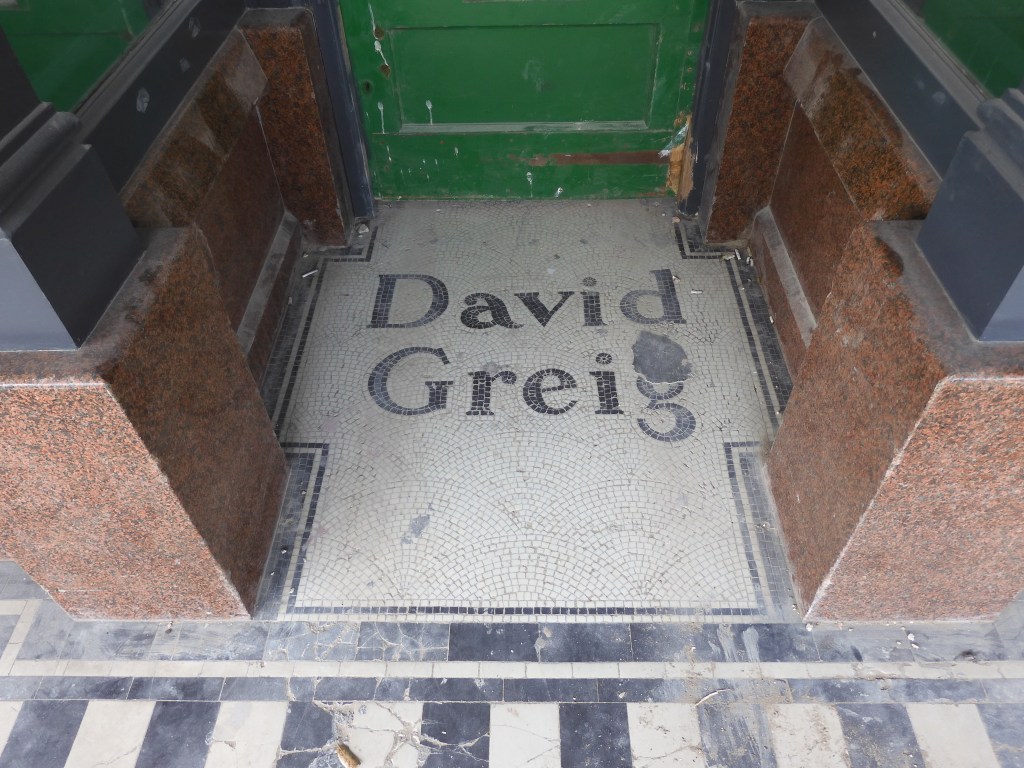
IMG_2322 - Copy.JPGSeveral former David Greig shops – or fragments of shops –  have come to my attention since publishing the story of this extensive London-based provisions chain in The Legacy of David Greig. Here is a selection.

Weston-Super-Mare

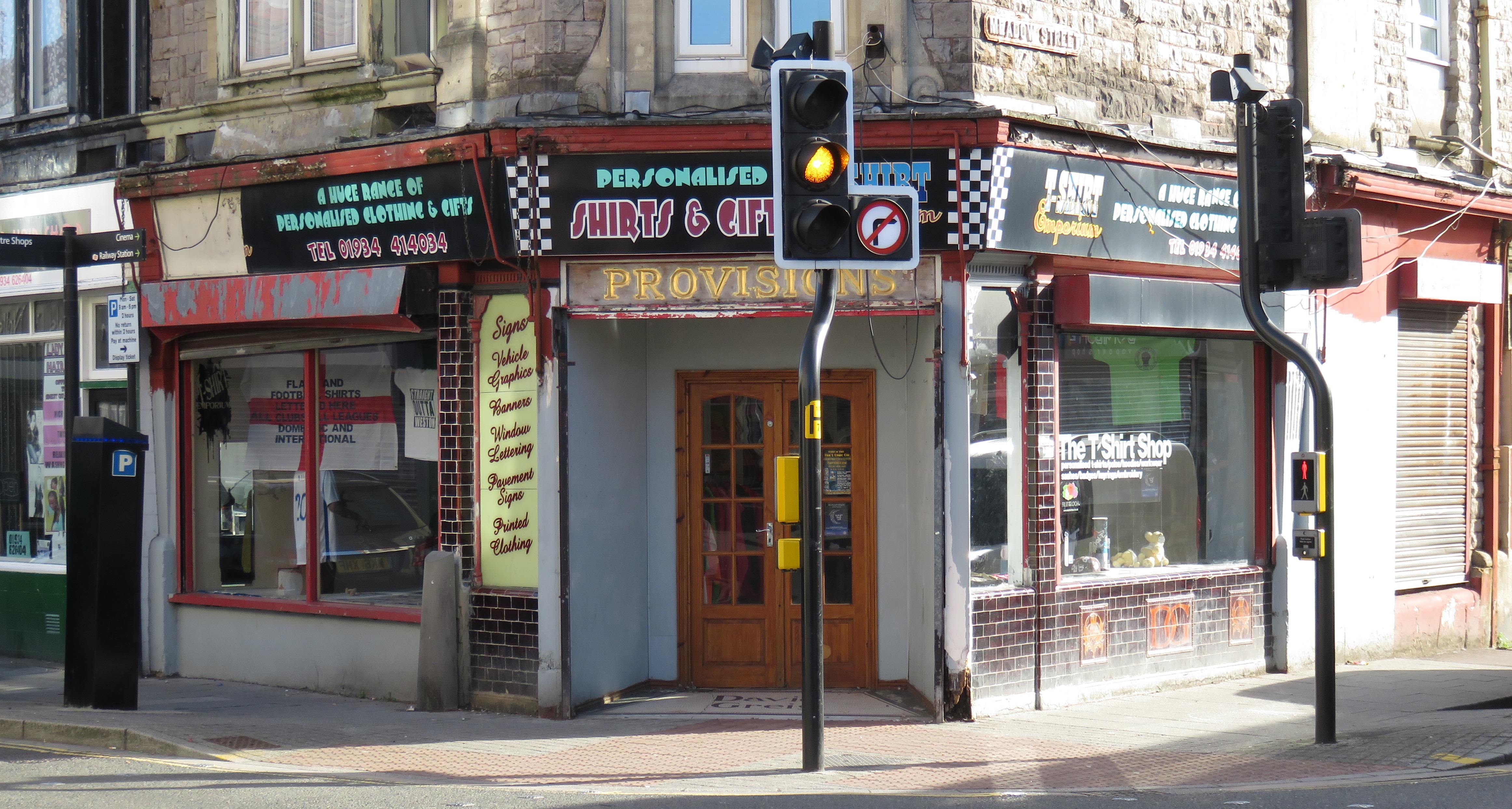
This small shop – now ‘The T Shirt Shop’ – occupies a Victorian building at the junction of Meadow Street and Orchard Street, on the edge of the town centre. David Greig seems to have occupied these premises from the 1920s, and several elements of the shopfront and the internal shopfitting have survived.

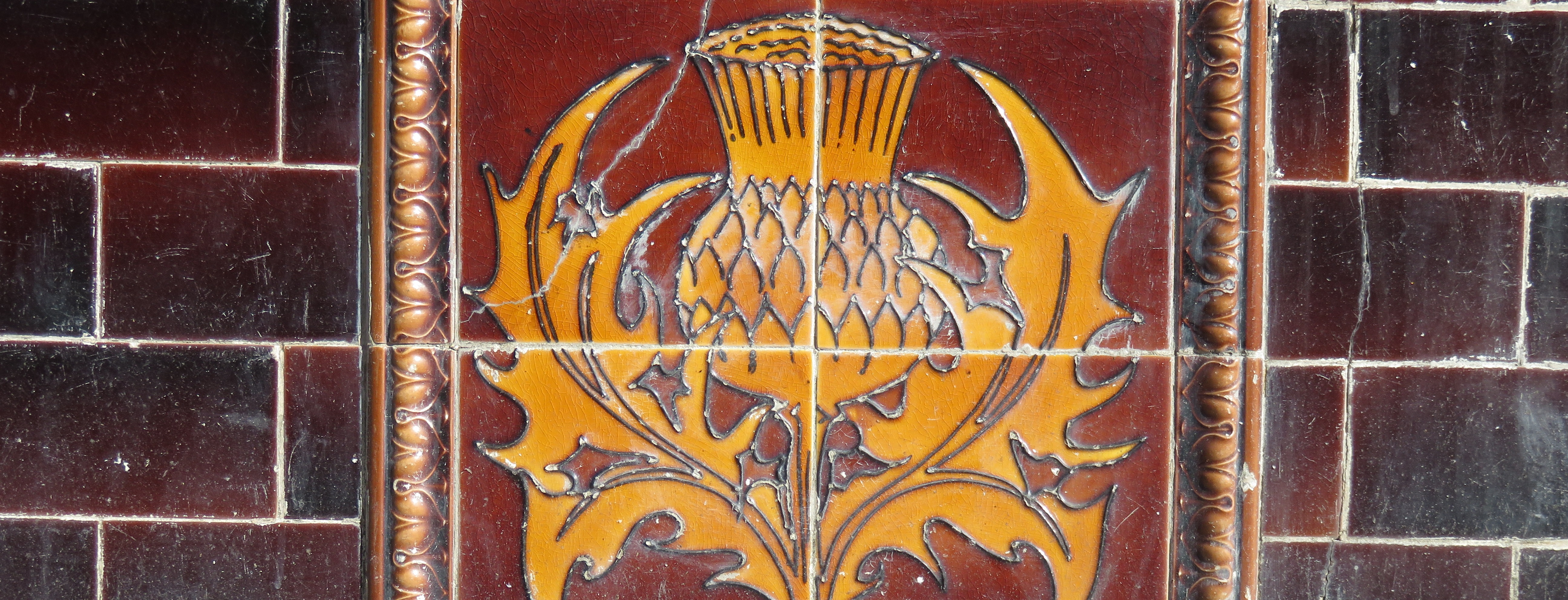
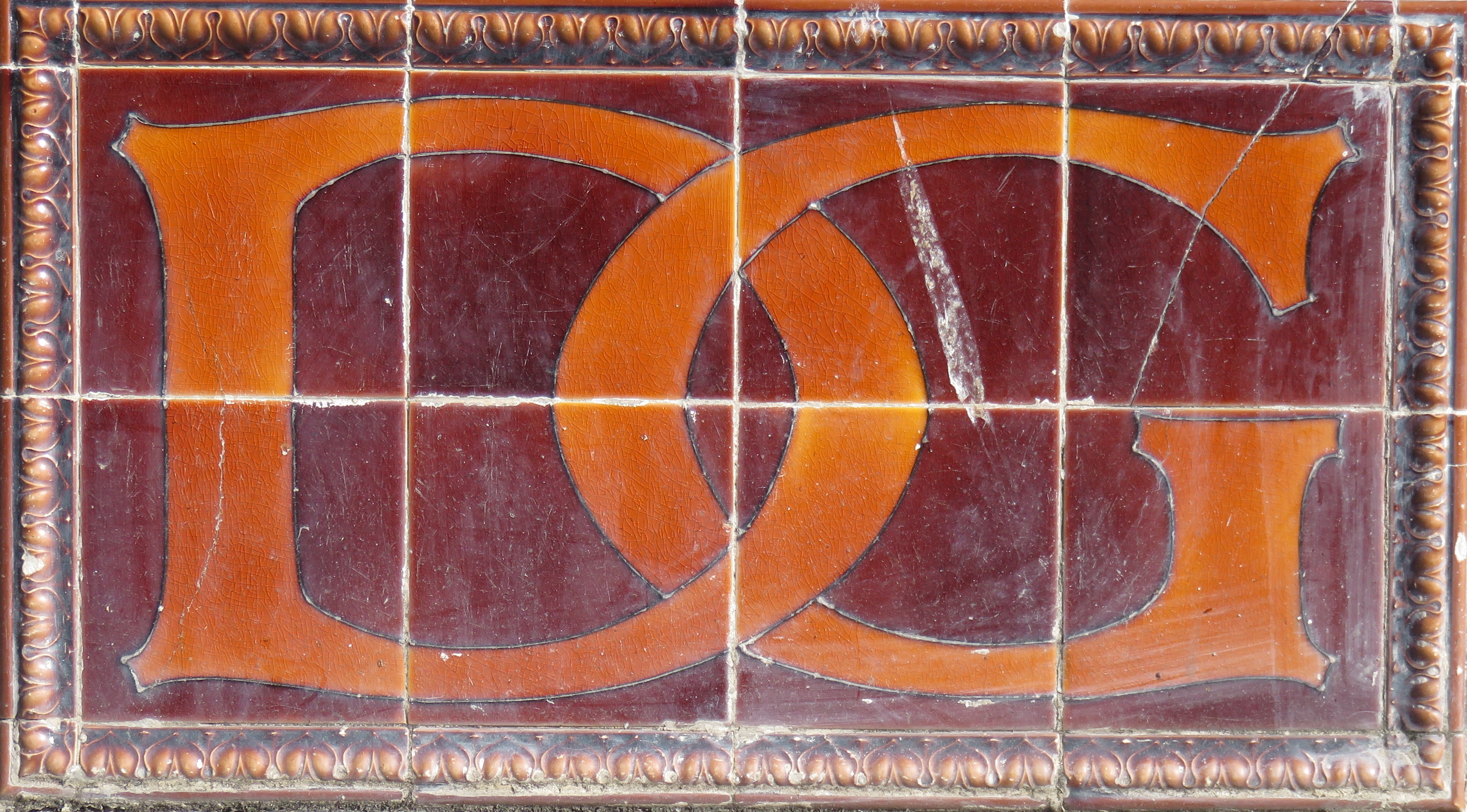
IMG_2307 - CopyThe frontage displays Greig’s characteristic orange-yellow and ox-blood coloured tiles, with the tube-lined ‘DG’ monogram and thistle motif. Smaller thistles are carved on the wooden spandrels of panels flanking the entrance. The modern fascia may conceal original lettering, but just the sign for ‘Provisions’, with its gilded lettering, is visible. The interior retains Greig’s black and white chequered floor and some meat rails. If decorative tiling survives inside the shop, it is hidden from view.

IMG_2314 - Copy.JPG

IMG_2320

IMG_2312 - Copy

Bridge St Evesham 2000 - Copy - CopyEvesham

To all intents and purposes the sole relic of David Greig’s shop at 15 Bridge Street, Evesham, is one of the firm’s standard consoles, with monogram and thistle. These consoles bracketed the fascias that crowned Greig’s shopfronts and are often the only remnants of the shops to survive. The modernised premises at Evesham are occupied by Thomas Cook.

Basingstoke 18 London St 2000 - CopyBasingstoke

At 18 London Street, Basingstoke, the form of David Greig’s shopfront is intact, complete with a pair of thistle consoles. This branch had polished grey granite stall risers and pilasters and is now a bar and restaurant.


Exmouth Market (4) - CopyExmouth Market, London

Seemingly rebuilt or remodelled by David Greig in 1924, as commemorated in a date stone on the façade, this branch is now an Italian restaurant called ‘Santore’. As usual, the consoles which flanked the signboard are the principal part of the shopfront to survive.

Exmouth Market (1) - Copy

Exmouth Market (6) - Copy

Westgate-on Sea

Gillingham

Posted in David Greig, Grocers, Provision Dealers and Dairies | 2 Comments

Manfield & Sons: Shoes of Bespoke Character

Manfields Display Dept Show Northampton Museum 1999.198.1520.2 - Copy

Manfield display, 1930s (Northampton Museums and Art Gallery)

Moses Philip Manfield (1819-99; better known as Sir Philip Manfield MP), was born in Bristol, the son of a shoemaker. He began his working life as a boot closer, stitching uppers to soles. In 1843 he arrived in Northampton, the heart of England’s boot and shoe industry, as foreman to a manufacturer named Swan. A few years later, when Swan gave up his business, Manfield decided to remain in Northampton and establish his own company. Success was swift. According to the census of 1851, Manfield was a ‘patent shoe manufacturer employing 200 hands’. In 1857-59 he built a ‘monster warehouse’ on Campbell Square, Northampton, where he installed closing machinery, thus inaugurating the indoor factory system for boot and shoe making. This imposing and revolutionary building was demolished in 1982.

BB82-7719

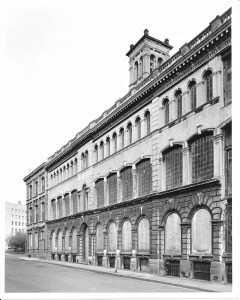
Manfield’s Warehouse of 1857-59, photographed just before demolition in 1982. (Crown copyright. Historic England Archive)

Manfield’s sons Harry (1855-1923) and James (1856-1925) entered into partnership with their father in 1878. Harry settled in a country house, Moulton Grange, while James commissioned the local architect Charles Dorman (1838-1901) to design a neo-Jacobean mansion at Weston Favell, just east of Northampton. This was completed in 1899. After trying and failing to sell this property, Manfield donated it to the town in 1925 as the Manfield Hospital for Crippled Children (later Manfield Orthopaedic Hospital). This closed in 1992 and was converted into apartments under the name Manfield Grange.
BB95-1798 7Feb1995

Manfield Hospital (Weston Favell House) in 1995 (Historic England Archive)

The mass production of footwear in factories inspired the development of retail chains, selling machine-made boots and shoes cheaply, for cash. Initially, manufacturers sold to shops through intermediaries: boot and shoe factors. By 1880, however, Manfield & Sons had become one of the first Northampton manufacturers to develop their own retail outlets, cutting out the middleman.
The first shops operated by Manfield & Sons were called Cash & Co. Some subterfuge was necessary because, rightly or wrongly, Northampton boots had acquired a poor reputation. Moreover, Manfield believed that it would arouse ill-feeling if other manufacturers in the town knew that he had entered the retail trade. In December 1883, with others diversifying in the same manner – and, confusingly, also trading under the name Cash & Co. – the shops were renamed ‘Manfield & Sons’. According to advertisements issued at this time, there were branches in London, Liverpool, Manchester, Birmingham, Sheffield and Brussels. Liverpool alone boasted three branches. By 1889, when the first Parisian branch opened, Manfield had 16 shops, some of which had been acquired from independent footwear retailers. This grew to 21 by 1895, 30 by 1900 and 70 by 1910. By 1901 additional Continental shops had opened in Belgium and the Netherlands, and many more outlets opened in France in the first decades of the new century.

Cash & Co - Copy

Manfield opened shops under the name Cash & Co. prior to 1883. The Wisbech shop illustrated here belonged to a different chain, affiliated with the Leicester manufacturers W. & E. Turner Ltd.

Clickers at Manfields Nton Museum 1993.3.6 - Copy

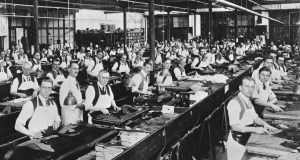
Clickers working in Manfield’s factory (Northampton Museums and Art  Gallery)

In 1892 Manfield built a new factory at Monks Park, Wellingborough Rd, Northampton. This was one of the first large single-storey factories in the industry, but only the front range survives today. When Monks Park opened Manfield & Sons reduced their export trade and concentrated on supplying their own shops. By 1950 Manfield had three other factories: in Northampton, Towcester and Atherstone.

bl15270

Manfield & Sons, 54-55 Cornhill, London. (Reproduced by permission of Historic England Archive)

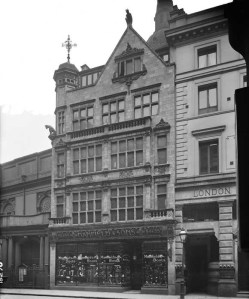
A photograph taken in 1899 by Bedford Lemere, the great architectural photographer, shows Manfield’s branch at 54-55 Cornhill, London. The shopfront surround – and especially the beautiful fascia lettering – evidently formed part of the original architectural design of the neo-Jacobean building, designed by the architect Ernest Runtz and erected in 1893. The building survives with its fantastical terracotta gargoyles, but sadly without Manfield’s shopfront.

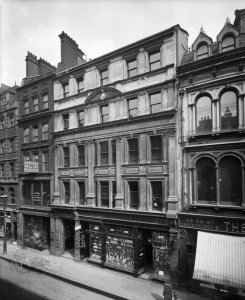
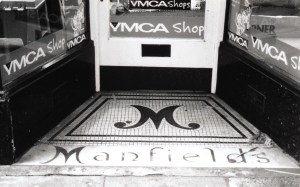
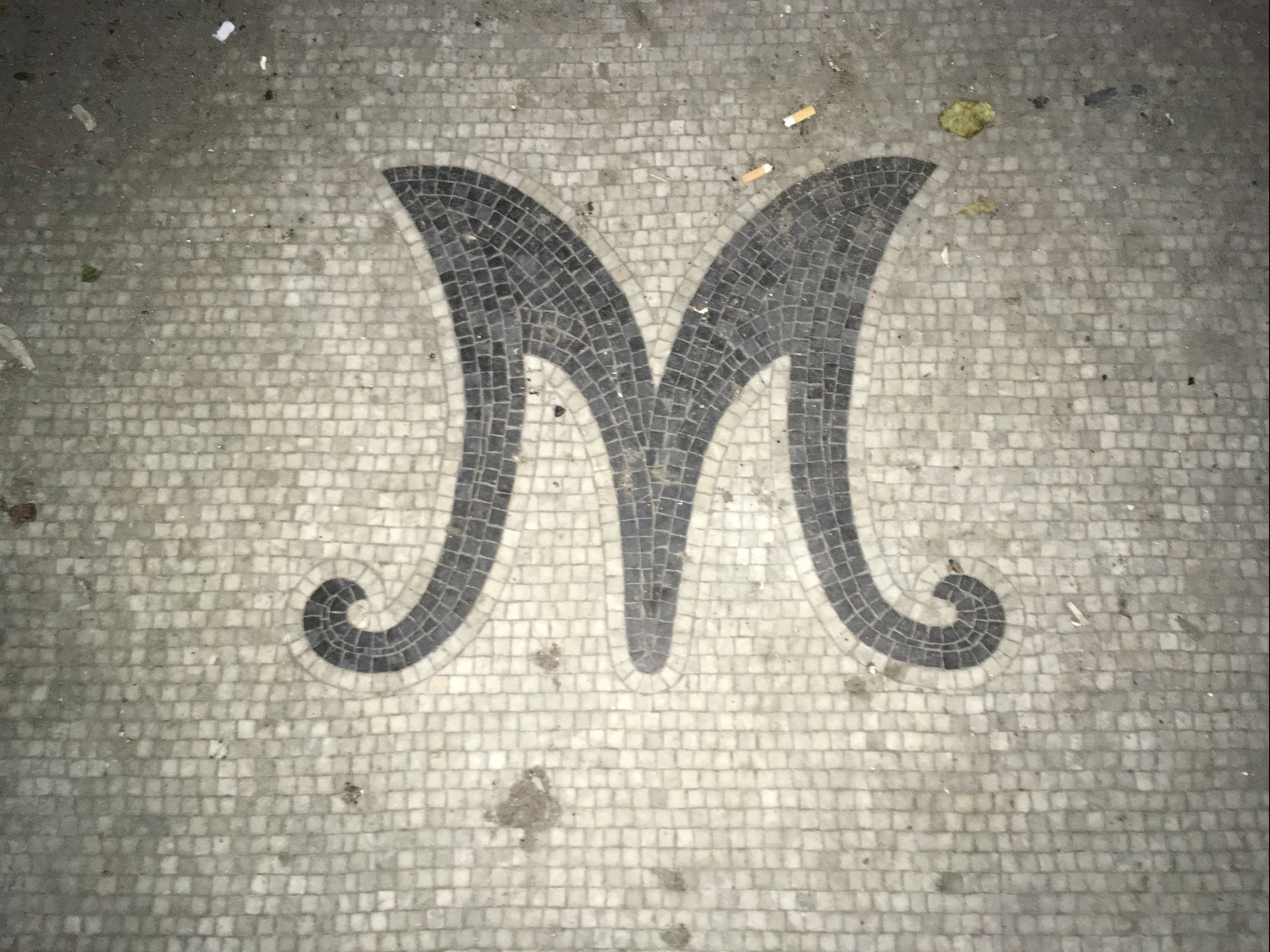
Nine years later, in 1908, Bedford Lemere photographed Manfield’s shop at 68 Gracechurch Street, just prior to its demolition. Aspects of the windows – such as the style of the transom lights and the low stall risers – closely resembled the Cornhill branch, confirming that this was the company’s house style. By 1914, however, Manfield had adopted a curly ‘M’ that endured as the company’s emblem, or logo, until after the Second World War, for example in Gloucester and  Liverpool.

bl20227

Manfield & Sons, 68 Gracechurch Street, London. (Reproduced by permission of Historic England Archive)

Gouucester YMCA Oxbode 1999

Manfield, The Oxebode, Gloucester, 1999. Now ‘Michelle Sabrina’.

In 1914-18, like other major footwear manufacturers, Manfield concentrated on producing boots for the Army. During the Easter Rising of 1916, the shop on Sackville Street in Dublin was plundered: some of ‘the mob’ were spotted sitting on the kerb trying on Manfield boots (The Times, 2 May 1916, 10). By 1918 the principal London branches were New Bond Street, Strand, Piccadilly, Cheapside, St Paul’s Churchyard, and Poultry, soon to be joined by 88 Oxford Street. Oxford Street sprouted dozens of shoe shops in the middle years of the 20th century.

Manfield 2

Manfield, 170 Regent Street, London,  in 1925. (Historic England Archive)

Manfield was incorporated as a private company in 1920. In 1921 a new floor for men’s footwear opened at the large branch at 59-60 St Paul’s Churchyard and 61 & 62 Paternoster Row, advertised as ‘A Man’s Club’. This shop had opened in 1917 for women only. Similarly the shop on Poultry was exclusively for men, but most Manfield branches catered for both sexes. It was also in 1921 that a new branch opened in at 170 Regent Street, designed by G. Crickmer & Sons with a shopfront by Frederick Sage & Co. This shop boasted ‘the most extensive stock of footwear ever seen under one roof. No shoppiness or fuss, just large, beautifully decorated and furnished apartments, comfortably provided with divans, settees, writing tables and everything that tends to make a congenial atmosphere while one decides on delicate questions of footwear apparel’. It is now (2016) occupied by Calvin Klein.

IMG_0479

In Sunderland, Manfield moved from 105 High Street West to No. 102 (Mackie’s Corner) around 1924.

IMG_0489

Manfield’s 1920s shopfront at 102 High Street West, Sunderland (boarded up but intact, Dec 2017)

Manfield was converted into a public company in 1950, in order to repay post-war loans (the company’s bank overdraft stood at £760,000). At that time there were 93 branches in the UK and Eire, plus 15 sites acquired, including one on Oxford Street. There were eight shops in Belgium, one in the Netherlands, and the company held 20% of the Société des Chaussures Manfield (France), which had 20 shops (17 in Paris, with others in Lyons, Marseilles, Bordeaux). The company had a thriving export trade to the USA. The early 1950s delivered record profits, and saw the opening of new branches, for example in Belfast, Newton Abbot, Sevenoaks, Lancaster and Rugby.

22 Market St Cambridge 1977

Manfield, 22 Market Street, Cambridge, 1977.

In 1956, however, Manfield was acquired by Sears and became part of its British Shoe Corporation. It was integrated with another BSC company, Saxone, in 1990. At the same time a new chain of 30 Manfield stores opened for the over-40s market. In 1995 Manfield was handed over to Fascia, which went into administration in 1997. Manfield stores in the Netherlands were bought out by their management. The Manfield and Dolcis brands are both owned currently by the Jacobson Group.

For more on the Northamptonshire boot and shoe industry click here.

Posted in Shoe Shops | 8 Comments